Question
State with reasons, whether the following algebraic operations with scalar and vector physical quantities are meaningful:
  1. adding any two scalars.
  2. adding a scalar to a vector of the same dimensions.
  3. multiplying any vector by any scalar.
  4. multiplying any two scalars.
  5. adding any two vectors.
  6. adding a component of a vector to the same vector.
Answer

  1. Yes, addition of two scalar quantities is meaningful only if they both represent the same physical quantity.
  2. No, addition of a vector quantity with a scalar quantity is not meaningful.
  3. Yes, scalar can be multiplied with a vector. For example, force is multiplied with time to give impulse.
  4. Yes, scalar, irrespective of the physical quantity it represents, can be multiplied with another scalar having the same or different dimensions.
  5. Yes, addition of two vector quantities is meaningful only if they both represent the same physical quantity.
  6. Yes, component of a vector can be added to the same vector as they both have the same dimensions.

Need a full question paper?

Generate a complete, print-ready paper with questions like this in minutes — across 16+ boards, with answer keys.

Start Generating Free

Similar questions

Why does oil form a thin film over the surface of water?
For any arbitrary motion in space, which of the following relations are true?
(a) $\vec{v}_{\text {avg }}=(1 / 2)\left[\vec{v}\left(t_1\right)+\vec{v}\left(t_2\right)\right]$
(b) $\vec{v}_{ avg }=\left[\vec{r}\left(t_2\right)-\vec{r}\left(t_1\right)\right] /\left(t_2-t_1\right)$
(c) $\vec{v}(t)=\vec{v}(0)+\vec{a} t$
(d) $\vec{r}( t )=\vec{r}(0)+\vec{v}(0) t+(1 / 2) \vec{a} t^2$
(e) $\vec{a}_{\text {avg }}=\left[\vec{v}\left(t_2\right)-\vec{v}\left(t_1\right)\right] /\left(t_2-t_1\right)$
Here, 'average' means the average values of physical quantities related to the time interval $t_2$ and $t_1$.
Give two uses of polar satellites.
What is the apparent weight of a man of mass 60kg who is standing on a lift which is moving up with a uniform speed? (g = 10ms-2)
A 50kg man is running at a speed of 18kmh-1. If all the kinetic energy of the man can be used to increase the temperature of water from 20°C to 30°C, how much water can be heated with this energy?
If the force of gravity acts on all bodies in proportion to their masses, then why doesn't a heavy body fall faster than a light body?
What is the angular velocity of minute hand of a clock?
Which harmonic will generate in close organ pipe?
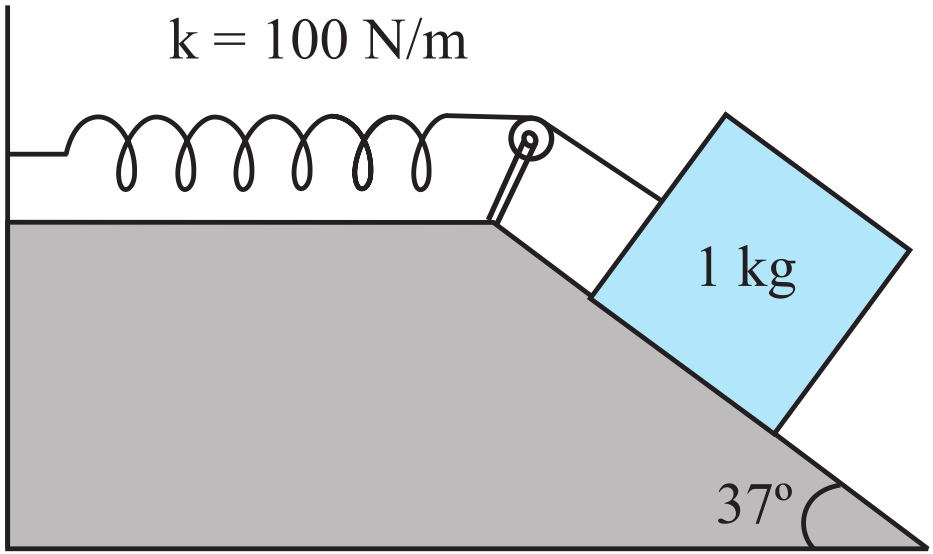
A 1kg block situated on a rough incline is connected to a spring of spring constant 100Nm-1 as shown in. The block is released from rest with the spring in the unstretched position. The block moves 10cm down the incline before coming to rest. Find the coefficient of friction between the block and the incline. Assume that the spring has a negligible mass and the pulley is frictionless.

Write the second law of thermodynamics.