Question
State work-energy theorem.

Answer

Work energy theorem states that the change in kinetic energy of an object is equal to the net work done on it by the net force. Let us suppose that a body is initially at rest and a forceis applied on the body to displace it through along the direction of the force. Then, small amount of work done is given by $\text{dW}=\overrightarrow{\text{F}}\times\overrightarrow{\text{dS}}=\text{FdS}$ Also, according to Newton's second law of motion, we have $F =$ ma where a is acceleration produced (in the direction of force) on applying the force. Therefore, $\text{dW}=\text{MadS}=\text{m}\frac{\text{dv}}{\text{dt}}\text{ds}$ Or $\text{dW}=\text{m}\frac{\text{ds}}{\text{dt}}\text{dv}=\text{Mvdv}$ Now, work done by the force in order to increase its velocity from $u ($initial velocity$)$ to $v$ (final velocity) is given by $\text{W}=\int\limits^\text{v}_\text{u}\text{Mvdv}=\text{M}\int^\text{v}_\text{u}\text{vdv}$ $=\text{M}\big|\frac{\text{v}^2}{2}\big|^\text{v}_\text{u}$ $\text{W}=\frac{1}{2}\text{Mv}^2-\frac{1}{2}\text{Mu}^2$ Hence, work done on a body by a force is equal to the change in its kinetic energy.

Need a full question paper?

Generate a complete, print-ready paper with questions like this in minutes — across 16+ boards, with answer keys.

Start Generating Free

Similar questions

A boy walks from his classroom to the bookshop along a straight corridor towards North. He covers a distance of $20m$ in $25$ seconds to reach the bookshop. After buying a book, he travels the same distance in the same time to reach back in the classroom. Find $(a)$ average speed, and $(b)$ average velocity, of the boy.
Show by using the graphical method that:$\text{s}=\text{ut}+\frac{1}{2}\text{at}^2$
where the symbols have their usual meanings.
The following data was obtained for a body of mass $1kg$ dropped from a height of $5$ metres:
 
Distance above ground
Velocity
$i.$
$5m$
$0m/s$
$ii.$
$3.2m$
$6m/s$
$iii.$
$0m$
$10m/s$
Show by calculations that the above data verifies the law of conservation of energy (Neglect air resistance). $(g = 10m/s^2).$
What should be do to get maximum benefit from a crop field?
An atom of element $E$ contains $3$ protons, $3$ electrons and $4$ neutrons:
  1. What is its atomic number?
  2. What is its mass number?
  3. Write the electronic configuration of the element $E$.
  4. State whether element $E$ is a metal or non-metal. Why?
  5. What type of ion, cation or anion, will be formed by an atom of element $E$? Why?
  6. Write the symbol of the ion formed by an atom of element $E$.
  7. What could element $X$ be?
Write down four main characters of Platyhelminthes. Give two examples.
Explain general characteristics of phylum Platyhelminthes and Nematoda. Give two examples of each.
Define irrigation. Why is irrigation of crops essential? Mention the harmful effects of excessive irrigation.
Write the differences between mass and weight of an object.
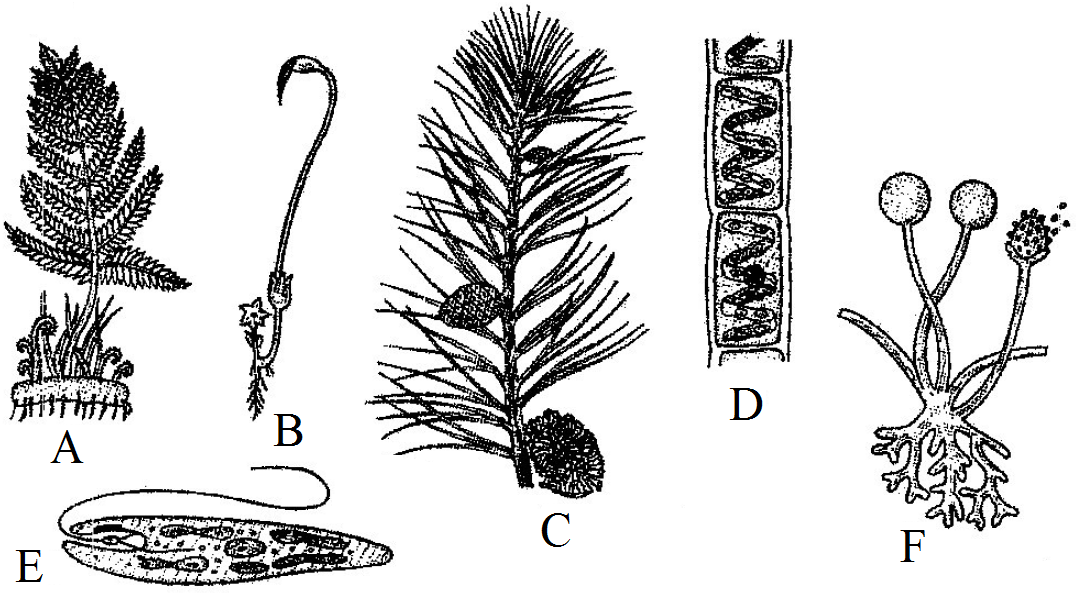
  1. Dentify figures $A$ to $F?$
  2. What is the phylum of $D, E$ and $F?$
  3. What is the division of $A, B,$ and $C?$
  4. Which of them is unicellular and eularyotic organism$?$
  5. Which one of them exhibits $(i)$ Heterotrophic nutrition; $(ii)$ Micotrophic nutririon.
  6. Which one of them is multicellular decomposer$?$
  7. Which one amphibian of plant kingdom?
  8. In which one of them play xylem lacks vessels and phloem is without companion cells$?$
  9. What is the scientific name of esch of them: $(i)$ Male shield fern; $(ii)$ Bread mould$?$
  10. In which of them endosperm is haploid$?$