Question
State your observations when ammonium hydroxide solution is added drop by drop and then in excess to each of the following solutions :
1) Copper sulphate solution
2) Zinc sulfate solution.
Answer

When $NH _4 OH$ is added to copper sulphate solution drop-wise, a pale blue ppt. is obtained.
$CuSO_4+2 NH_4 OH \longrightarrow Cu(OH)_2+\left(NH_4\right)_2 SO_4+4 H_2 O$
With the excess of $NH _4 OH$, the ppt. dissolves to give a deep blue solution of tetraamine copper(II)sulphate
$Cu(OH)_2+\left(NH_4\right)_2 SO_4+2 NH_4 OH \longrightarrow\left[Cu\left(NH_3\right)_4\right]_{SO_4}+4 H_2 O$
2) When $NH _4 OH$ is added to zinc sulphate solution drop-wise, a white, gelatinous ppt. is obtained.
$ZnSO_4+2 NH_4 OH \longrightarrow Zn(OH)_2+\left(NH_4\right)_2 SO_4$
With the excess of NH 4 OH , the ppt. dissolves to give a colorless solution of tetraamine zinc(II)sulphate.$Zn(OH)_2+\left(NH_4\right)_2 SO_4+2 NH_4 OH \longrightarrow\left[Zn\left(NH_3\right)_4\right] SO_4+4 H_2 O$

Need a full question paper?

Generate a complete, print-ready paper with questions like this in minutes — across 16+ boards, with answer keys.

Start Generating Free

Similar questions

A metal $M,$ forms a volatile chloride containing $65.5\%$ Chlorine. If the density of the chloride relative to hydrogen is $162.5,$ find the molecular formula of the chloride. $[M = 56, Cl = 35.5]$
The gases hydrogen, oxygen, carbon dioxide, sulphur dioxide, and chlorine are arranged in order of their increasing relative molecular masses. Given 8 g of each gas at S.T.P., which gas will contain the least number of molecules and which gas the most?
How will you demonstrate the solubility of ammonia in water? Explain.
$112 cm^3$ of $H_2S(g)$ is mixed with $120 cm^3$ of $Cl_2(g)$ at STP to produce $HCl(g)$ and sulphur(s). Write a balanced equation for this reaction and calculate (i) the volume of gaseous product formed (ii) composition of the resulting mixture.
Draw the structures of isomer of : pentane. Write the IUPAC and common names of these isomer
Consider the following reaction and based on the reaction answer the questions that follow :
$\left( NH _4\right)_2 Cr _2 O _7 \xrightarrow{\text { heat }} N _2( g )+4 H _2 O ( g )+ Cr _2 O _3$
Calculate :
$(i)$ The quantity in moles of $(NH_4)_2Cr_2O_7$ if $63 \ gm$ of $(NH_4)_2Cr_2O_7$​​​​​​​ is heated.
$(ii)$ The quantity in moles of nitrogen formed.
$(iii)$ The volume in litres or $dm^3$​​​​​​​ of $N_2$​​​​​​​ evolved at $\text{STP}$.
$(iv)$ The mass in grams of $Cr_2O_3$​​​​​​​ formed at the same time
$[$Atomic masses $: H = 1, Cr=52, N=14]$
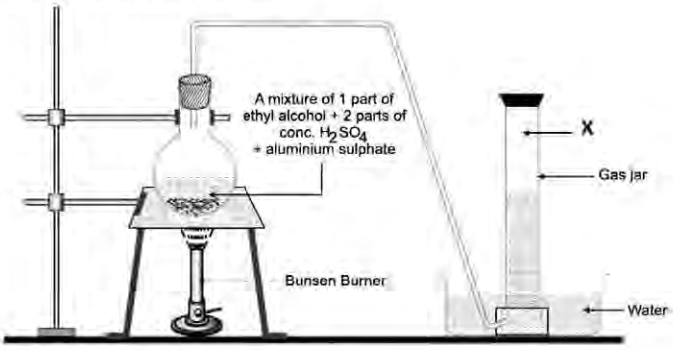
Look at the set-up of given apparatus carefully.
Image
(i) Identify 'X'.
(ii) Name the process of collection of 'X'. Justify.
(iii) Write the chemical equations involved.
(iv) What is the role of sulphuric acid in the above process?
What volume of air (containing $20 \% O _2$ by volume) will be required to burn completely $10 cm ^3$ each of methane and acetylene?
$CH _4+2 O _2 \rightarrow CO _2+2 H _2 O$
$2 C _2 H _2+5 O _2 \rightarrow 4 CO _2+2 H _2 O$
$10.47\  g$ of a compound contained $6.25\ g$ of metal A and rest non-metal B. Calculate the empirical formula of the compound [At. wt of $A = 207, B = 35.5$]
Write the names and formula of the products formed when Methane reacts with $: (i)$ Chlorine $(ii)$ bromine. Write the chemical equations.