Question
Statement $-1$ : When a magnet is made to fall freely through a closed coil, its acceleration is always less than acceleration due to gravity.

and

Statement $-2$ : Current induced in the coil opposes the motion of the magnet, as per Lenz's law.
Answer

Get the step-by-step solution for this question inside the Vidyadip app.

Get the answer in the app

Need a full question paper?

Generate a complete, print-ready paper with questions like this in minutes — across 16+ boards, with answer keys.

Start Generating Free

Similar questions

The distance travelled by a particle is directly proportional to $t^{1/2}$, where $t =$ time elapsed. What is the nature of motion ?
A body covered a distance of 5 m along a semicircular path. The ratio of distance to displacement is:
A sounding body of negligible dimension emitting a frequency of $150\,\, Hz$ is dropped from a height. During its fall under gravity it passes near a balloon moving up with a constant velocity of $2m/s$ one second after it started to fall.The difference in the frequency observed by the man in balloon just before and just after crossing the body will be : (Given that -velocity of sound $= 300m/s; g = 10m/s^2$)
The acceleration of a train travelling with speed of $400 \,m/s$ as it goes round a curve of radius $160\,m$, is
$Assertion$ : Graph between potential energy of a spring versus the extension or compression of the spring is a straight line.

$Reason$ : Potential energy of a stretched or compressed spring, proportional to square of extension or compression.

A solid sphere of radius $R$ and density $\rho$ is attached to one end of a mass-less spring of force constant $k$. The other end of the spring is connected to another solid sphere of radius $R$ and density $3 p$. The complete arrangement is placed in a liquid of density $2 p$ and is allowed to reach equilibrium. The correct statement$(s)$ is (are)

$(A)$ the net elongation of the spring is $\frac{4 \pi R^3 \rho g}{3 k}$

$(B)$ the net elongation of the spring is $\frac{8 \pi R^3 \rho g}{3 k}$

$(C)$ the light sphere is partially submerged.

$(D)$ the light sphere is completely submerged.

A string is wrapped around the rim of a wheel of moment of inertia $0.40 \mathrm{kgm}^2$ and radius $10 \mathrm{~cm}$. The wheel is free to rotate about its axis. Initially the wheel is at rest. The string is now pulled by a force of $40 \mathrm{~N}$. The angular velocity of the wheel after $10$ $\mathrm{s}$ is $\mathrm{x} \mathrm{rad} / \mathrm{s}$, where $\mathrm{x}$ is $\qquad$
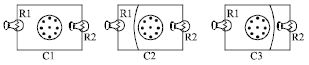
A solenoid is oriented end-on so that its opening is perpendicular to the circuit containing the two light bulbs as drawn in figure $C_1.$ For figure $C_2$ and $C_3,$ a shorting wire of negligible resistance is added as shown. Assume that the magnetic field from the solenoid, shown coming out of the plane of the page, decreases uniformly with time at the same rate for each circuit. Rank the circuits for the brightness of the bulb labeled $R_1$ from brightest to dimmest.
A particle of mass $m$ and charge $q$ is thrown from origin at $t = 0$ with velocity $2\hat{i}$ + $3\hat{j}$ + $4\hat{k}$ units in a region with uniform magnetic field $\vec B$ = $2\hat{i}$ units. After time $t =\frac{{\pi m}}{{qB}}$ , an electric field  is switched on such that particle moves on a straight line with constant speed. $\vec E$ may be
The unit vector along $\hat i + \hat j$ is