MCQ
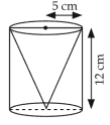
Statement A (Assertion) : From a solid cylinder, whose height is $12 cm$ and diameter $10 cm$, a conical cavity of same height and same diameter is hollowed out. Then,volume of the cone is $\frac{2200}{7} cm ^3$.
Statement R (Reason) : If a conical cavity of same height and same diameter is hollowed out from a cylinder of height $h$ and base radius $r$, then volume of the cone will be half of the volume of the cylinder.
  • A
    Both assertion (A) and reason ( $R$ ) are true and reason $(R)$ is the correct explanation of assertion $(A)$.
  • B
    Both assertion (A) and reason ( $R$ ) are true and reason $(R)$ is not the correct explanation of assertion (A).
  • Assertion $(A)$ is true but reason $(R)$ is false.
  • D
    Assertion (A) is false but reason $(R)$ is true.
Answer

Correct option: C.
Assertion $(A)$ is true but reason $(R)$ is false.
(c) : $\because$ Volume of cylinder $=\pi r^2 h$ and volume of conical cavity $=\frac{1}{3} \pi r^2 h$
$\therefore \quad$ Volume of cone $=\frac{1}{3}$ Volume of cylinder
So, Reason is false.
Image
Now, diameter of cone $=10 cm$
$\therefore \quad$ Radius of cone, $r=5 cm$
Also, height of cone, $h=12 cm$
Volume of cone $=\frac{1}{3} \pi r^2 h$
$
=\frac{1}{3} \times \frac{22}{7} \times 5 \times 5 \times 12=\frac{6600}{21}=\frac{2200}{7} cm ^3
$

Need a full question paper?

Generate a complete, print-ready paper with questions like this in minutes — across 16+ boards, with answer keys.

Start Generating Free

Similar questions

Directions : In the following questions, a statement of assertion $(A)$ is followed by a statement of reason $(R).$ Mark the correct choice as:
Assertion : If the height of a cone is $24\ cm$ and diameter of the base is $14\ cm,$ then the slant height of the cone is $15\ cm.$
Reason : If $r$ be the radius and fh the slant height of the cone, then slant height $=\sqrt{\text{h}^2+\text{r}^2}$
Statement-1 (A): If $\tan \theta+\cot \theta=2$, then $\tan ^2 \theta+\cot ^2 \theta=4$.
Statement-2 (R): If $\operatorname{cosec} A=\sqrt{2}$, then $\frac{2 \sin ^2 A+3 \cot ^2 A}{4 \tan ^2 A-2 \cos ^2 A}=\frac{4}{3}$.
Statement-1 (A): If $a_1, a_2, a_3, \ldots, a_n$ is an AP such that $a_1+a_4+a_7+\ldots+a_{16}=147$, then $a_1+a_6+a_{11}+a_{16}=98$
Statement-2 (R): In an A.P., the sum of the terms equidistant from the beginning andthe end is always same and is equal to the sum of first and last term.
Directions : In the following questions, the Assertions $(A)$ and Reason $(s) \ (R)$ have been put forward. Read both the statements carefully and choose the correct alternative from the following:
Assertion : $-1$ is not multiplicative identity.
Reason : If we mutiply $-1$ to any real no. sign of that no. gets changed.
Assertion (A): If $\sin A =\frac{1}{3}\left(0^{\circ}< A <90^{\circ}\right)$, then the value of $\cos A$ is $\frac{2 \sqrt{2}}{3}$
Reason (R): For every angle $\theta, \sin ^2 \theta+\cos ^2 \theta=1$.
Assertion (A): Arithmetic mean between 8 and 12 is 10 .
Reason (R): Arithmetic mean between two numbers a and b is given as $\frac{a+b}{2}$.
Directions : In the following questions, the Assertions $(A)$ and Reason $ (s) \ (R)$ have been put forward. Read both the statements carefully and choose the correct alternative from the following :
Assertion : $(2-\sqrt{3}) $ is one zero of the quadratic polynomial then other zero will be $(2+\sqrt{3}).$
Reason : Irrational zeros $($roots$)$ always occurs in pairs.
Statement A (Assertion) : The points $(-4,0),(4,0)$ and $(0,3)$ are the vertices of an isosceles triangle.
Statement R (Reason) : Two sides of an isosceles triangle are equal.
Statement-1 (A): If the graph of a polynomial touches the $x$-axis at only one point, then the polynomial cannot be a quadratic polynomial.
Statement-2 (R) : A polynomial of degree $n(n>1)$ can have at most $n$ real zeroes.