Sample QuestionsSurface Areas and Volumes questions
One sample from each question group in this chapter. Select any group above to see the full set with answer keys.
A solid right circular cone is cut into two parts at the middle of its height by a plane parallel to its base. The ratio of the volume of the smaller cone to the whole cone is :
- A
$1 : 2$
- B
$1 : 4$
- C
$1 : 6$
- ✓
$1 : 8$
Answer: D.
View full solution →The radius $($in $\ cm)$ of the largest right circular cone that can be cut out from a cube Of edge $4.2 \ cm$ is
- A
$4.2$
- ✓
$2.1$
- C
$8.4$
- D
$1.05$
Answer: B.
View full solution →The number of solid spheres, each of diameter $6\ cm$ that can be made by melting a solid metal cylinder of height $45 \ cm$ and diameter $4\ cm,$ is :
Answer: B.
View full solution →If the radius of the base of a right circular cylinder is halved, keeping the height the same, then the ratio of the volume of the cylinder thus obtained to the volume of original cylinder is :
- A
$1 : 2$
- B
$2 : 1$
- ✓
$1 : 4$
- D
$4 : 1$
Answer: C.
View full solution →A sphere of diameter $18 \ cm$ is dropped into a cylindrical vessel of diameter $36 \ cm,$ partly filled with water. If the sphere is completely submerged, then the water level rises $($in $\ cm)$ by
Answer: A.
View full solution →Directions: In the following questions, a statement of assertion $(A)$ is followed by a statement of reason $(R)$.Mark the correct choice as:
Assertion: Two identical solid cube of side $5 \ cm$ are joined end to end.Then total surface area of the resulting cuboid is $300 \ cm^2$
Reason: Total surface area of a cuboid is $2(lb + bh + lh).$
- A
Both assertion $(A)$ and reason $(R)$ are true and reason $(R)$ is the correct explanation of assertion $(A)$.
- B
Both assertion $(A)$ and reason $(R)$ are true but reason $(R)$ is not the correct explanation of assertion $(A)$.
- C
Assertion $(A)$ is true but reason $(R)$ is false.
- ✓
Assertion $(A)$ is false but reason $(R)$ is true.
Answer: D.
View full solution →Directions : In the following questions, a statement of assertion $(A)$ is followed by a statement of reason $(R)$.Mark the correct choice as:
Assertion: If a ball is in the shape of a sphere has a surface area of $ 221.76\ cm^2$, then its diameter is $8.4\ cm.$
Reason: If the radius of the sphere be $r,$ then surface area, $\text{S}=4\pi\text{r}^2\text{ i.e}.\text{r}=\frac{1}{2}\sqrt{\frac{\text{S}}{\pi}}$
- ✓
Both assertion $(A)$ and reason $(R)$ are true and reason $(R)$ is the correct explanation of assertion $(A)$.
- B
Both assertion $(A)$ and reason $(R)$ are true but reason $(R)$ is not the correct explanation of assertion $(A)$.
- C
Assertion $(A)$ is true but reason $(R)$ is false.
- D
Assertion $(A)$ is false but reason $(R)$ is true.
Answer: A.
View full solution →Directions : In the following questions, a statement of assertion $(A)$ is followed by a statement of reason $(R).$ Mark the correct choice as:
Assertion : From a solid cylinder, whose height is $12\ cm$ and diameter $10\ cm$ a conical cavity of same height and same diameter is hollowed out. Then, volume of the cone is $\frac{2200}{7}\text{ cm}^3$
Reason : If a conical cavity of same height and same diameter is hollowed out from a cylinder of height $h$ and base radius $r,$ then volume of the cone will be half of the volume of the cylinder.
- A
Both assertion $(A)$ and reason $(R)$ are true and reason $(R)$ is the correct explanation of assertion $(A)$.
- B
Both assertion $(A)$ and reason $(R)$ are true but reason $(R)$ is not the correct explanation of assertion $(A)$.
- ✓
Assertion $(A)$ is true but reason $(R)$ is false.
- D
Assertion $(A)$ is false but reason $(R)$ is true.
Answer: C.
View full solution →Directions : In the following questions, a statement of assertion $(A)$ is followed by a statement of reason $(R)$.Mark the correct choice as:
Assertion : If the areas of three adjacent faces of a cuboid are $x, y, z$ respectively then the volume of the cuboid is $\sqrt{\text{xyz}}$
Reason : Volume of a cuboid whose edges are $l, b$ and $h$ is lbh units.
- ✓
Both assertion $(A)$ and reason $(R)$ are true and reason $(R)$ is the correct explanation of assertion $(A)$.
- B
Both assertion $(A)$ and reason $(R)$ are true but reason $(R)$ is not the correct explanation of assertion $(A)$.
- C
Assertion $(A)$ is true but reason $(R)$ is false.
- D
Assertion $(A)$ is false but reason $(R)$ is true.
Answer: A.
View full solution →Directions: In the following questions, a statement of assertion $(A)$ is followed by a statement of reason $(R)$.Mark the correct choice as:
Assertion: Total surface area of the cylinder having radius of the base $14 \ cm$ and height 30\ cm is $3872 \ cm^2$
Reason: If $r$ be the radius and h be the height of the cylinder, then total surface area $(2\pi\text{r}\text{h}+2\pi\text{r}^2)$
- ✓
Both assertion $(A)$ and reason $(R)$ are true and reason $(R)$ is the correct explanation of assertion $(A)$.
- B
Both assertion $(A)$ and reason $(R)$ are true but reason $(R)$ is not the correct explanation of assertion $(A)$.
- C
Assertion $(A)$ is true but reason $(R)$ is false.
- D
Assertion $(A)$ is false but reason $(R)$ is true.
Answer: A.
View full solution →Write ‘True’ or ‘False’ and justify your answer in the following:
A solid cylinder of radius r and height h is placed over other cylinder of same height and radius. The total surface area of the shape so formed is $4\pi\text{r h}+4\pi\text{r}^2.$
View full solution →Write ‘True’ or ‘False’ and justify your answer in the following: A solid cone of radius r and height h is placed over a solid cylinder having same base radius and height as that of a cone. The total surface area of the combined solid $\pi\text{r}\Big[\sqrt{\text{r}^2+\text{h}^2}+3\text{r}+2\text{h}\Big].$
View full solution →Write ‘True’ or ‘False’ and justify your answer in the following: The capacity of a cylindrical vessel with a hemispherical portion raised upward at the bottom as shown in the Fig. is $\frac{\text{r}^2}{3}3\text{h}-2\text{r}.$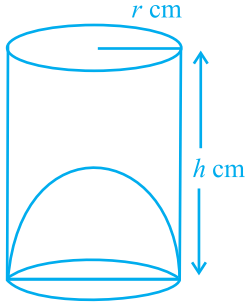
View full solution →Write ‘True’ or ‘False’ and justify your answer in the following:
A solid ball is exactly fitted inside the cubical box of side a. The volume of the ball is $\frac{4}{3}\pi\text{a}^3.$
View full solution →Write ‘True’ or ‘False’ and justify your answer in the following:
The curved surface area of a frustum of a cone is $\pi\text{l}(\text{r}_1+\text{r}_2),$ where $\text{l}\sqrt{\text{h}^2(\text{r}_1\ \ \text{r}_2)^2},$ $r_1$ and $r_2$ are the radii of the two ends of the frustum and h is the vertical height.
View full solution →A spherical metal ball of radius 8cm is melted to make 8 smaller identical balls. The radius of each new ball is _________cm.
A cylinder and a cone are of same base radius and of same height. Find the ratio of the volume of cylinder to that of the cone.
The slant height of the frustum of a cone is 5cm. If the difference between the radii of its two circular ends is 4cm, write the height of the frustum.
A solid metallic cuboid of dimensions $\text{9 m} \times 8 \text{ m} \times \text{2 m}$ is melted and recast into solid cubes of edge 2 m. Find the number of cubes so formed.
View full solution →Volume and surface area of a solid hemisphere are numerically equal. What is the diameter of hemisphere?
The slant height of a frustum of a cone is 4cm and the perimeters (circumferences) of its circular ends are 18cm and 6cm. Find the curved surface area of the frustum. $\Big[\text{Use } \pi = \frac{22}{7}\Big]$
View full solution →Mayank made a bird-bath for his garden in the shape of a cylinder with a hemispherical depression at one end (see Fig.). The height of the cylinder is 1.45 m and its radius is 30 cm. Find the total surface area of the bird-bath.
(Take $\pi = \frac{22}{7}$ )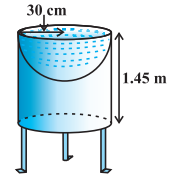
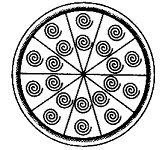
View full solution →A brooch is made with silver wire in the form of a circle with diameter 35 mm. The wire is also used in making 5 diameters which divide the circle into 10 equal sectors as shown in figure. Find:
- the total length of the silver wire required.
- the area of each sector of the brooch.
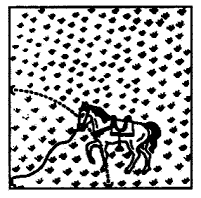
A horse is tied to a peg at one corner of a square shaped grass field of side $15 \ m$ by means of a $5 \ m$ long rope. Find
- the area of that part of the field in which the horse can graze.
- the increase in the grazing area if the rope were $10 \ m$ long instead of 5 m (Use $\pi$ = 3.14)
View full solution →A chord of a circle of radius 10 cm subtends a right angle at the centre. Find the area of the corresponding:
- minor segment
- major sector.
Find the area of a quadrant of a circle whose circumference is 22 cm.
Find the area of a sector of a circle with radius 6 cm, if the angle of the sector is $60^o.$
View full solution →A vessel is in the form of an inverted cone. Its height is 8 cm and the radius of its top, which is open, is 5 cm. It is filled with water up to the brim. When lead shots, each of which is a sphere of radius 0.5 cm are dropped into the vessel, one-fourth of the water flows out. Find the number of lead shots dropped in the vessel.
A solid is consisting of a right circular cone of height 120 cm and radius 60 cm standing on a hemisphere of radius 60 cm. It is placed upright in a right circular cylinder full of water such that it touches the bottom. Find the volume of water left in the cylinder, if the radius of the cylinder is 60 cm and its height is 180 cm.
A gulab jamun, contains sugar syrup up to about 30% of its volume. Find approximately how much syrup would be found in 45 gulab jamun, each shaped like a cylinder with two hemispherical ends with length 5 cm and diameter 2.8 cm.
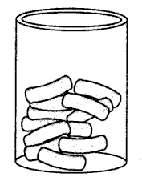
Rachel, an engineering student, was asked to make a model shaped like a cylinder with two cones attached at its two ends by using a thin aluminium sheet. The diameter of the model is 3 cm and its length is 12 cm. If each cone has a height of 2 cm, find the volume of air contained in the model that Rachel made. (Assume the outer and inner dimensions of the model to be nearly the same).
A solid is in the shape of a cone standing on a hemisphere with both their radii being equal to 1 cm and the height of the cone is equal to its radius. Find the volume of the solid in terms of $\pi$.
View full solution →
To make the learning process more interesting, creative and innovative, Amayras' class teacher brings clay in the classroom, to teach the topic-Surface Areas and Volumes. With clay, she forms a cylinder of radius 6cm and height 8cm. Then she moulds the cylinder into a sphere and asks some questions to students.
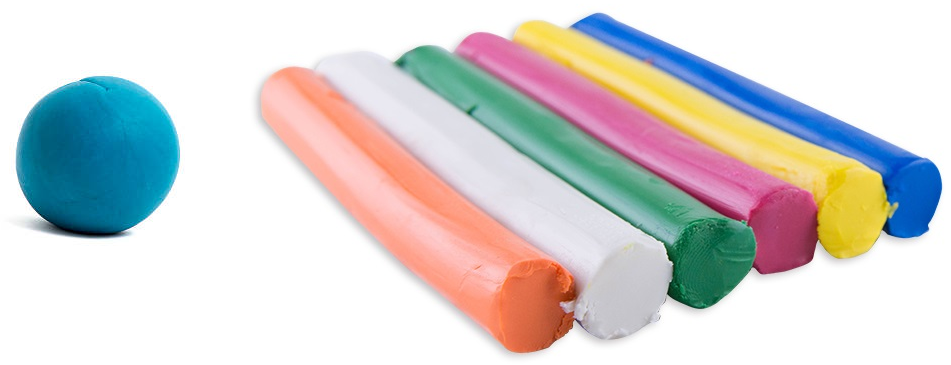
- During the conversion of a solid from one shape to another the volume of new shape will be Increase, Decrease or Remain unaltered?
- The radius of the sphere so fanned is:
- The volume of the sphere so formed is:
Or
Find the ratio of the volume of sphere to the volume of cylinder.
One day Rinku was going home from school, saw a carpenter working on wood. He found that he is carving out a cone of same height and same diameter from a cylinder. The height of the cylinder is 24cm and base radius is 7cm. While watching this, some questions came into Rinku's mind. Help Rinku to find the answer of the following questions.
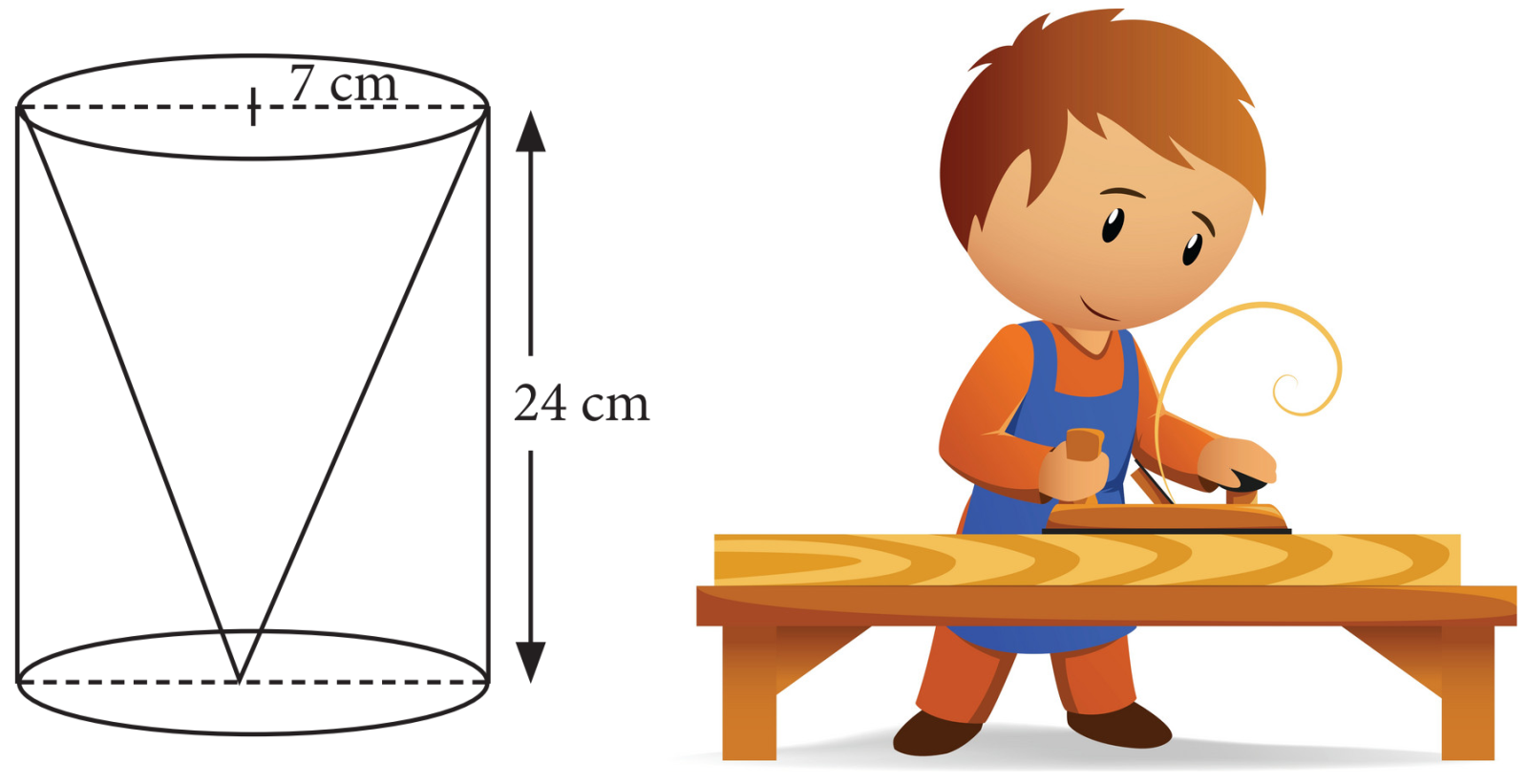
- After carving out cone from the cylinder,
- Find the slant height of the conical cavity so formed.
- The curved surface area of the conical cavity so formed is:
Or
External curved surface area of the cylinder is:
Meera and Dhara have 12 and 8 coins respectively each of radius 3.5cm and thickness 0.5cm. They place their coins one above the other to form solid cylinders.

Based on the above information, answer the following questions.
- When two coins are shifted from Meera's cylinder to Dharas cylinder, then,
- The ratio of curved surface area of the cylinders made by Meera and Dhara is:
- Curved surface area of the cylinder made by Meera is:
Or
The volume of the cylinder made by Dhara is:
To promote cooperation, culture, creativity, sharing, self-confidence, and other social values, a student adventure camp was organized by the school for X-class students and their accommodation was planned in texts. The teacher divides the students into groups, each group of four students was given to prepare a conical tent of radius 7m and canvas of area $551m^2$ in which $1m^2 $is used in stitching and wasting of canvas:
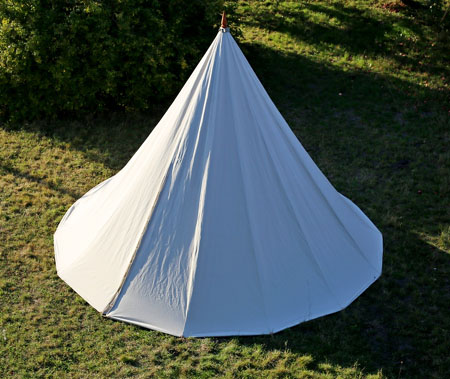
- Find Curved surface of conical tent.
- Find Height of the conical tent.
- Find Volume of tent.
Or
How much space is occupied by each student in the tent?
View full solution →
Due to heavy floods in a state, thousands of people were homeless. 50 schools collectively offered to the state government to provide the place and the canvas for 1500 tent to be fixed by the government and decided to share the whole expenditure equally. The lower part of each tent is cylindrical of base radius 2.8m and height 3.5m, with the conical upper part of the same base radius but of height 2.1m. $(\text{use}\ \pi=\frac{22}7)$
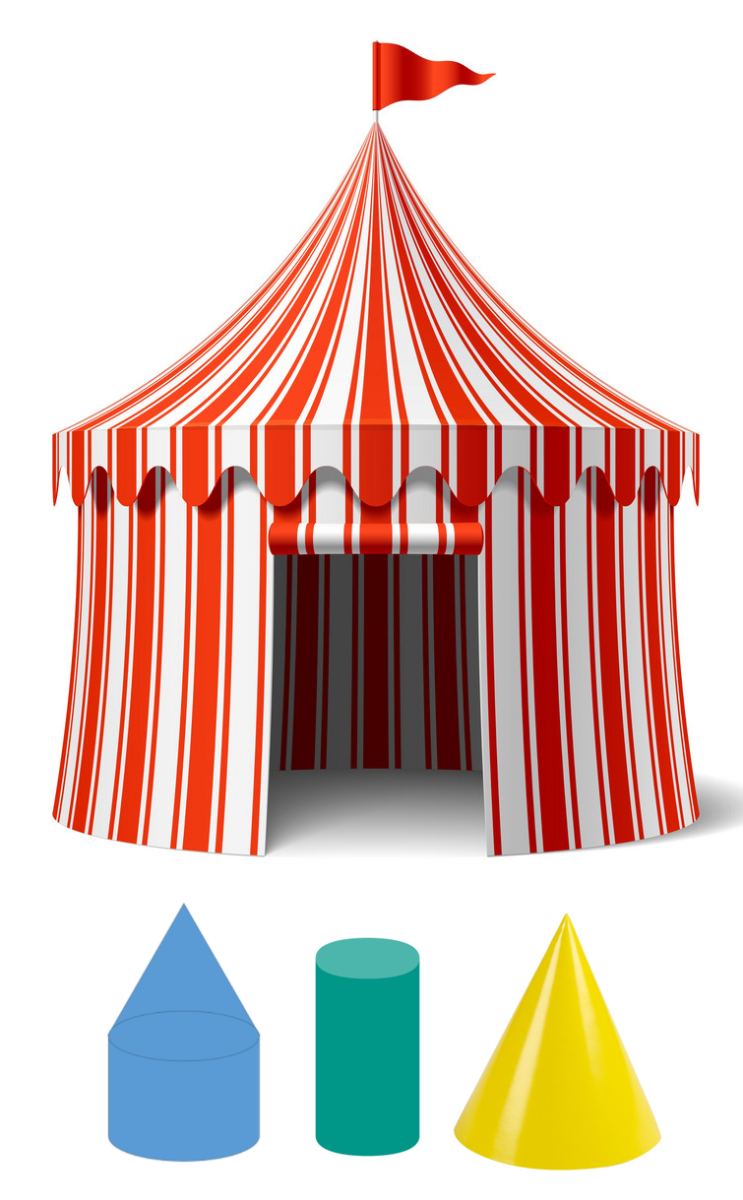
- Area of canvas used to make the tent is:
- The volume of the tent is:
- If the canvas used to make the tent cost ₹120 per sq.m, find the amount to be paid by the schools for making the tents.
Or
Amount shared by each school to set-up the tents.