MCQ
Statement A (Assertion) : $\sqrt{5}$ is an irrational number.
Statement $R$ (Reason) : If $m$ is a natural number which is not a perfect square, then $\sqrt{m}$ is irrational.
  • Both assertion (A) and reason ( $R$ ) are true and reason $(R)$ is the correct explanation of assertion (A).
  • B
    Both assertion $(A)$ and reason $(R)$ are true and reason $(R)$ is not the correct explanation of assertion (A).
  • C
    Assertion (A) is true but reason ( $R$ ) is false.
  • D
    Assertion (A) is false but reason $(R)$ is true.
Answer

Correct option: A.
Both assertion (A) and reason ( $R$ ) are true and reason $(R)$ is the correct explanation of assertion (A).
(a) : Clearly, 5 is not a perfect square.
$\therefore \sqrt{5}$ is irrational.
$\therefore \quad$ Assertion and Reason both are true and Reason is the correct explanation of Assertion.

Need a full question paper?

Generate a complete, print-ready paper with questions like this in minutes — across 16+ boards, with answer keys.

Start Generating Free

Similar questions

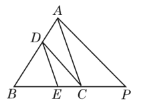
Statement A (Assertion) : In figure, $D E|| A C$ and $D C|| A P$. Then $\frac{B E}{E C}=\frac{B C}{C P}$.
Image
Statement $R$ (Reason) : If a line divides any two sides of a triangle in the same ratio, then the line must be parallel to the third side.
Statement-1 (A): If the points $A(4,3)$ and $B(x, 5)$ lie on a circle with centre $O(2,3)$, then the value of $x$ is 2 .
Statement-2 (R) : Centre of the circle is the mid-point of each chord of the circle.
Directions : In the following questions, the Assertions $(A)$ and Reason $(s)\ (R) $ have been put forward. Read both the statements carefully and choose the correct alternative from the following:
Assertion : Every positive odd integer is of the form $2q + 1.$
Reason : By $\text{EUCLID’S}$ algorithm $a = 2q + R$ for some positive integers $q$ if $r = 1, a$ is odd $.a$
Statement-1 (A) : For $0 < \theta < 90^{\circ}, \sec \theta+\tan \theta$ and $\sec \theta-\tan \theta$ are reciprocal of each other.
Statement-2 (R): $\tan ^2 \theta-\sec ^2 \theta=1$
Statement $A ($Assertion$) : \triangle \text{ABC} \sim \triangle \text{DEF}$ such that $\operatorname{ar}(\triangle\text{ABC})=100 \ cm ^2$ and $\operatorname{ar}(\triangle \text{DEF})$
$=144 \ cm ^2$. If $A B=24 \ cm$, then $D E=36 \ cm$.
Statement $R ($Reason$) :$ The ratio of the areas of two similar triangles is equal to the ratio of the squares of their corresponding medians.
Statement-1 (A): $-5,-\frac{5}{2}, 0, \frac{5}{2}, \ldots .$. is an A.P.
Statement-2 (R): The terms of an A.P. cannot have both positive and negative rational numbers.
Statement-1 (A): HCF of two consecutive natural numbers is 1.
Statement-2 (R): HCF of two co-primes is 1
Directions: In the following questions, a statement of assertion $(A)$ is followed by a statement of reason $(R)$.Mark the correct choice as:
Assertion: Area of the square inscribed in a circle of radius $r$ is $2r^2$sq units.
Reason: Area of the major segment of a circle $=$ Area of the circle $-$ Area of minor segment.
Statement-1 (A): Mid-point of a line segment divides the line segment in the ratio $1: 1$.
Statement-2 (R) : The ratio in which the point $(-3, k)$ divides the line segment joining the points $(-5,4)$ and $(-2,3)$ is $1: 2$.
Directions: In the following questions, the Assertions $(A)$ and Reason$(s) (R)$ have been put forward. Read both the statements carefully and choose the correct alternative from the following:Assertion: $(100+2)^2=10404$.
Reason: $(a+b)^2=a^2+b^2+2 a b$.