Statement (B): Electric potential is vector.
- AA is true but B is false.
- BB is true but A is false.
- CBoth A and B false.
- DBoth A and R are true.
Explanation:
Positive charges move from higher to lower potential whereas negative charges move from lower to higher potential. Hence, A is false. Electric potential does not have direction and is a scalar quantity.
Generate a complete, print-ready paper with questions like this in minutes — across 16+ boards, with answer keys.
An extremely hot star would appear to be
|
(a) Red |
(b) Blue |
(c) Yellow |
(d) Orange |
Four wires of equal length and of resistances 10 ohms each are connected in the form of a square. The equivalent resistance between two opposite corners of the square is
|
(a) 10 ohm |
(b) 40 ohm |
(c) 20 ohm |
(d) 10/4 ohm |
The amplification factor of a triode is 20 and trans-conductance is 3 milli mho and load resistance 3
then the voltage gain is
|
(a) 16.36 |
(b) 28 |
(c) 78 |
(d) 108 |
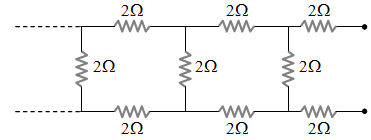
The equivalent resistance of the following infinite network of resistances is

|
(a) Less than 4 Ω |
(b) 4 Ω |
|
(c) More than 4 Ω but less than 12 Ω |
(d) 12 Ω |
The radius of the Bohr orbit in the ground state of hydrogen atom is 0.5 Å. The radius of the orbit of the electron in the third excited state of
will be
|
(a) 8 Å |
(b) 4 Å |
(c) 0.5 Å |
(d) 0.25 Å |