Question
An extremely hot star would appear to be
|
(a) Red |
(b) Blue |
(c) Yellow |
(d) Orange |
An extremely hot star would appear to be
|
(a) Red |
(b) Blue |
(c) Yellow |
(d) Orange |
(b) Blue
Generate a complete, print-ready paper with questions like this in minutes — across 16+ boards, with answer keys.
Some electric bulbs are connected in series across a 220 V supply in a room. If one bulb is fused then remaining bulbs are connected again in series across the same supply. The illumination in the room will
|
(a) Increase |
(b) Decrease |
(c) Remains the same |
(d) Not continuous |
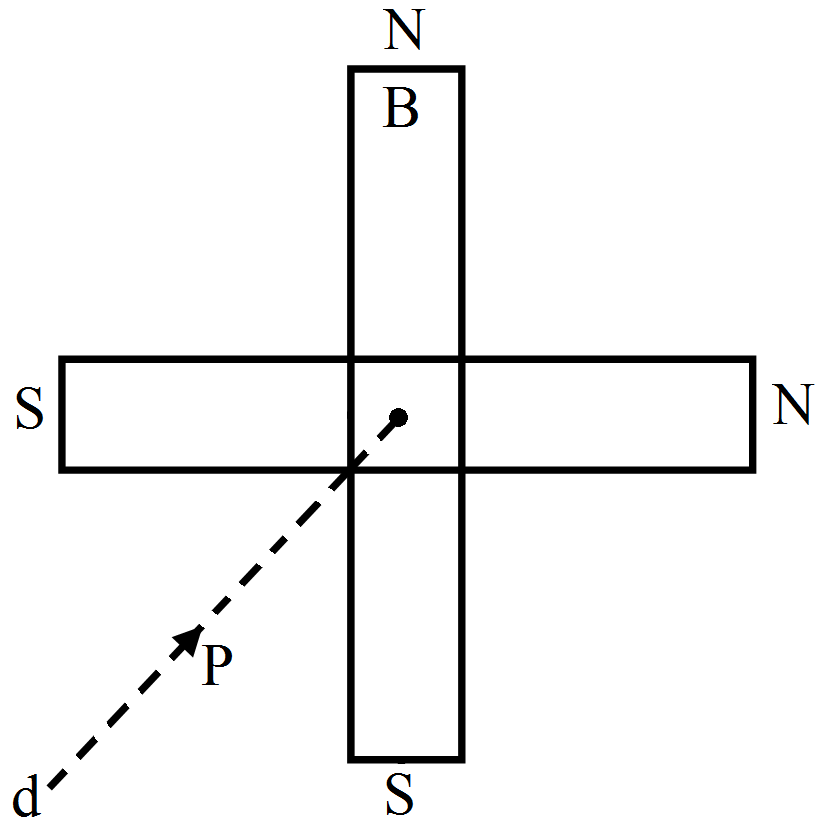
$\frac{\mu_0}{4\pi}\frac{2\text{M}}{\text{d}^3}$
In the circuit, the potential difference across PQ will be nearest to

|
(a) 9.6 V |
(b) 6.6 V |
(c) 4.8 V |
(d) 3.2 V |
The current sensitivity of a moving coil galvanometer can be increased by
|
(a) Increasing the magnetic field of the permanent magnet |
|
(b) Increasing the area of the deflecting coil |
|
(c) Increasing the number of turns in the coil |
|
(d) a, b, c |
An electron is revolving round a proton, producing a magnetic field of 16 weber/m2 in a circular orbit of radius 1Å. It’s angular velocity will be
|
(a) 1017 rad/sec |
(b) 1/2 π × 1012 rad/sec |
|
(c) 2π × 1012 rad/sec |
(d) 4 π × 1012 rad/sec |