MCQ
Static friction between two surfaces
  • Prevents the relative motion between them
  • B
    Opposite to the direction of motion of them
  • C
    Acts in opposite direction of applied force
  • D
    Both $(a)$ and $(b)$

Answer

Correct option: A.
Prevents the relative motion between them
a
(a)

Need a full question paper?

Generate a complete, print-ready paper with questions like this in minutes — across 16+ boards, with answer keys.
Start Generating Free

Similar questions

The value of escape velocity on a certain planet is $2 \,km/s$. Then the value of orbital speed for a satellite orbiting close to its surface is
Vector$\overrightarrow A $ makes equal angles with $x, y$ and $z$ axis. Value of its components (in terms of magnitude of $\overrightarrow A $) will be
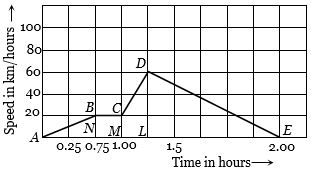
A train moves from one station to another in $2$ hours time. Its speed-time graph during this motion is shown in the figure. The maximum acceleration during the journey is.............$km\, h^{-2}$
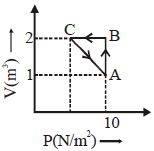
An ideal gas is taken through the cycle $A \to B \to C \to A,$ as shown in the figure. What is the change in internal energy ...... $J$.
The velocity with which a projectile must be fired so that it escapes earth’s gravitation does not depend on
A bakelite beaker has volume capacity of $500\, cc$ at $30^{\circ} C$. When it is partially filled with $V _{ m }$ volume (at $30^{\circ}$ ) of mercury, it is found that the unfilled volume of the beaker remains constant as temperature is varied. If $\gamma_{\text {(beaker) }}=6 \times 10^{-6}{ }^{\circ} C ^{-1}$ and $\gamma_{(\text {mercury })}=1.5 \times 10^{-4}{ }^{\circ} C ^{-1},$ where $\gamma$ is the coefficient of volume expansion, then $V _{ m }($in $cc )$ is close to
Which one of the following relations is true?
A cart moves with a constant speed along $a$ horizontal circular path. From the cart, $a$ particle is thrown up vertically with respect to the cart
A particle reaches its highest point when it has covered exactly one half of its horizontal range. The corresponding point on the displacement time graph is characterised by
A particle moves with a velocity $\vec v\, = \,5\hat i - 3\hat j + 6\hat k\,\,m/s$ under the influence of a constant force $\vec F\, = \,10\hat i + 10\hat j + 20\hat k$. Instantaenous power will be ............... $J/s$