MCQ
A particle moves with a velocity $\vec v\, = \,5\hat i - 3\hat j + 6\hat k\,\,m/s$ under the influence of a constant force $\vec F\, = \,10\hat i + 10\hat j + 20\hat k$. Instantaenous power will be ............... $J/s$
  • A
    $200$
  • B
    $40$
  • $140 $
  • D
    $170$

Answer

Correct option: C.
$140 $
c
$P = \vec F.\vec v$$ = (10\hat i + 10\hat j + 20\hat k).(5\hat i - 3\hat j + 6\hat k) $

$= 50 - 30 + 120 = 140\,J{\rm{ - }}{s^{ - 1}}$

Need a full question paper?

Generate a complete, print-ready paper with questions like this in minutes — across 16+ boards, with answer keys.

Start Generating Free

Similar questions

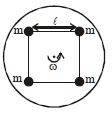
Four identical point masses $'m'$ joined by light string of length $'l'$ arrange such that they form square frame. Centre of table is coincide with centre of arrangment. If arrangement rotate with constant angular velocity $'\omega '$ , find out tension in each string
Correct Bernoulli's equation is (symbols have their usual meaning) :
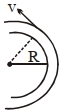
A cart moves with a constant speed along a horizontal circular path. From the cart, a particle is thrown up vertically with respect to the cart, the particle will,
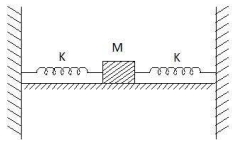
In the figure given below. a block of mass $M =490\,g$ placed on a frictionless table is connected with two springs having same spring constant $\left( K =2 N m ^{-1}\right)$. If the block is horizontally displaced through ' $X$ 'm then the number of complete oscillations it will make in $14 \pi$ seconds will be $.........$
In an adiabatic change, the pressure $P$ and temperature $T$ of a diatomic gas are related by the relation $\text{P}\propto\text{T}^{\text{c}}$ where $c$ equals:
A body of mass $2\,kg$ is moving with velocity $10 \,m/s$ towards east. Another body of same mass and same velocity moving towards north collides with former and coalsces and moves towards north-east. Its velocity is
Which of the following is a self adjusting force?
The mechanical equivalent of heat:
A mass of $5\ kg$ is moving along a circular path of radius $1m.$ If the mass moves with $300$ revolutions per minute, its kinetic energy would be:
A modern grand-prix racing car of mass $m$ is travelling on a flat track in a circular arc of radius $R$ with a speed $v$. If the coefficient of static friction between the tyres and the track is $\mu_{s},$ then the magnitude of negative lift $F_{L}$ acting downwards on the car is

(Assume forces on the four tyres are identical and $g =$ acceleration due to gravity)