MCQ
Static friction occurs.
  • always greater than kinetic friction
  • B
    equal to kinetic friction
  • C
    less than kinetic friction
  • D
    None of the above

Answer

Correct option: A.
always greater than kinetic friction
A

Need a full question paper?

Generate a complete, print-ready paper with questions like this in minutes — across 16+ boards, with answer keys.
Start Generating Free

Similar questions

The angular momentum of a planet of mass $M$ moving around the sun in an elliptical orbit is $\overrightarrow{ L }$. The magnitude of the areal velocity of the planet is:
Two identical spheres each of mass $2 \mathrm{~kg}$ and radius $50 \mathrm{~cm}$ are fixed at the ends of a light rod so that the separation between the centers is $150 \mathrm{~cm}$. Then, moment of inertia of the system about an axis perpendicular to the rod and passing through its middle point is $\frac{x}{20} \mathrm{~kg} \mathrm{~m}^2$, where the value of $\mathrm{x}$ is____.
Escape velocity from the moon surface is less than that on the earth surface, because
In an elastic collision between disks $A$ and $B$ of equal mass but unequal radii, $A$ moves along the $x$ -axis and $B$ is stationary before impact. Which of the following is possible after impact?
A heat engine operates with the cold reservoir at temperature $324 K$. The minimum temperature of the hot reservoir, if the heat engine takes $300 \; J$ heat from the hot reservoir and delivers $180 \; J$ heat to the cold reservoir per cycle, is $\dots \; K .$
Particle is dropped from the height of  $20\,\,m$ on horizontal ground. There is wind blowing due to which horizontal acceleration of the particle becomes  $6\,\,ms^{-2}$ . Find the horizontal displacement of the particle till it reaches ground.......$m$
A circular hole of diameter $R$ is cut from a disc of mass $M$ and radius $R ;$ the circumference of the cut passes through the centre of the disc . The moment of inertia of the remaining portion of the disc about an axis perpendicular to the disc and passing through its centre is
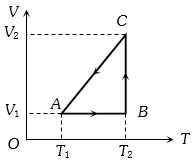
A cyclic process for $1\, mole$ of an ideal gas is shown in figure in the $V-T,$ diagram. The work done in $AB, BC$ and $CA$ respectively
Which of the following quantities is zero on an average for the molecules of an ideal gas in equilibrium?
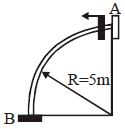
A bead of mass $\frac {1}{2}\,kg$ starts from rest from $A$ to move in a vertical plane along a smooth fixed quarter ring of radius $5\,m$, under the action of a constant horizontal force $F = 5\,N$ as shown. The speed of bead as it reaches the point $B$ is ................ $\mathrm{m}/ \mathrm{s}$ [Take $g = 10\,m/s^2$ ]