Stationary waves are set up in air column. Velocity of sound in air is $330 m/s$ and frequency is $165\,Hz$. Then distance between the nodes is ... $m$
Easy
Download our app for free and get started
(b) $v = 330$$m/s$; $n = 165$$Hz$.
Distance between two successive nodes
= $\frac{\lambda }{2}$ $ = \frac{v}{{2n}} = \frac{{330}}{{2 \times 165}} = 1m$

Download our appand get started for free
Experience the future of education. Simply download our apps or reach out to us for more information. Let's shape the future of learning together!No signup needed.*
Similar Questions
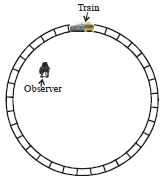
- 1An engine is moving with uniform speed along a circular track emitting a sound of frequency $400\, Hz$ as shown in the figure. Speed of engine is $30\, m/sec$ and speed of sound is $330\, m/sec$. An observer is standing inside the track. Maximum frequency observed by the observer isView Solution
- 2When two sound sources of the same amplitude but of slightly different frequencies $v_1$ and $v_2$ are sounded simultaneously, the sound one hears has a frequency equal toView Solution
- 3Two sirens situated one kilometer apart are producing sound of frequency $330 Hz$. An observer starts moving from one siren to the other with a speed of $2 m/s$. If the speed of sound be $330 m/s$, what will be the beat frequency heard by the observerView Solution
- 4A transverse wave is described by the equation $y = A \,\,sin\,[2\pi (f t - x/\lambda ) ]$.The maximum particle velocity is equal to four times the wave velocity if:View Solution
- 5A wave represented by the equation $y = A cos (kx - \omega t)$ is superimposed with another wave to form a statioary wave such that the point $x =0$ is a node. The equation of the other wave is:View Solution
- 6Two vibrating tuning forks produce progressive waves given by $Y_1 = 4\, sin\, 500\pi t$ and $Y_2 = 2\, sin\, 506\, \pi t$ Number of beats produced per minute isView Solution
- 7Two men are walking along a horizontal straight line in the same direction. The man in front walks at a speed $1.0 m s ^{-1}$ and the man behind walks at a speed $2.0 ms ^{-1}$. A third man is standing at a height $12 m$ above the same horizontal line such that all three men are in a vertical plane. The two walking men are blowing identical whistles which emit a sound of frequency $1430 Hz$. The speed of sound in air is $330 m s ^{-1}$. At the instant, when the moving men are $10 m$ apart, the stationary man is equidistant from them. The frequency of beats in $Hz$, heard by the stationary man at this instant, is. . . . .View Solution
- 8A vibrating string of certain length $l$ under a tension $T$ resonates with a mode corresponding to the first overtone (third harmonic) of an air column of length $75\, cm$ inside a tube closed at one end. The string also generates $4\, beats$ per second when excited along with a tuning fork of frequency $n$. Now when the tension of the string is slightly increased the number of beats reduces to $2\, per second$. Assuming the velocity of sound in air to be $340\, m/s$, the frequency $n$ of the tuning fork in $Hz$ isView Solution
- 9A stretched string of $1m$ length and mass $5 \times {10^{ - 4}}kg$ is having tension of $20N.$ If it is plucked at $25cm$ from one end then it will vibrate with frequency ... $Hz$View Solution
- 10$Assertion :$ For the formation of stationary waves the medium must be bounded having definite boundaries.View Solution
$Reason :$ In the stationary wave, some particles of the medium remain permanently at rest.