MCQ
Stationary waves
  • A
    Transport energy
  • B
    Does not transport energy
  • C
    Have nodes and antinodes
  • Both $(b)$ and $(c)$

Answer

Correct option: D.
Both $(b)$ and $(c)$
d
Stationary waves do not transport energy. The energy gets cancelled out due to superposing of the two waves in opposite directions. These stationary waves have points which equals to zero at all time. These points are called nodes. Also there are points at which the amplitude gets to maximum or minimum at all time. These points are called antinodes.

Need a full question paper?

Generate a complete, print-ready paper with questions like this in minutes — across 16+ boards, with answer keys.
Start Generating Free

Similar questions

Small droplets of a liquid are usually more spherical in shape than larger drops of the same liquid because
For nuclei with $A > 100:$
  1. The binding energy of the nucleus decreases on an average as $A$ increases.
  2. The binding energy per nucleon decreases on an average as $A$ increases.
  3. If the nucleus breaks into two roughly equal parts, energy is released.
  4. If two nuclei fuse to form a bigger nucleus, energy is released.
A rope $1\ cm$ in diameter breaks if the tension in it exceeds $500N.$ The maximum tension that may be given to a similar rope of diameter $2\ cm$ is:
The vector that must be added to the vector $\hat i - 3\hat j + 2\hat k$ and $3\hat i + 6\hat j - 7\hat k$ so that the resultant vector is a unit vector along the $y-$axis is
A small mass $m$ is launched from the top of a cliff with speed Vat an angle of $30^o$ above the horizontal. When the mass reaches the ground, its velocity is directed at $45^o$ below the horizontal. Which one of the following choices is the magnitude of the total impulse that was imparted to the mass during its flight ? Ignore air resistance
Two springs $A$ and $B(k_A = 2k_B)$ are stretched by applying forces of equal magnitudes at the four ends. If the energy stored in $A$ is $E,$ that in $B$ is:
From a tower of height $H$, a particle is thrown vertically upwards with a speed $ u$. The time taken by the particle, to hit the ground, is $n$ times that taken by it to reach the highest point of its path. The relation between $H, u$ and $n$ is:
How much work to be done in decreasing the volume of and ideal gas by an amount of $2.4 \times {10^{ - 4}}{m^3}$ at normal temperature and constant normal pressure of .......$joule$  $1 \times {10^5}N/{m^2}$
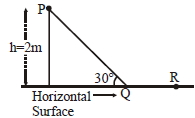
A point particle of mass, moves along the uniformly rough track $PQR$ as shown in the figure. The coefficient of friction, between the particle and the rough track equals $\mu$. The particle is released, from rest, from the point $P$ and it comes to rest at a point $R$. The energies, lost by the ball, over the parts, $PQ$ and $PR$, of the track, are equal to each other, and no energy is lost when particle changes direction from $PQ$ to $QR$. The values of the coefficient of friction $\mu$ and the distance $x(=QR)$ are, respecitvely close to
A satellite is moving with a constant speed ' $V$ ' in a circular orbit about the earth. An object of mass ' $m$ ' is ejected from the satellite such that it just escapes from the gravitational pull of the earth. At the time of its ejection, the kinetic energy of the object is