Question
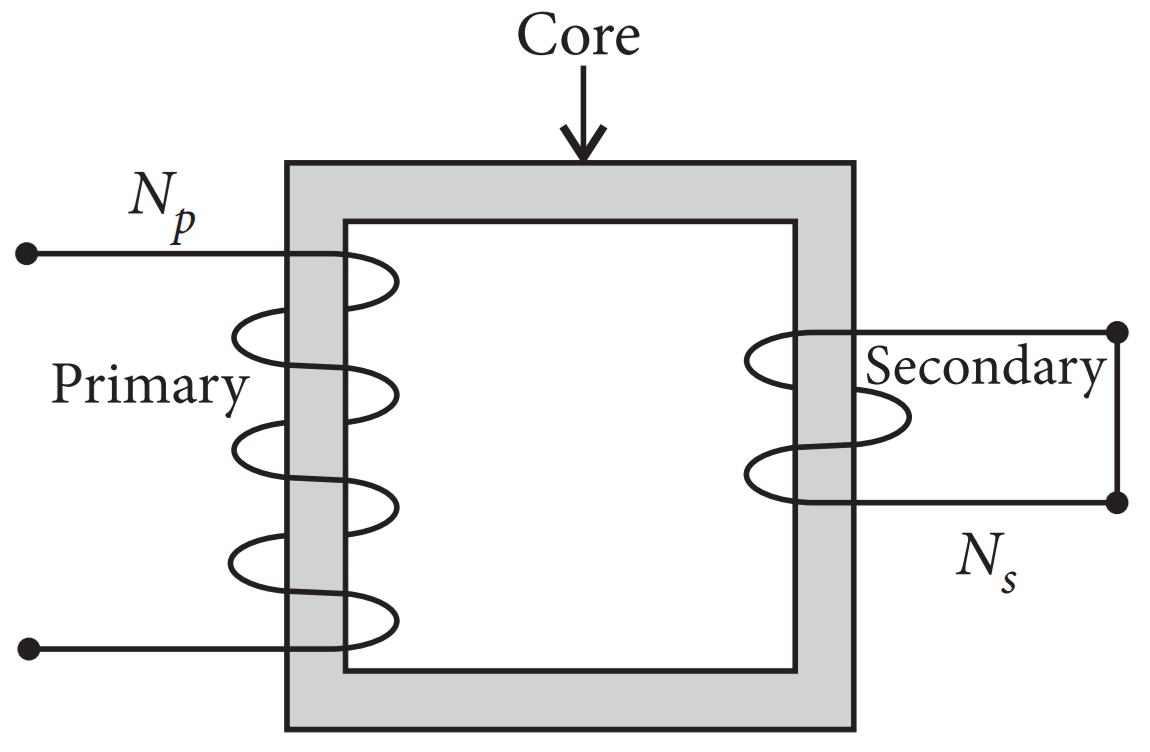
Step $-$ down transformers are used to decrease or step $-$ down voltages. These are used when voltages need to be lowered for use in homes and factories. A small town with a demand of $800kW$ of electric power at $220V$ is situated $15\ km$ away from an electric plant generating power at $440V$. The resistance of the two wire line carrying power is $0.5Q$ per $\ km$. The town gets power from the line through a $4000 - 220V$ step $-$ down transformer at a sub $-$ station in the town.
  1. The value of total resistance of the wires is:
  1. $25\Omega$
  2. $30\Omega$
  3. $35\Omega$
  4. $15\Omega$
  1. The line power loss in the form of heat is:
  1. $550kW$
  2. $650kW$
  3. $600kW$
  4. $700kW$
  1. How much power must the plant supply, assuming there is negligible power loss due to leakage?
  1. $600kW$
  2. $1600kW$
  3. $500W$
  4. $1400kW$
  1. The voltage drop in the power line is:
  1. $1700V$
  2. $3000V$
  3. $2000V$
  4. $2800V$
  1. The total value of voltage transmitted from the plant is:
  1. $500V$
  2. $4000V$
  3. $3000V$
  4. $7000V$

Answer

  1. $(d) 15\Omega$
Resistance of the two wire lines carrying power $=0.5\frac{\Omega}{\text{ Km}}$
Total resistance $=(15+15)0.5=15\Omega$
  1. $(c)\ 600kW$
Line power loss $= I^2R$
$\text{RMS}$ current in the coil,
$\text{I}=\frac{\text{P}}{\text{V}_1}=\frac{800\times10^3}{4000}=200\text{A}$
$\therefore$ Power loss $= (200)^2 \times 15 = 600kW$
  1. $(d) \ 1400kW$
Assuming that the power loss is negligible due to the leakage of the current.
The total power supplied by the plant,
$= 800kW + 600kW = 1400kW$
  1. $(b)\ 3000V$
Voltage drop in the power line $= IR$
$= 200 \times 15 = 3000V$
  1. $(d) \ 7000V$
Total voltage transmitted from the plant,
$= 3000V + 4000V = 7000V$

Need a full question paper?

Generate a complete, print-ready paper with questions like this in minutes — across 16+ boards, with answer keys.

Start Generating Free

Similar questions

A collision experiment is done on a horizontal table kept in an elevator. Do you expect a change in the results if the elevator is accelerated up or down because of the noninertial character of the frame?
Write the equation of average power for $L - C - R$ series $AC$ circuit and discuss its special cases.

To study photoelectric effect, an emitting electrode C of a photosensitive material is kept at negative potential and collecting electrode A is kept at positive potential in an evacuated tube. When light of sufficiently high frequency falls on emitting electrode, photoelectrons are emitted which travel directly to collecting electrode and hence an electric current called photoelectric current starts flowing in the circuit, which is directly proportional to the number of photoelectrons emitted by emitting electrode C.

While demonstrating the existence of electromagnetic waves, Hertz found that high voltage sparks passed across the metal electrodes of the detector loop more easily when the cathode was illuminated by ultraviolet light from an arc lamp. The ultraviolet light falling on the metal surface caused the emission of negatively charged particles, which are now known to be electrons, into the surrounding space and hence enhanced the high voltage sparks.
  1. Cathode rays were discovered by:
  1. Maxwell Clerk James.
  2. Heinrich Hertz.
  3. William Crookes.
  4. J. J. Thomson.
  1. Cathode rays consists of:
  1. Photons
  2. Electrons
  3. Pistons
  4. $\alpha$-particles
  1. Who discovered the charge on an electron for the frist time?
  1. Millikan
  2. Thomson
  3. Kelvin
  4. Coulomb
  1. The dual nature oflight is exhibited by:
  1. Diffraction and photoelectric effect.
  2. Photoelectric effect.
  3. Refraction and interference.
  4. Diffraction and reflection.
  1. ln the phenomenon of electric discharge through gases at low pressure, the coloured glow in the tube appears as a result of:
  1. Collisions between the charged particles emitted from the cathode and the atoms of the gas.
  2. Collision between different electrons of the atoms of the gas.
  3. Excitation of electrons in the atoms.
  4. Collision between the atoms of the gas.
A bar magnet makes 40 oscillations per minute in an oscillation magnetometer. An identical magnet is demagnetized completely and is placed over the magnet in the magnetometer. Find the time taken for 40 oscillations by this combination. Neglect any induced magnetism.
Suppose the bent part of the frame of the previous problem has a thermal conductivity of $780Js^{-1}m^{-1^\circ }C^{-1}$ whereas it is $390Js^{-1}m^{-1^\circ }C^{-1}$ for the straight part. Calculate the ratio of the rate of heat flow through the bent part to the rate of heat flow through the straight part.
A person goes to bed at sharp 10:00 pm every day. Is it an example of periodic motion? If yes, what is the time period? If no, why?
(a) What do you mean by equivalent lens? In a system of two lenses these are placed at a some distance from each other. Establish the formula for the equivalent focal length of the system.
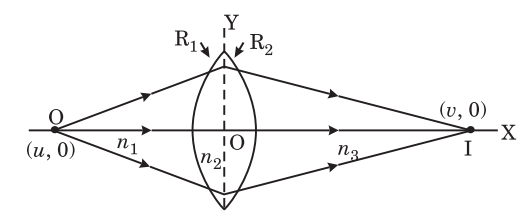
(b) A lens converted by two curved surfaces of radius of curvature R1 and R2 is placed according to the following figure :
Image
Prove that: $\frac{n_3}{v}-\frac{n_1}{u}=\frac{n_2-n_1}{R_1}+\frac{n_3-n_2}{R_2}$
Two friends $A$ and $B$ are standing a distance $x$ apart in an open field and wind is blowing from $A$ to $B$. $A$ beats a drum and $B$ hears the sound $t_1$ time after he sees the event. $A$ and $B$ interchange their positions and the experiment is repeated. This time $B$ hears the drum $t_2$ time after he sees the event. Calculate the velocity of sound in still air $v$ and the velocity of wind $u$. Neglect the time light takes in travelling between the friends.
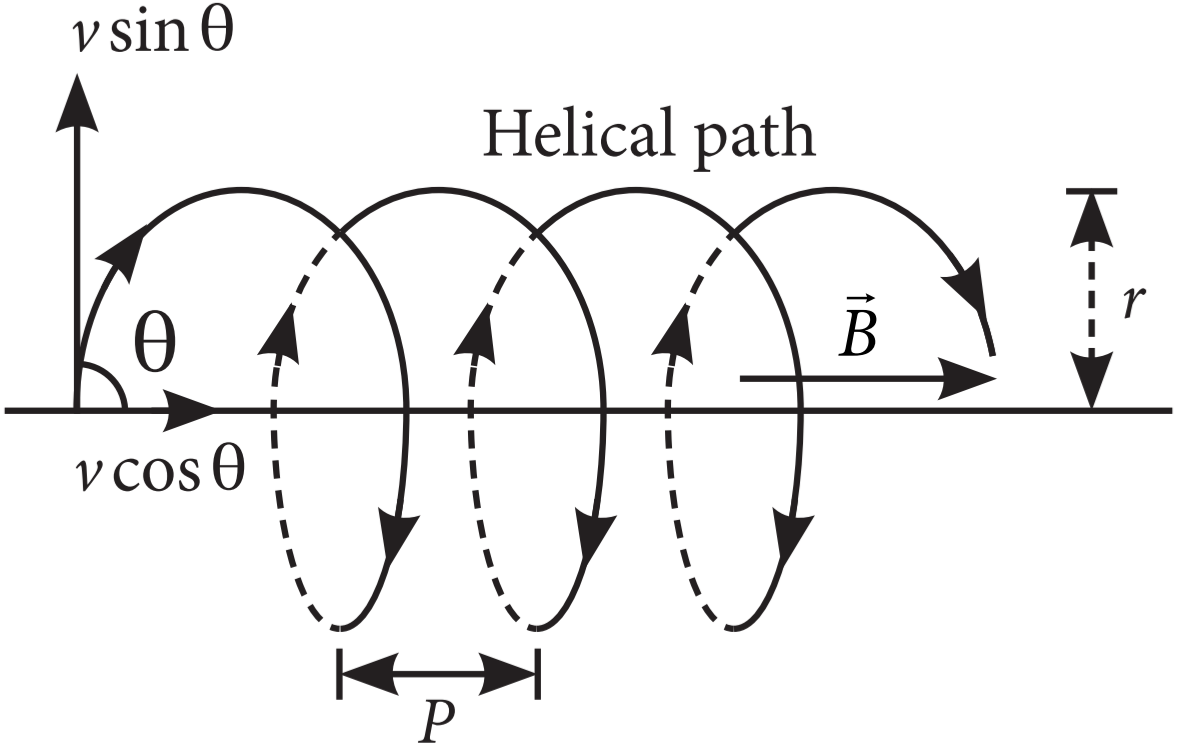
The path of a charged particle in magnetic field depends upon angle between velocity and magnetic field. If velocity $\vec{\text{v}}$ is at angle $\theta$ to $\vec{\text{B}},$ component of velocity parallel to magnetic field $(\text{v}\cos\theta)$ remains constant and component of velocity perpendicular to magnetic field $(\text{v}\sin\theta)$ is responsible for circular motion, thus the charge particle moves in a helical path.
The plane of the circle is perpendicular to the magnetic field and the axis of the helix is parallel to the magnetic field. The charged particle moves along helical path touching the line parallel to the magnetic field passing through the starting point after each rotation. Radius of circular path is $\text{r}=\frac{\text{mv}\sin\theta}{\text{qB}}$ Hence the resultant path of the charged particle will be a helix, with its axis along the direction of $\vec{\text{B}}$ as shown in figure.
  1. When a positively charged particle enters into a uniform magnetic field with uniform velocity, its trajectory can $b$:
  1. A straight line.
  2. A circle.
  3. A helix.
  1. $(i)$ Only
  2. $(i)$ or $(ii)$
  3. $(i)$ or $(iii)$
  4. Any one of $(i), (ii)$ and $(iii)$
  1. Two charged particles $A$ and $B$ having the same charge, mass and speed enter into a magnetic field in such a way that the initial path of $A$ makes an angle of $30^\circ$ and that of $B$ makes an angle of $90^\circ$ with the field. Then the trajectory of:
  1. B will have smaller radius of curvature than that of $A$.
  2. Both will have the same curvature.
  3. A will have smaller radius of curvature than that of $B.$
  4. Both will move along the direction of their original velocities.
  1. An electron having momentum $2.4 \times 10^{-23}kg m/ s$ enters a region of uniform magnetic field of $0.15T.$ The field vector makes an angle of $30^\circ$ with the initial velocity vector of the electron. The radius of the helical path of the electron in the field shall be:
  1. $mm$
  2. $1\ mm$
  3. $\frac{\sqrt{3}}{2}\text{ mm}$
  4. $0.5\ mm$
  1. The magnetic field in a certain region of space is given by $\vec{\text{B}}=8.35\times10^{-2}\hat{\text{i}}\text{T}.$ A proton is shot into the field with velocity $\vec{\text{v}}=(2\times10\hat{\text{i}}+4\times10^5\hat{\text{j}.}$ The proton follows a helical path in the field. The distance moved by proton in the $x-$ direction during the period ofone revolution in the $yz-$ plane will be:
$($Mass of proton $= 1.67 \times 10^{-27}kg)$
  1. $0.053m$
  2. $0.136m$
  3. $0.157m$
  4. $0.236m$
  1. The frequency of revolution of the particle is:
  1. $\frac{\text{m}}{\text{pB}}$
  2. $\frac{\text{qB}}{2\pi\text{m}}$
  3. $\frac{2\pi\text{R}}{\text{v}\cos\theta}$
  4. $\frac{2\pi\text{R}}{\text{v}\sin\theta}$
A moving-coil galvanometer has a 50-turn coil of size 2cm × 2cm. It is suspended between the magnetic poles producing a magnetic field of 0.5T. Find the torque on the coil due to the magnetic field when a current of 20mA passes through it.