Question
Step-down transformers are used to decrease or step-down voltages. These are used when voltages need to be lowered for use in homes and factories. A small town with a demand of 800kW of electric power at 220V is situated 15km away from an electric plant generating power at 440V. The resistance of the two wire line carrying power is 0.5Q per km. The town gets power from the line through a 4000 - 220V step-down transformer at a sub-station in the town.
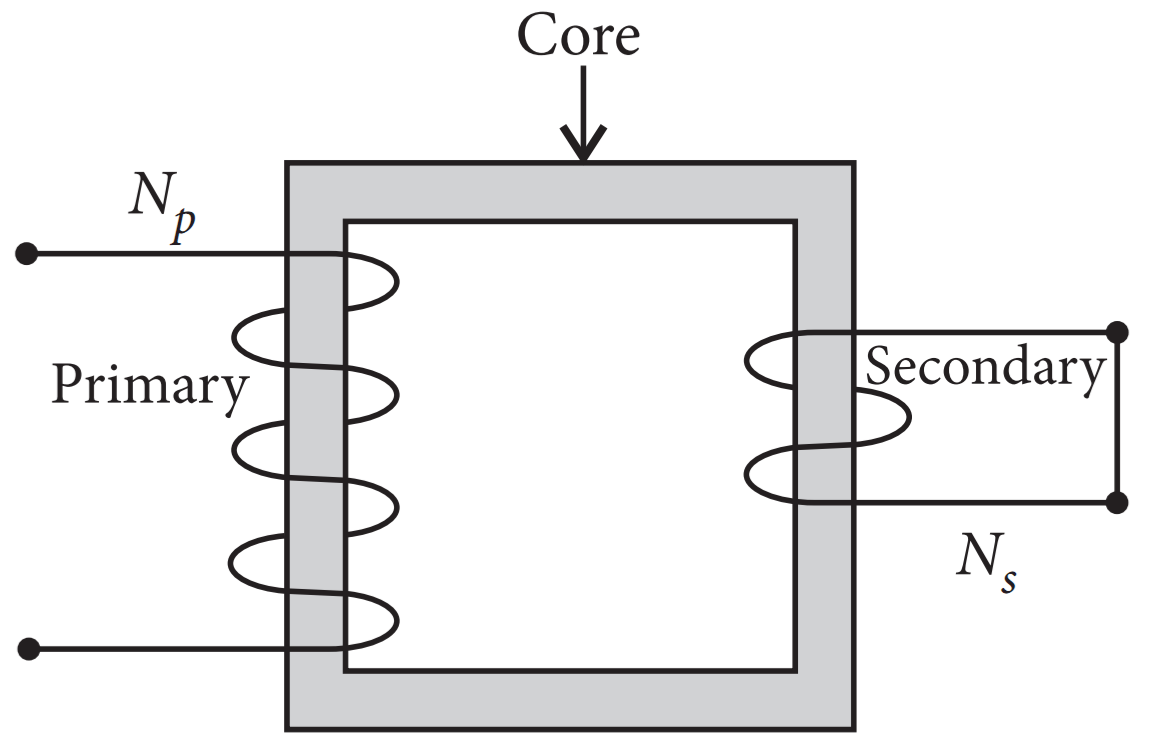
  1. The value of total resistance of the wires is:
  1. $25\Omega$
  2. $30\Omega$
  3. $35\Omega$
  4. $15\Omega$
  1. The line power loss in the form of heat is:
  1. 550kW
  2. 650kW
  3. 600kW
  4. 700kW
  1. How much power must the plant supply, assuming there is negligible power loss due to leakage?
  1. 600kW
  2. 1600kW
  3. 500W
  4. 1400kW
  1. The voltage drop in the power line is:
  1. 1700V
  2. 3000V
  3. 2000V
  4. 2800V
  1. The total value of voltage transmitted from the plant is:
  1. 500V
  2. 4000V
  3. 3000V
  4. 7000V

Answer

  1. (d) $15\Omega$

Explanation:

Resistance of the two wire lines carrying power $=0.5\frac{\Omega}{\text{Km}}$

Total resistance $=(15+15)0.5=15\Omega$

  1. (c) 600kW

Explanation:

Line power loss = I2R

RMS current in the coil,

$\text{I}=\frac{\text{P}}{\text{V}_1}=\frac{800\times10^3}{4000}=200\text{A}$

$\therefore$ Power loss = (200)2 × 15 = 600kW

  1. (d) 1400kW

Explanation:

Assuming that the power loss is negligible due to the leakage of the current.

The total power supplied by the plant,

= 800kW + 600kW = 1400kW

  1. (b) 3000V

Explanation:

Voltage drop in the power line = IR

= 200 × 15 = 3000V

  1. (d) 7000V

Explanation:

Total voltage transmitted from the plant,

= 3000V + 4000V = 7000V

Need a full question paper?

Generate a complete, print-ready paper with questions like this in minutes — across 16+ boards, with answer keys.

Start Generating Free

Similar questions

Two submarines are approaching each other in a calm sea. The first submarine travels at a speed of 36km/h and the other at 54km/h relative to the water. The first submarine sends a sound signal (sound waves in water are also called sonar) at a frequency of 2000Hz.
  1. At what frequency is this signal received by the second submarine?
  2. The signal is reflected from the second submarine. At what frequency is this signal received by the first submarine. Take the speed of the sound wave in water to be 1500m/s.
A lady cannot see objects closer than 40cm from the left eye and closer than 100cm from the right eye. While on a mountaineering trip, she is lost from her team. She tries to make an astronomical telscope from her reading glasses to look for her teammates.
  1. Which glass should she use as the eyepiece?
  2. What magnification can she get with relaxed eye?
In the year 1939, German scientist Otto Hahn and Strassmann discovered that when an uranium isotope was bombarded with a neutron, it breaks into two intermediate mass fragments. It was observed that, the sum of the masses of new fragments formed were less than the mass of the original nuclei. This difference in the mass appeared as the energy released in the process. Thus, the phenomenon of splitting of a heavy nucleus (usually A > 230) into two or more lighter nuclei by the bombardment of proton, neutron $\alpha$-particle, etc. with liberation of energy is called nuclear fission.
$\ _{92}\text{U}^{235}+\ _0\text{n}^{1}\rightarrow_{92}\text{U}^{236} \rightarrow\ _{56}\text{B}^{114}+\ _{36}\text{Kr}^{89}\ +3\ _{0}\text{n}^{1} + \text{Q}$
$\big[\because \ _{92}\text{U}^{236}= \text{Unstable nucleus}\big]$
  1. Nuclear fission can be explained on the basis of.
  1. Millikan's oil drop method
  2. Liquid drop model
  3. Shell model
  4. Bohr's model.
  1. For sustaining the nuclear fission chain reaction in a sample (of small size) of $_{92}^{235}\text{U}$ it is desirable to slow down fast neutrons by.
  1. Friction
  2. Elastic damping/ scattering
  3. Absorption
  4. None of these.
  1. Which of the following is/ are fission reaction(s)?
  1. $_0^1\text{n}\ +\ _{92}^{235}\text{U}\rightarrow\ _{92}^{235}\text{U}\rightarrow\ _{51}^{133}\text{Sb}+\ _{41}^{99}\text{nb}+\ 4_1^0\text{n}$
  2. $_0^1\text{n}\ +\ _{92}^{235}\text{U}\rightarrow\ _{54}^{1.40}\text{Xe}+\ _{38}^{94}\text{Sr}\ +2_0^1\text{n}$
  3. $_1^2\text{H}\ +\ _1^2\text{H}\rightarrow\ _2^3\text{He}+\ _0^1\text{n}$
  1. Both II and III
  2. Both I and III
  3. Only II
  4. Both I and II
  1. On an average, the number of neutrons and the energy of a neutron released per fission of a uranium atom are respectively.
  1. 2.5 and 2 keV
  2. 3 and 1 keV
  3. 2.5 and 2 MeV
  4. 2 and 2 keV
  1. In any fission process, ratio of mass of daughter nucleus to mass of parent nucleus is.
  1. Less than I
  2. Greater than I
  3. Equal to I
  4. Depends o the mass of parent nucleus.
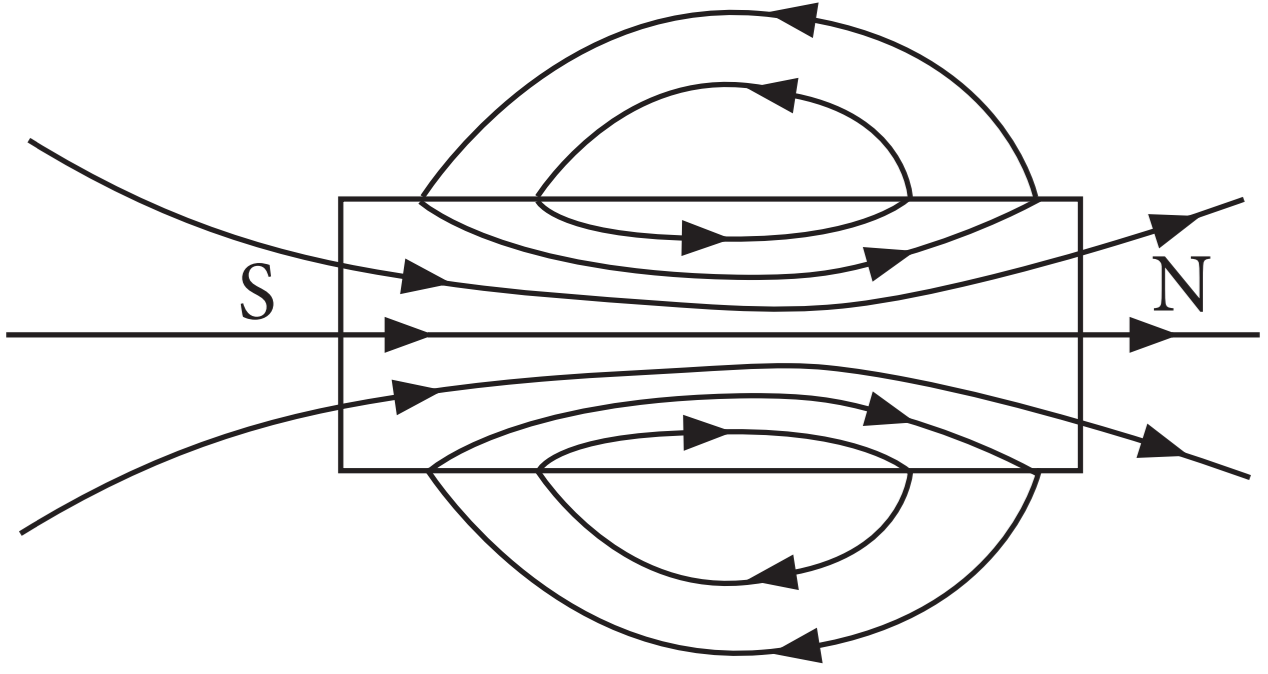
By analogy to Gauss's law of electrostatics, we can write Gauss's law of magnetism as $\oint\vec{\text{B}}.\text{d}\vec{\text{v}}=\mu_0\text{m}_{\text{inside}}$ where $\oint\vec{\text{B}}.\text{d}\vec{\text{s}}$ is the magnetic flux and $\text{m}_{\text{inside}}$ is the net pole strength inside the closed surface. We do not have an isolated magnetic pole in nature. At least none has been found to exist till date. The smallest unit of the source of magnetic field is a magnetic dipole where the net magnetic pole is zero. Hence, the net magnetic pole enclosed by any closed surface is always zero. Correspondingly, the flux of the magnetic field through any closed surface is zero. 

  1. Consider the two idealised systems
  1. a parallel plate capacitor with large plates and small separation and
  2. a long solenoid of length L >> R, radius of cross-section.

(In) (i) $\vec{\text{E}}$ is ideally treated as a constant between plates and zero outside. In (ii) Magnetic field is constant inside the solenoid and zero outside. These idealised assumptions, however, contradict fundamental laws as below

  1. Case (i) contradicts Gauss's law for electrostatic fields.
  2. Case (ii) contradicts Gauss's law for magnetic fields.
  3. Case (i) agrees with $\oint\vec{\text{E}}.\text{d}\vec{\text{l}}=0$
  4. Case (ii) contradicts $\oint\vec{\text{H}}.\text{d}\vec{\text{l}}=\text{l}_{\text{en}}.$ 
  1. The angle between the true geographic north and the north shown by a compass needle is called as:
  1. $\text{Zero}$

  2. $\frac{\mu_0}{4\pi}$

  3. $4\pi\mu_0$

  4. $\frac{4\mu_0}{\pi}$

  1. A closed surface S encloses a magnetic dipole of magnetic moment 2ml. The magnetic flux emerging from the surface is:
  1. $\mu_0\text{m}$

  2. $\text{Zero}$

  3. $2\mu_0\text{m}$

  4. $\frac{2\text{m}}{\mu _0}$

  1. Which of the following is not a consequence of Gauss's law?
  1. The magnetic poles always exist as unlike pairs of equal strength.
  2. If several magnetic lines of force enter in a closed surface, then an equal number of lines of force must leave that surface.
  3. There are abundant sources or sinks of the magnetic field inside a closed surface.
  4. Isolated magnetic poles do not exist.
  1. The surface integral of a magnetic field over a surface:
  1. Is proportional to mass enclosed.
  2. Is proportional to charge enclosed.
  3. S zero.
  4. Equal to its magnetic flux through that surface.
In the derivation of P1 - P2 = Pgz, it was assumed that the liquid is incompressible. Why will this equation not be strictly valid for a compressible liquid?
A magnetic dipole of magnetic moment $0.72\sqrt{2}\text{ A-m}^2$ -is placed horizontally with the north pole pointing towards east. Find the position of the neutral point if the horizontal component of the earth's magnetic field is $18\mu\text{T.}$
Resistance of tungsten filament in one bulb at $27{ }^{\circ} C$ is $18 \Omega$. When this bulb is connected to 60 V source, steady current passing through it is 0.3 A . Find temperature of this filament taking $\alpha=4.5 \times 10^{-3} K^{-1}$. Assume that Ohm's law is obeyed.
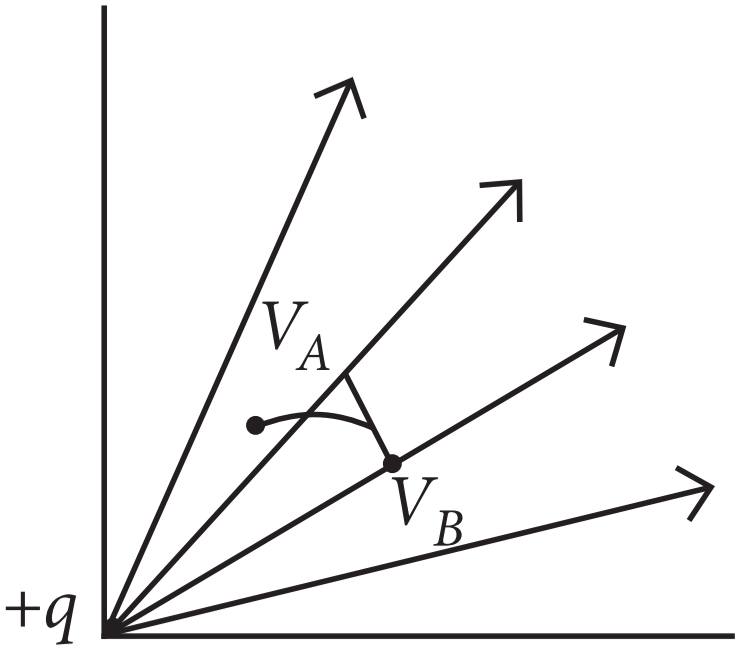
Electrostatic potential energy of a system of point charges is defined as the total amount of work done in bringing the different charges to their respective positions from infinitely charge mutual separations. The work is stored in the system of two point charges in the form of electrostatic potential energy U of the system. Electric potential difference between any points A and B in an electric field is the amount of work done in moving a unit positive test charge from A to B along any path agents the electrostatic force $\text{V}_\text{B}-\text{V}_\text{A}=\frac{\text{W}_\text{AB}}{\text{q}_\text{o}}=\int\vec{\text{E}}.\text{dl}.$

  1. A test charge is moved from lower potential point to a higher potential point. The potential energy of test charge wiII.
  1. Remain the same.
  2. Increase.
  3. Decrease.
  4. Become zero.
  1. Which of the following statement is not true?
  1. Electrostatic force is a conservative force.
  2. Potential energy of charge q at a point is the work done per unit charge in bringing a charge from any point to infinity.
  3. Spring force and gravitational force are conservative force.
  4. Both (a) and (c).
  1. Work done in moving a charge from one point to another inside a uniformly charged conducting sphere is:
  1. Always zero.
  2. Non-zero.
  3. May be zero.
  4. None of these.
  1. The work done in bringing a unit positive charge from infinite distance to a point at distance x from a positive charge Q is W. Then the potential $\phi$ at that point is:
  1. $\frac{\text{WQ}}{\text{x}}$

  2. W

  3. $\frac{\text{W}}{\text{x}}$

  4. WQ

  1. If $1\mu\text{C}$ charge is shifted from A to B and it is found that work done by an external force is $40\mu\text{J}.$ ln doing so against electrostatics force, the potential difference VA - VB is:
  1. 40V
  2. -40V
  3. 20V
  4. -60V
Bohr's model explains the spectral lines of hydrogen atomic emission spectrum. While the electron of the atom remains in the ground state, its energy is unchanged. When the atom absorbs one or more quanta of energy, the electrons moves from the ground state orbit to an excited state orbit that is further away.

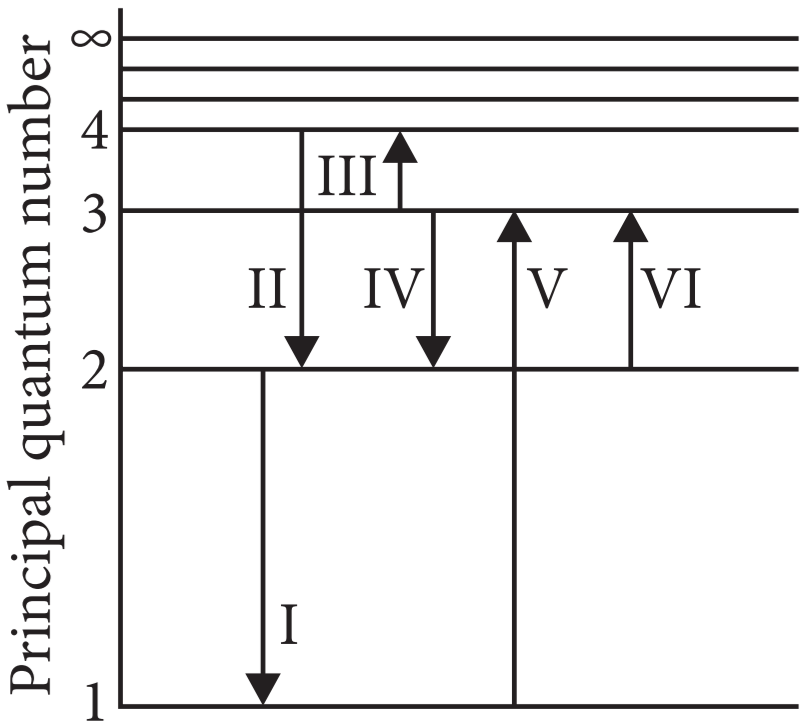
The given figure shows an energy level diagram of the hydrogen atom. Several transitions are marked as I, II, III and so on. The diagram is only indicative and not to scale.
  1. In which transition is a Balmer series photon absorbed?
  1. II
  2. III
  3. IV
  4. VI
  1. The wavelength of the radiation involved in transition II is
  1. 291nm
  2. 364nm
  3. 487nm
  4. 652nm
  1. Which transition will occur when a hydrogen atom is irradiated with radiation of wavelength 103nm?
  1. I
  2. II
  3. IV
  4. V
  1. The electron in a hydrogen atom makes a transition from n = n1 to n = n2 state. The time period of the electron in the initial state is eight times that in the final state. The possible values of n1 and n2 are.
  1. n1 = 4,n2 = 2
  2. n1 = 8,n2 = 2
  3. n1 = 8,n2 = 3
  4. n1 = 6,n2 = 2
  1. The Balmer series for the H-atom can be observed
  1. If we measure the frequencies of light emitted when an excited atom falls to the ground state.
  2. If we measure the frequencies of light emitted due to transitions between excited states and the first excited state.
  3. In any transition in a H-atom.
  4. None of these.
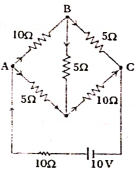
Determine the current in each branch of the network shown in figure.
Image