MCQ
Stopping potential for photoelectrons
  • A
    Does not depend on the frequency of the incident light
  • B
    Does not depend upon the nature of the cathode material
  • Depends on both the frequency of the incident light and nature of the cathode material
  • D
    Depends upon the intensity of the incident light
Answer

Correct option: C.
Depends on both the frequency of the incident light and nature of the cathode material

Need a full question paper?

Generate a complete, print-ready paper with questions like this in minutes — across 16+ boards, with answer keys.

Start Generating Free

Similar questions

A cart of mass $M$ is tied by one end of a massless rope of length $ 10 m$. The other end of the rope is in the hands of a man of mass $M$. The entire system is on a smooth horizontal surface. The man is at $x =0$ and the cart at $x=10 m$. If the man pulls the cart by the rope, the man and the cart will meet at the point
The amount of work done in an adiabatic expansion from temperature $T$ to $T_1$ is
A particle starts from rest, accelerates at $2 m / s$ for $10 s$ and then goes for constant speed for $30 s$ and then decelerates at $4 m / s$ till it stops. What is the distance travelled by it
For a small temperature difference between the body and the surroundings the relation between the rate of loss heat $R$ and the temperature of the body is depicted by
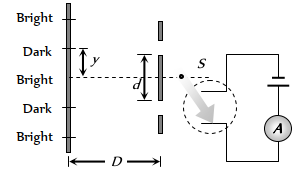
In the following arrangement $y=1.0 \mathrm{~mm}, d=0.24 \mathrm{~mm}$ and $D=1.2 \mathrm{~m}$. The work function of the material of the emitter is $2.2 \mathrm{eV}$. The stopping potential $V$ needed to stop the photo current will beImage
What is the angle between $\vec{P}$ and the resultant of $(\vec{P}+\vec{Q})$ and $(\vec{P}-\vec{Q})$
Which of the following is not correct regarding the radio telescope
When heat energy of $1500$ Joules, is supplied to a gas at constant pressure $2.1 \times 10^5 \mathrm{~N} / \mathrm{m}^2$, there was an increase in its volume equal to $2.5 \times 10^{-3} \mathrm{~m}^3$. The increase in internal energy of the gas in Joules is
An ideal gas expands in such a manner that its pressure and volume can be related by equation $P V^2=$ constant. During this process, the gas is
Pressure-temperature relationship for an ideal gas undergoing adiabatic change is $\left(\gamma=C_p / C_v\right)$