Stress required in a wire to produce $0.1\%$ strain is $4 \times10^8\, N/m^2$. Its yound modulus is $Y_1$. If stress required in other wire to produce $0.3\%$ strain is $6 \times 10^8\, N/m^2$. Its young modulus is $Y_2$. Which relation is correct
Medium


Download our appand get started for free
Experience the future of education. Simply download our apps or reach out to us for more information. Let's shape the future of learning together!No signup needed.*
Similar Questions
- 1A force $F$ is needed to break a copper wire having radius $R.$ The force needed to break a copper wire of radius $2R$ will beView Solution
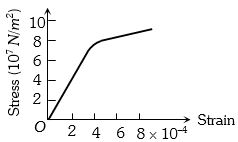
- 2Which one of the following is the Young’s modulus $($in $N/m^2)$ for the wire having the stress-strain curve shown in the figureView Solution
- 3A steel rod of length $1\,m$ and cross sectional area $10^{-4}\,m ^2$ is heated from $0^{\circ}\,C$ to $200^{\circ}\,C$ without being allowed to extend or bend. The compressive tension produced in the rod is $........\times 10^4\,N$ (Given Young's modulus of steel $=2 \times 10^{11}\,Nm ^{-2}$, coefficient of linear expansion $=10^{-5}\, K ^{-1}$.View Solution
- 4View SolutionIn the three states of matter, the elastic coefficient can be
- 5Two exactly similar wires of steel and copper are stretched by equal forces. If the total elongation is $2 \,cm$, then how much is the elongation in steel and copper wire respectively? Given, $Y_{\text {steel }}=20 \times 10^{11} \,dyne / \ cm ^2$, $Y_{\text {copper }}=12 \times 10^{11} \,dy ne / \ cm ^2$View Solution
- 6The Young's modulus of a wire is $Y.$ If the energy per unit volume is $E$, then the strain will beView Solution
- 7In the Young’s experiment, If length of wire and radius both are doubled then the value of $Y$ will becomeView Solution
- 8The elastic limit of brass is $3.5 \times 10^{10}\,N / m ^2$. Find the maximum load that can be applied to a brass wire of $0.75\,mm$ diameter without exceeding the elastic limit$.......\times 10^4\,N$View Solution
- 9A uniform wire (Young's modulus $2 \times 10^{11}\, Nm^{-2}$ ) is subjected to longitudinal tensile stress of $5 \times 10^7\,Nm^{-2}$ . If the over all volume change in the wire is $0.02\%,$ the fractional decrease in the radius of the wire is close toView Solution
- 10Two wires $A$ and $B$ of same length and of same material have radii $r_1$ and $r_2$ respectively. Their one end is fixed with a rigid support and at other end equal twisting couple is applied. Then ratio of the angle of twist at the end of $A$ and the angle of twist at the end of $B$ will be ..............View Solution