Two wires $A$ and $B$ of same length and of same material have radii $r_1$ and $r_2$ respectively. Their one end is fixed with a rigid support and at other end equal twisting couple is applied. Then ratio of the angle of twist at the end of $A$ and the angle of twist at the end of $B$ will be ..............
Medium


Download our appand get started for free
Experience the future of education. Simply download our apps or reach out to us for more information. Let's shape the future of learning together!No signup needed.*
Similar Questions
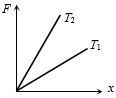
- 1The diagram shows the change $x$ in the length of a thin uniform wire caused by the application of stress $F$ at two different temperatures $T_1$ and $T_2$. The variations shown suggest thatView Solution
- 2View SolutionTo keep constant time, watches are fitted with balance wheel made of
- 3A force $F$ is applied on the wire of radius $r$ and length $L$ and change in the length of wire is $l.$ If the same force $F$ is applied on the wire of the same material and radius $2r$ and length $2L,$ Then the change in length of the other wire isView Solution
- 4Two wires are made of the same material and have the same volume. The first wire has cross-sectional area $A$ and the second wire has cross-sectional area $3A$. If the length of the first wire is increased by $\Delta l$ on applying a force $F$, how much force is needed to stretch the second wire by the same amount?View Solution
- 5View SolutionThe compressibility of a material is
- 6The Young's modulus of a wire of length $L$ and radius $r$ is $Y$ $N/m^2$. If the length and radius are reduced to $L/2$ and $r/2,$ then its Young's modulus will beView Solution
- 7Increase in length of a wire is $1\, mm$ when suspended by a weight. If the same weight is suspended on a wire of double its length and double its radius, the increase in length will be ........ $mm$View Solution
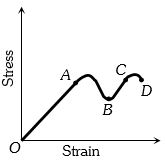
- 8In the below graph, point $B$ indicatesView Solution
- 9A wire extends by $1 mm$ when a force is applied. Double the force is applied to another wire of same material and length but half the radius of cross-section. The elongation of the wire in mm will be ........View Solution
- 10A stress of $1.5\,kg.wt/mm^2$ is applied to a wire of Young's modulus $5 \times 10^{11}\,N/m^2$ . The percentage increase in its length isView Solution