Question
Study the graph given below and answer the questions that follow:
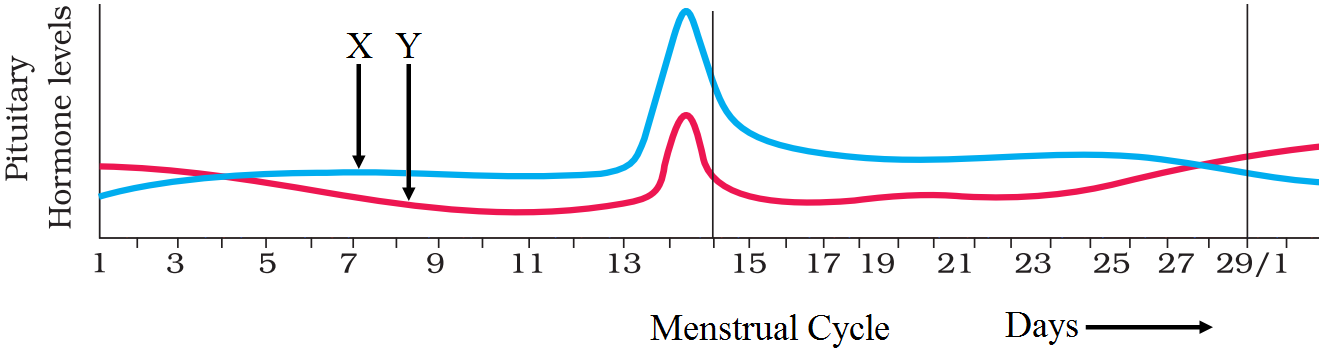
Explain the ovarian events (i), (ii) and (iii) under the influence of hormones ‘X’ and ‘Y’.

Answer

Both LH and FSH attain a peak level in the middle of cycle (about 14th day).
Rapid secretion of LH leading to its maximum level during the mid-cycle called LH surge induces rupture of Graafian follicle and thereby the release of ovum (ovulation).
The remaining cells of ovarian follicles are stimulated by the LH to transform into corpus luteum. The corpus luteum secretes large amount of progesterone which is essential for maintenance of the endometrium.

Need a full question paper?

Generate a complete, print-ready paper with questions like this in minutes — across 16+ boards, with answer keys.

Start Generating Free

Similar questions

Explain how xerarch succession progresses from serie to mesic condition and forms a stable climax community. You may use a flow chart.
In a pond, we see plants which are free-floating; rooted–submerged; rooted emergent; rooted with floating leaves. Write the type of plants against each of them.
 
Plant Name
Type
a.
Hydrilla
____________
b.
Typha
____________
c.
Nymphaea
____________
d.
Lemna
____________
e.
Vallisnaria
____________
The following is the illustration of the sequence of ovarian events (a – i) in a human female.

Explain the changes that occur in the uterus simultaneously in anticipation.

In which categories have been classified the contraceptive methods. Describe any three methods in detail.
With the help of one example each, provide genetic explanation for the following observations:
F1-generation resembles both the parents.
One of the main objectives of biotechnology is to minimise the use of insecticides on cultivated crops. Explain with the help of a suitable example how insect resistant crops have been developed using techniques of biotechnology.
If a population growing exponentially double in size in 3 years, what is the intrinsic rate of increase (r) of the population?
Draw and explain a logistic curve for a population of density (N) at time (t) whose intrinsic rate of natural increase is (r) and carrying capacity is (k).
A single base mutation in a gene may not 'always' result in loss or gain of function. Do you think the statement is correct? Defend your answer.
Angiosperm flowers may be monoecious, cleistogamous or show self-incompatibility. Describe the characteristic features of each one of them and state which one of these flowers promotes inbreeding and outbreeding respectively.
