Question
Study the graph given below and answer the questions that follow:
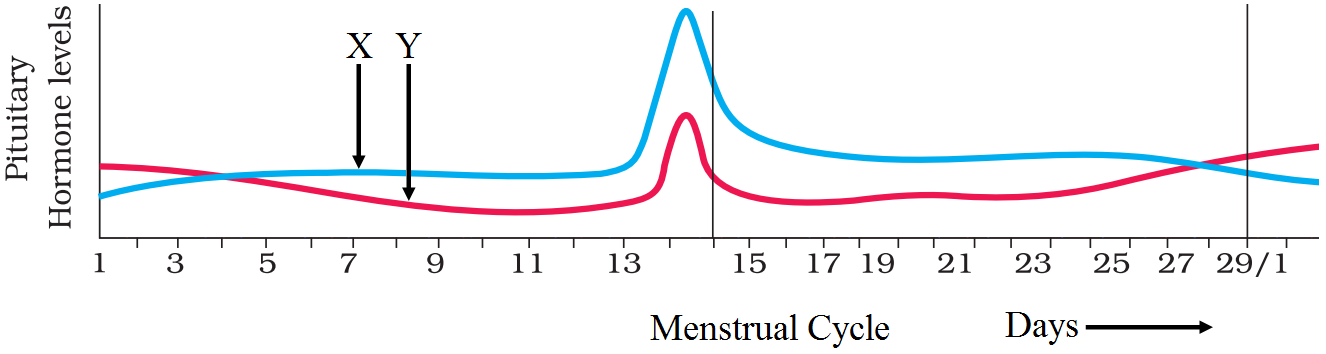
Identify the ovarian phases during a menstrual cycle:
  1. 5th day to 12th day of the cycle.
  2. 14th day of the cycle.
  3. 16th day to 25th day of the cycle.

Answer

  1. 5th day to 12th day of the cycle: Follicular phase (Proliferative phase).
  2. 14th day of the cycle: Ovulatory phase (release of ovum) followed by luteal phase.
  3. 16th day to 25th day of the cycle: Luteal phase.
  4. FSH is secreted by the anterior pituitary which stimulates the ovarian follicle to secrete estrogen, which in turn stimulates the proliferation of the endometrium of the uterine wall.

Need a full question paper?

Generate a complete, print-ready paper with questions like this in minutes — across 16+ boards, with answer keys.

Start Generating Free

Similar questions

Describe the structure of human sperm.###Describe the structure of sperm with suitable diagram. Also define supermatogenesis.
A few statements are given below followed by a set of terms in a box. Pick the correct term and write it against the appropriate statement,
  1. Mating of closely related individuals within the same breed.
  2. Mating of animals of same breed but having no common ancestors on either side for 4-6 generations.
  3. Mating of animals of two different species.
  4. Breeding of animals belonging to different breeds.
  1. Cross breeding.
  2. Inter-specific hybridization.
  3. Out breeding.
  4. Out crossing.
  5. Inbreeding.
Do all the gametes formed from a parent organism have the same genetic composition (identical DNA copies of the parental genome)? Analyse the situation with the background of gametogenesis and provide or give suitable explanation.
Explain the difference between apes and human.
Answer the following questions:
Write the Mendelian $F_2$ phenotypic ratio in a dihybrid cross. State the law that he proposed on the basis of this ratio. How is this law different from the law of segregation?
Give details of different types of immune globulins in humans.
Correct the following statements:
  1. Surgical methods of contraception prevent gamete formation.
  2. All sexually transmitted diseases are completely curable.
  3. Oral pills are very popular contraceptives among the rural women.
  4. In E. T. techniques, embryos are always transferred into the uterus.
  1. Represent diagrammatically three kinds of age-pyramids for human populations.
  2. How does an age pyramid for human population at given point of time helps the policymakers in planning for future?
  1. State one difference and one similarity between geitonogamy and xenogamy.
  2. Explain any three devices developed in flowering plants to discourage self pollination and encourage cross-pollination.
Explain the two complexities that are observed in the process of transcription in eukaryotes and not in prokaryotes.