Question
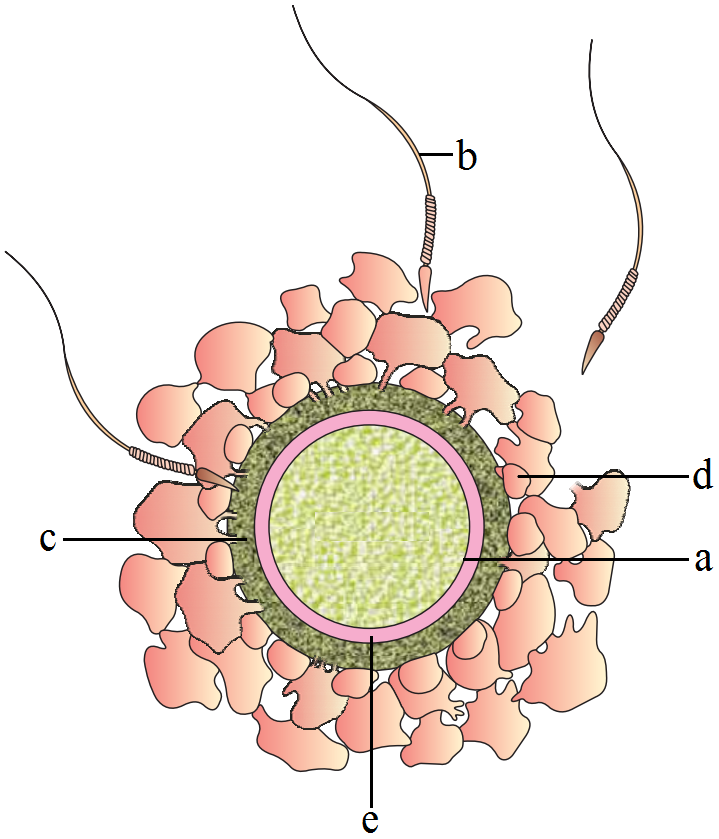
Study the illustration given and answer the questions that follow:

Identify ‘d’.

Answer

d – cells of corona radiata.

Need a full question paper?

Generate a complete, print-ready paper with questions like this in minutes — across 16+ boards, with answer keys.
Start Generating Free

Similar questions

A pregnant woman was adviced to undergo medical termination of pregnancy. Her doctor found that the foetus in her womb was developed from a zygote made of an XX egg fertilized by a Y-bearing sperm? Why was she advised to undergo MTP?
Samya visited a zoo with her mother, on watching the cheetah, she wondered how he uses his forelimbs for running. While the same forelimbs in bats are used for flying. She wanted to know more about it and so asked her mother (a biology teacher) about it. Her mother explained her how forelimbs are modified in different animal groups for different functions.
  1. What are such organs called?
  2. Give an example of such organs from the plant world.
  3. What led to the origin of such organs?
  4. What are the values shown by Samya?
Study the following flow chart. Name the hormones involved at each stage. Explain their functions.
Hypothalamus → Pituitary → Testes → Sperms.
The genetic code is, for the most part, universal, with few exceptions. Explain it by giving the example of mitochondria, the power house of cell.
Write the function of following parts of sperm :
(i) head
(ii) middle piece
(iii) tail
Write any four ways used to introduce a desired DNA segment into a bacterial cell in recombinant technology experiments.
  1. How is amensalism different from parasitism and competition? Give an example for each.
  2. Define predation.
  1. Explain the process of microsporogenesis in angiosperms.
  2. Draw a labelled diagram of a mature pollen grain.
Suggest and describe a technique to obtain multiple copies of a gene of interest in vitro.
Describe in sequence the events that lead to the development of a 3-celled pollen grain from microspore mother cell in angiosperms.