Question

Study the state-wise Literacy Rate in India according to 2021 Census. (10 m)

State/Union TerritoryLiteracy rate in % (Person)Literacy rate in % (Male)Literacy rate in % (Female)
1. Kerala94.096.192.1
2. Lakshadweep91.895.687.9
3. Mizoram91.393.389.3
4. Goa88.792.684.7
5. Tripura87.291.582.7
6. Daman & Diu87.191.579.5
7. Andaman & Nicobar Island86.690.382.4
8. NCT or Delhi86.290.980.8
9. Chandigarh86.090.081.2
10. Puducherry85.891.380.7
11. Himachal Pradesh82.889.575.9
12. Maharashtra82.388.475.9
13. Sikkim81.486.675.6
14. Tamil Nadu80.186.873.4
15. Nagaland79.682.876.1
16. Manipur79.286.172.4
17. Uttarakhand78.887.470.0
18. Gujarat78.085.869.7
19. West Bengal76.381.770.5
20. Dadra & Nagar Haveli76.285.264.3
21. Punjab75.880.470.7
22. Haryana75.684.165.9
23. Karnataka75.482.568.1
24. Meghalaya74.476.072.9
25. Odisha72.981.664.0
26. Assam72.277.866.3
27. Chhattlsgarh70.380.360.2
28. Madhya Pradesh69.378.759.2
29. Uttar Pradesh67.777.357.2
30. Jammu & Kashmir67.276.356.4
31. Andhra Pradesh67.074.959.1
32. Jharkhand66.476.855.4
33. Rajasthan66.179.252.1
34. Arunachal Pradesh65.472.657.2
35. Bihar61.871.251.5

Answer the following questions, based on the table above.

(i) Discuss reasons why male literacy is higher than female literacy in India. (2)

(ii) In which state is the difference between the male literacy rate and female literacy rate highest? (1)
(a) West Bengal
(b) Bihar
(c) Rajashtan
(d) Tamil Nadu

(iii) What does the lower gap between male literacy rate and female literacy rate show? (2)

(iv) Select the correct option to fill in the blank and complete the analogy: (1)
67.2% : Literacy rate : : : Male Literacy rate
(a) 76.3%
(b) 57.2%
(c) 56.4%
(d) 51.5%

(v) Name the States/UTs with female literacy lower from 60%. (1)

(vi) Complete the given sentence appropriately. (1)
The overall literacy rate is 91.3% for ……………..

(vii) Name the State/UTs with the highest female literacy. (1)

(viii) Which of the following can be said for all states? (1)
(a) The female literacy rate is decreasing.
(b) The female literacy rate is improving.
(c) The female literacy rate is stagnant.
(d) The female literacy rate is inconsequential.
Answer

i.The male literacy rate is usually higher than the female literacy rate because of the regressive mindset of the society wherein boys are to be educated and girls are supposed to take care of the household. Further, the lack of proper school and facilities also leads the parents to not send the girls to schools.
ii.
(b) Bihar
iii. The lower gap between male literacy rate and the female literacy rate shows that the regressive attitude that places males as superior to female is reducing. More and more parents are sending their girls to schools and getting them educated. Further, it also means that education facilities are improving, especially for girls.
iv. (a) 76.3%
v. The States or UTs with female literacy lower than 60% are- Madhya Pradesh, Uttar Pradesh, Jammu and Kashmir, Andhra Pradesh, Jharkhand, Rajasthan, Arunachal Pradesh and Bihar.
vi. Mizoram
vii. The States or UTs with the highest female literacy rate is Kerala.
viii. (b) The female literacy rate is improving.

Need a full question paper?

Generate a complete, print-ready paper with questions like this in minutes — across 16+ boards, with answer keys.

Start Generating Free

Similar questions

3 Feb - 6 Feb
FAIRS
NAGAUR FAIR - 2025
The Nagaur Fair is the second biggest fair in India. Held every year between the months of January and February, it is popularly known as the Cattle Fair of Nagaur as this is where owners gather to trade animals. Approximately 70,000 bullocks, camels and horses are traded every year at this fair. The animals are lavishly decorated and even their owners dress up with colourful turbans. Besides cattle, sheep, horses and even spices are traded. Other attractions include the Mirchi Bazaar (largest red chilli market of India).
26 Sep - 27 Sep
FESTIVALS
ABHANERI FESTIVAL - 2025
'Abhaneri festival' is named after the village Abhaneri in the Dausa district which is around 90 km from Jaipur on the Agra road. This two-day festival has gained immense popularity amongst the tourists around the the globe. It commences with various Rajasthani & local folk performances like Kachhi Ghori, Kalbeliya, Ghoomar, and Bhawai. The village of Abhaneri was originally named Abha Nagri, meaning 'city of brightness'. The place is popular for the Chand Baori-step well, one of the largest step wells built over a thousand years ago.

Answer the following questions, based on your reading of the above information.
I.
Why is the tag 'A Hub for Livestock Trading' suitable for the Nagaur fair instead of  ‘Colourful Celebrations’?

II. Complete the following with the correct option. 
The Nagaur Fair is held ____.  
a) quarterly 
b) once in two years 
c) annually 
d) twice in a year

III. State which of the following is True. 
a) Chand Baori is referred to as ‘Abha Nagri’.  
b) Chand Baori is a recent construction. 
c) Chand Baori is an ancient stepwell.

IV.
What does the writer wish to convey by stating that the Abhaneri Festival ‘has gained immense popularity among tourists’?

V.
What might be the most likely reason for the lavish decorations of animals at the Nagaur Fair? 
a) To celebrate the cultural heritage of Rajasthan. 
b) To attract buyers and showcase the animals for trading. 
c) To compete for the best-decorated animal. 
d) To honour the animals as part of a religious ritual.

VI. Fill in the blank by choosing the correct option from those given in the brackets. 
The Mirchi Bazaar is most likely an attraction at the Nagaur Fair because it 
provides a platform for ____ (tourists and organisers / farmers and traders) to display an essential spice.

VII. If the Nagaur Fair highlights trading as its primary focus, what does the Abhaneri Festival most likely focus on? 
a) Promoting local agriculture 
b) Encouraging community interaction 
c) Celebrating historical heritage 
d) Showcasing regional culture 

VIII
What might be the most likely reason why the Nagaur Fair spans across four days while the Abhaneri Festival ends in two days?
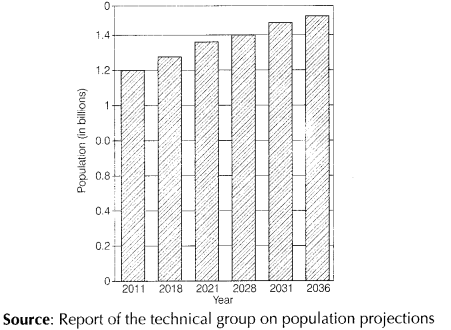
1. India’s population is expected to grow by 25%, with reference to 2011, to 1.52 billion by 2036, according to the final report of the technical group on population projections dated July 2020. The group was constituted by the National Commission on Population (NCP) under the Ministry of Health and Family Welfare with the mandate to provide population projections for the period 2011 to 2036.

2. India’s population growth rate is expected to decline to its lowest since Independence in the 2011-2021 decade, with a decadal growth rate of 12.5%. It will decline further to 8.4% in the 2021-2031 decade, as per the report, which The Wire has seen. According to these projections, India will overtake China as the world’s most populous country around 2031 – almost a decade later than the United Nations projection of 2022. India’s population is projected to increase to 1.52 billion by 2036.


Image
3. The projections have been delayed quite significantly “Ideally, they should have come by 2016. But there were delays in setting up the committee and then more delays at the government’s end even after we submitted the rcporl.We had submitted our report in November 2019,’’ said a member of the committee wishing to remain anonymous. This was confirmed by two other members as well.

4. India’s population was 1.21 billion as per the Census of 2011 and the projections now estimate that the population will grow by 311 million by 2036

5. The report projects that as much as 70% of this increase will be in urban areas. India’s urban population will increase from 377 million ¡n 2011 to 594 million in 2036 – a growth of 57%. So, while 31% of Indians were living in urban India in 2011 ,that will grow to 39% by 2036.

6. Consequently, the proportion of the rural population will decline from 69% to 61% as the urban population is projected to increase more than twice the projected increase in the rural population.

Answer the following questions, based on the passage above.

(i) What does the research in the above passage mention about rural population? (2)

(ii) The purpose of the above report was to give (1)
(a) Population projections for 2036 – 2050
(b) Population projections for 2011 – 2021
(C) Population projections for 2011 – 2036
(d) Population projections for 2031 – 2040

(iii) Infer two facts about India on the basis of your reading of the passage. (2)

(iv) Fill in the blanks with the appropriate option. (1)
This passage contains the decadal ……………… rate for the decade 2011 – 2021, which is 12.5%.
(a) growth
(b) decline
(c) stagnant
(d) fluctuating

(v) “It will decline further to 8.4% in the 2021-2031 dcca&…” What does this statement mean? (1)

(vi) Complete the sentence appropriately. (1)
The number by which the population of India is estimated to grow by 2036 is …………..

(vii) According to the passage, how much delay can be seen in India becoming the most populated country in the world as per the projections made by the UN? (1)

(viii) Why did the projections come in July of 2020? (1)
(a) Delay in setting up the committee
(b) Delay by the government
(c) Delay by the committee
(d) Both (a) and (b)
  • Bama – Born 1958, creative Tamil, woman writer, committed teacher, social activist – popularly known as Karukku Bama.
  • Penname – Faustina Mary Fatima Rani.
  • Novels – Karukku, Sangati and Vanman – translated into other Indian languages, English and French.
  • Wrote twenty short stories – not published in book form.
  • Honorary doctorate degree, Crossword Award for her semi-fictional autobiography Karukku.
  • Invited by universities in India and abroad – lectures at various conferences.
  • Multi-faceted personality-woman with extraordinary courage, conviction, resistance to any form of oppression
  • Keep eye for beauty in nature, profound insight into issues pertaining to caste, religion, women.
  • Clear thoughts and expression
  • Dedicated to the upliftment of the downtrodden: passion-Teaching: Mission-Building a casteless society.
Answer the following questions based on the information above.

(i) Identify the type of writing for which the given data can be easily used?Support your answer with one reason. (2)

(ii) Which issues are Bama’s writings concerned with? (1)
(a) Class
(b) Religion
(c) Women
(d) All of these

(iii) On the basis of the information given above, write about Bama’s writing style. (2)

(iv) Select the correct option to fill in the blank and complete the analogy: (1)
Passion : Teaching :: Mission : …………………..
(a) Education to all women
(b) Casteless society
(c) A keen understanding of religion
(d) Upliftment of the downtrodden

(v) How can Bama be characterised on the basis of the information given? (1)

(vi) Complete the given sentence appropriately (1)
Bama is invited by Universities all over the world to …………….

(vii) Write about Bama’s writing career on the basis of the data given in the box. (1)

(viii) Based on the information given above, which of the following qualities can you not attach with Bama? (1)
(a) Dedicated
(b) Compassionate
(c) Short tempered
(d) Observant

1. Festivals are synonymous with celebration, ceremony and joy. However, festivals bring to for the flip side of celebrations – pollution – air, water, soil and noise. This led to the need of assessing the awareness level among people about ecological pollution during festivals. So, a study was conducted by scholars of an esteemed university in India. This study was titled Awareness Towards Impact of Festivals on Ecology.

2. There were two main objectives of the study. The first one was to assess the awareness level among people about ecological protection during festivities. Exploring solutions to bring awareness about celebrating festivals without harming ecology was the second objective. The method used to collect data was a simple questionnaire containing 6 1 questions, shared with 50 respondents across four selected districts of a state in the Southern region of India.

3. The research began by understanding the socio-economic conditions of the respondents before sharing the questionnaire. Once the responses were received, the data collected was tabulated (Table 1), for analysis.

Table-1: Awareness level among respondents

QuestionsYES%NO%CAN’T SAY%
1. Do you feel that bursting crackers is a must during festivities?46540
2. Do you think most people abuse environmental resources during celebration of festivals?72280
3. Do you think that celebrations and festivities result in uniting people?64324
4. Do you enjoy bursting crackers for amusement?68320
5. Do you feel pressured to burst crackers during festivals as an expectation of your social status?82126
6. Are you aware of waste segregation and disposal guidelines for better ecology?56404

4. The study recommended the imposition of strict rules and regulations as opposed to a total ban on all festive activities which have a drastic impact on our environment. The researchers believed that such measures would help in harnessing some ill-effects that add to the growing pollution and suggested further studies be taken up across the country to assess awareness about ecological degradation.

5. The observations made in the study pointed to the environmental groups and eco-clubs fighting a losing battle due to city traffic issues, disposal of plastics, garbage dumping and all sorts of ecological degradation. The researchers stressed that the need of the hour is increasing awareness among people to reduce ecological pollution which can be facilitated by celebrating all festivals in an eco-friendly manner. (291 words)

Answer the following questions, based on the passage above.

(i) What was the objective of the study mentioned in the passage? (2)
Answer:
The objective of the study mentioned in the passage is to assess how much people knew about ecological protection during festivals and to find ways to bring awareness to people about celebrating festival without harming ecology.

(ii) According to the study, what percentage of people do not enjoy bursting crackers? (1)
(a) More than half
(b) Less than half
(c) A thendred percent
(d) Only adults

(iii) Justify the researcher’s recommendation for limiting the drastic impact of festival pollution on the environment with reference to lines 16 – 21. (1)

(iv) According to the passage, festival is synonymous with ……………… (1)
(a) celebration
(b) ceremony
(c) joy
(d) All of these

(v) Even though a larger number of people say ‘no’ to bursting crackers than those who say ‘yes’, festival pollution persists. How does evidence from table 1 support this statement? (2)

(vi) Complete the sentence given below. (1)
The eco-clubs are losing the battle because ……………..

(vii) Comment on the significance of the second objective of the study with reference to lines 7 – 12. (1)

(viii) Which of the following was NOT recommended by the study? (1)
(a) Imposition of strict rules
(b) A total ban on festive activities
(c) Punishment for the violators of the regulations
(d) Both (a) and (c)

1. Tourism, for millennia, has been a perpetual industry. Though initially unorganised and highly chaotic, it retained a place in each nook of history. The present tourism scenario in India is on the rise, with destinations grabbing eyeballs globally and domestically. Being the youngest nation in the world, it’s no wonder that the aggregate of ‘millennials’ spends more time and money on travel than previous generations. This could be huge for the economy of various states that rely majorly on tourism, if only it were sustainable.

2. Unsustainability prevails throughout the country, m states with higher domestic tourist inflow than foreign. The Dev Bhoomi is a prime example. No matter how popular, Uttarakhand tourism is loop-holed through and through.

3 Approx. 80% of tourists arrive to complete the infrastructure of the Dham Yatra. Such unchecked tourism puts immense pressure on natural and infrastructure facilities. The extreme shortage of accommodation in correspondence with thriving footfalls has led to the construction of illegal buildings, the majority of which exist on riverbanks. With an increasing number of tourists coming in through private vehicles to save ‘transportation money’, pollution levels are rising, increasing temperatures in return. With unlawful construction and pollution on riverbanks, the Ganges could cause direct harm to local species in Rishikesh and Haridwar.
4. Around 10,000 hilly areas are being convened for the construction of roads alone. We know roads are basic infrastructure but the Forest Conservation Act requires a project developer to plant trees in a non-forest/degraded forest area equal to or twice the trees, it’s clearing respectively, to compensate which does not happen.

5. The India State of Forest Report illustrates how Uttarakhand is losing its forest cover, which has indirect development through tourism, at its core. The government and private tour operators may think they can deny allegations but the charts speak for themselves.
6. We, as consumers of the tourism industry, hold the power to cause a massive stir in this context. According to research conducted, Uttarakhand’s mass tourism comprises people between 25-35 years of age, with higher education, out with either family or friends and enough average income to contribute to the local economy.

7. Regardless of what the figures say, if we look forward to sustainable tourism being the target market, it leaves little choice to the rest of the hierarchy. Consciously making efforts to be responsible tourists ‘and thinking of how to provide for the local community/environment in a way – tiny or big, could act as a catalyst in obliterating this ruckus due to ignorance. After all, there can only ever be seven deadly sins and wanderlust isn’t one of them.  

Answer the following questions, based on the passage above.
(i) Infer one consequence, based on your understanding of the passage, that highlights the result of the pressures of a large number of tourists. (2)

(ii) Select the appropriate option to fill in the blank. (1)
From paragraph 1, we can infer that …………………………. is the main cause for putting pressure on infrastructural and natural resources.
(a) unchecked tourism
(b) illegal construction
(c) pollution
(d) increasing temperatures

(iii) List any two reasons to explain why unsustainability prevails in the Dev Bhoomi. (2)

(iv) Complete the following analogy correctly with a word/phrase from the passage. (1)
Movie : Viewers :: Product :
(a) Service
(b) Consumers
(c) Operators
(d) Millennia

(v) What do the tourist statistics show in the region of Uttarakhand? (1)

(vi) Complete the sentence appropriately. (1)
The Forest Conservation Act vouches for ………………

(vii) Based on your understanding of the passage, choose the option that lists the result of the pressures of a large number of tourists. (1)
(a) Illegal infrastructural constructions, Rise in pollution
(b) Higher education, Deforestation
(c) Higher education, Rise in pollution
(d) None of the above

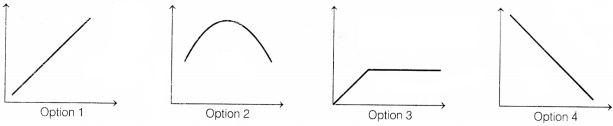
(viii) According to the passage, select the chart that is the correct depiction of the relation between incoming tourists and the temperature of the region. (1)
1. India’s average temperature has already increased by around 0.7 degrees Celsius during the 1901-2018 period due to Greenhouse gas emissions and by the end of 2100 it is expected to rise by approximately 4.4 degrees Celsius warns the first-ever climate change assessment report by the Indian government.

2. The report Assessment of Climate Change over the Indian Region prepared by the Union Ministry of Earth Sciences (MoES) warned that the rapid changes in the temperature would mean increasing stress on India’s “natural ecosystems, agricultural output and freshwater resources, while also causing escalating damage to infrastructure.” This ultimately means a serious impact on the country’s biodiversity, food, water, energy security and public health.

3. It said that several regions in India are global biodiversity hotspots with numerous endemic species of plants and animals and with the “climate changing more rapidly than usual, they may face increasing threats on account of these changes.”

4. The MoES report cautioned that by the end of 2100, the “frequency of summer (April-June) heat waves over India is projected to be 3 to 4 times higher” and the “average duration of heat-wave events is also projected to approximately double.” According to the report, the Sea Surface Temperature (SST) of the Tropical Indian Ocean has also risen by one degree Celsius, on average, during 1951-2015.

5. The rise in temperature is playing havoc with India’s rainfall which is significant for ‘India’s agriculture sector. The report noted that the summer monsoon precipitation (June to September) over India has declined by around six per cent from 1951 to 2015, with notable decreases over the Indo-Gangetic Plains and the Western Ghats. It stressed that the overall decrease of seasonal summer monsoon rainfall during the last 6-7 decades has led to an increased propensity for droughts in India.

6. “In particular, areas over Central India, South-West coast, Southern peninsula and North-Eastern India have experienced more than two droughts per decade. The area affected by drought has also increased by 1.3 per cent per decade over the same period. Climate model projections indicate a high likelihood of an increase in the frequency, intensity and area under drought conditions in India by the end of the twenty-first century,” said the MoES report.
Image

Answer the following questions, based on the passage above.

(i) Infer 3 reasons for the following, based on information in Paragraph 1. (2)
India’s average temperature has already increased by around 0.7 degrees Celsius during the 1901 – 2018 period.

(ii) Select the appropriate option to fill in the blanks. (1)
From Paragraph 5 we can infer that the ……………… in temperature has wreaked havoc on the rainfall pattern. The overall of seasonal summer monsoon rainfall during the last 6 – 7 decades has led to an increased tendency of droughts.
1. decrease
2. sufficient
3. exaggerated
4. elaborate
5. significant
6. rise Codes
(a) 6 and 1
(b) 2 and 4
(c) 3 and 2
(d) 1 and 6

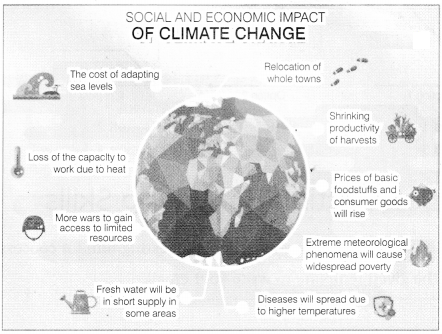
(iii) List any two social and economic impacts of climate change. (2)

(iv) Select the correct option to fill in the blank and compelete the following analogy: (1)
Rainfall : Monsoon : : : Summer
(a) Heatwave
(b) Temperature
(c) Endemic
(d) Drought

(v) List any one point how the temperature rise will affect the summer heat waves. (1)

(vi) Complete the following sentence appropriately: (1)
As per reports, an overall decrease in seasonal summer monsoon rainfall has lead to ………………

(vii) What will be the titles of the Paragraphs 1 – 3 appropriately. (1)

(viii) Select the chart that appropriately represents the drought trend with climate in India from the year 1951 to 2015, as per Paragraph 5. (1)
Image

Student Council Unveils School's First Student-Made Drone Programme

-by Tanveer Siddiqui, Secretary, Student Council

Bengaluru, Nov. 10 - The Student Council at ABC School has initiated a ground-breaking project involving the construction and operation of drones made by students. The programme was introduced at the school's monthly public presentation on November 7, attracting significant interest from students, faculty, and parents alike.
Mr. J. Rao, the school's vice-principal, and the head of the Student Council, Priya Desai, kicked off the event by explaining the motivation behind the project. They noted that the programme aims to provide students with hands-on experience in technology and engineering while promoting teamwork and creativity. The Student Council collaborated with local engineers and technology experts to ensure safety and compliance with regulations.
During the event, the council members demonstrated a live drone flight, showcasing the capabilities of the drones built by the students. They performed a variety of manoeuvres, including aerial photography and obstacle course navigation.
The Student Council has planned several future activities to keep the momentum going. These include a drone-building workshop, a photography contest using the drones, and an inter-school drone race in the spring. The programme is designed to engage students in innovative ways and foster a deeper interest in technology and engineering.

Answer the following questions, based on the report above.

I. Complete with a suitable reason.
The most likely reason why the student council secretary was chosen to draft the report was because _________ .
II. Fill in the blank with an appropriate word/ phrase.
The term 'ground-breaking' project suggests that the project is __________ and reflects a level of creativity.
III. What was the primary goal of the Student Council's drone programme at National Public School?
A. To encourage teamwork and creativity among students
B. To demonstrate the latest drone technology to the public
C. To generate interest in aerial photography
D. To promote engineering skills and provide hands-on experience
IV. Who did the Student Council turn to, to ensure safety and regulatory compliance?
1. Faculty and parents
2. Vice-Principal
3. Local Engineers
4. Head of Student Council
5. Technology experts
Select the correct option
A. Only 1    B. Only 5    C. 2 and 4    D. 3 and 5
V. What was the most likely purpose of showcasing the capabilities of the drones during the event?
VI. What in the passage suggests that the live drone demonstration aimed to engage and excite the audience? 
VII. What skills are the students expected to develop through the photography contest using drones?
VIII. Explain how the Student Council's drone programme at National Public School align with the school's goals of promoting holistic education.

Image
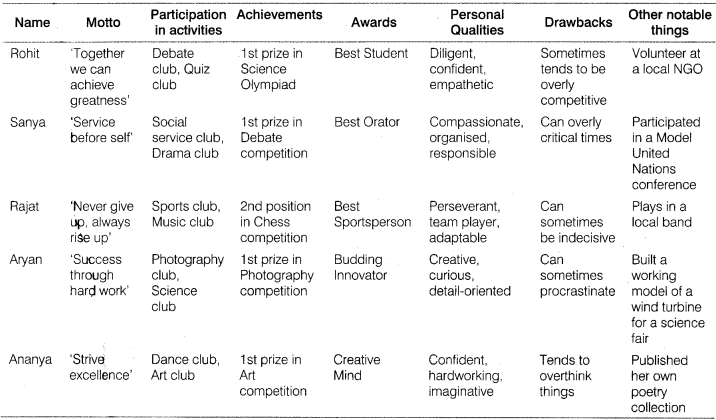
Answer the following questions, based on the table above.

1.Identify the person who is likely to ask many "why" questions, and support your choice with one reason.

2.Which house captain is most likely to struggle the most with handling stress during the school's annual inter-house sports tournament?
A. Rohit
B. Sanya
C. Rajat
D. Ananya

3.Give two justifications for Sanya being the best fit to lead a school-wide initiative to promote mental health and well-being among students.

4.Select the correct option to fill the blank and complete the analogy.
__________: paint brush:: Rajat: tabla
A. Rohit
B. Sanya
C. Aryan
D. Ananya

5.Based on the personal qualities of the House Captains, why is Rajat the most likely to be a collaborative worker?

6.Complete the given sentence with the appropriate reason, with reference to the information in the table.
We can infer that Aryan's overall performance may be negatively impacted by his weakness in time management because _____________.

7.Explain briefly why situation (b), from the three situations given below, showcases Ananya's motto, "Lead by example"?
(a) During a group project, Ananya assigns each team member specific tasks and sets a high standard for the project's quality. She tells them to actively participate in the project and take it to fruition.

(b) During a house debate competition, Ananya notices that a few of her house members are struggling to articulate their arguments effectively. Ananya takes the time to listen to their concerns and provides constructive feedback and support.

(c) During a fundraising event, Ananya volunteers to be in charge of organizing and coordinating the event but she frequently delegates tasks to others and attends to her school assignment while her team completes the task successfully.

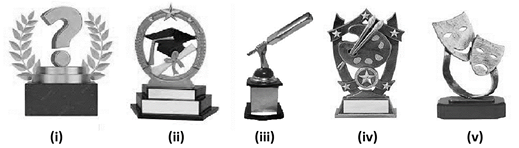
8. Select the option that correctly matches the House Captains (a) -(c), to the trophies (1)-(v).

HOUSE CAPTAINS - (a) RAJAT (b) ANANYA (c) ARYAN
Image

A. (a) (ii), (b) (i), (c) (iii)
B. (a) (i), (b) (v), (c) - (iv)
C. (a)(v), (b) (iii), (c) (ii)
D. (a) (iii), (b)- (iv), (c) (1)

FOR THE VISUALLY IMPAIRED CANDIDATES

Identify the House Captain who fits the saying-Being too hard on oneself