Question types

Grammar question types

96 questions across 11 question groups — pick any mix to generate a ENGLISH [Communicative] paper with step-by-step answer keys.

96
Questions
11
Question groups
5
Question types
Sample Questions

Grammar questions

One sample from each question group in this chapter. Select any group above to see the full set with answer keys.

A.Dirshti was young woman who had always been fascinated by the supernatural. She had read countless books and watched numerous documentaries about ghosts and otherworldly beings. So, when she heard about an abandoned hotel on the outskirts of town that was said to be haunted, she knew she had to investigate.
B.One night. Dirshti decided to sneak into the dilapidated hotel with a few of her friends. As they made their way through the dark, eerie corridors, they heard strange noises and felt cold spots. They were convinced that they were not alone.
C.Suddenly, they came across a room that was different from the rest. It was filled with old cooking equipment and strange symbols etched into the walls. Drishti felt a chill run down her spine as she entered the room. She knew that this was where the most paranormal activity occurred. As they were examining the room, they heard a loud bang coming from the hallway. They froze in fear, not knowing what was coming their way. They could hear footsteps approaching, and they knew they had to hide.
D.They quickly ducked behind some old shelves as the footsteps grew louder. The sound of breathing was getting closer and closer until finally, they saw a figure appear in the doorway. It was a man wearing a chef's hat, with a face that was twisted in a sinister smile. Drishti and her friends felt their blood run cold as the man approached them. They could feel his cold breath on their faces as he leaned in, whispering in a deep voice, "You shouldn't be here."
E.Dirshti and her friends were frozen with fear as they stared into the chef's eyes. But suddenly, the lights flickered on and the figure disappeared. They looked around the room, and everything seemed normal. They had been so scared that they hadn't realized they were in a room with faulty wiring.
F.Disappointed, they realized that their ghost hunt had been a bust. They left the hotel feeling deflated and let down. They had hoped for an exciting, spine-tingling adventure, but all they got was a scary moment caused by faulty wiring. As they drove home, they couldn't help but feel foolish for getting so worked up over nothing. They had been so convinced that they would find evidence of the paranormal that they had overlooked the simple explanation for the noises they had heard.
G.Dirshti learned an important lesson that night. Sometimes, the scariest things are the ones that we create in our own minds. She realized that she didn't need to chase after the supernatural to experience thrills and excitement. The world around her was full of mystery and wonder, and she was content to experience it without the need for ghosts and ghouls.

Answer the following questions, based on the passage above.

1.How does the setting contribute to the overall mood and atmosphere of the story?
A. It creates a sense of nostalgia.
B. It provides a sense of false security.
C. It adds to the suspense in the story.
D. It presents a contrast with the real world.

2.What is the main flaw in Drishti's approach to investigating the haunted hotel? (2)

3.What was the author's initial reaction to academic failures?
A. She was too focused on finding evidence of the paranormal.
B. She was too skeptical and refused to believe in the possibility of ghosts.
C. She relied too heavily on other people's accounts of the supernatural.
D. She didn't take enough precautions to ensure her safety.

4.After which paragraph of the story, would the following paragraph most likely be placed?
They commenced walking through the hotel, Drishti's torchlight barely illuminating the darkness around her. Suddenly, they heard a loud creaking noise behind them. Drishti whipped around, pointing her flashlight in the direction of the noise. Nothing. Shaken, they all quickened their
pace. (1)


5.Briefly explain (in 30-40 words) any two elements that classify the story as scary. (2)

6.Substitute the underlined word in the following sentence with a word/ phrase from paragraphs 4- 1 6, that means the same.
The sound of the footsteps outside the door left her petrified and the rasping breathing added to her horror.

7.What is the most significant lesson that Drishti learns from her experience in the haunted hotel? 
A. The importance of avoiding risk- taking.
B. The need to be more sceptical of the supernatural.
C. The value of evaluating your weaknesses
D. The power of imagination to create suspense.

8.Complete the following appropriately.
Based on the use of the word "dilapidated" to describe the hotel, in Paragraph 2, we can infer that its condition was  __________.

9.Complete the sentence appropriately.
If the title, The Hotel Haunting is given to this passage, it would be an inappropriate title, as compared to The Unsettling Encounter at the Abandoned Hotel because  __________.

10. State whether the given assertion is TRUE or FALSE.
The reason Drishti and her friends visited the abandoned hotel was to prove the existence of ghosts.
View full solution
1. I got posted in Srinagar in the 1980s. Its rugged mountains, gushing rivers and vast meadows reminded me of the landscapes of my native place – the Jibhi Valley in Himachal Pradesh. Unlike Srinagar that saw numerous tourists, Jibhi Valley remained clouded in anonymity. That’s when the seed of starting tourism in Jibhi was planted. I decided to leave my service in the Indian Army and follow the urge to return home.
2. We had two houses – a family house and a traditional house, which we often rented out. I pleaded with my father to ask the tenant to vacate the house so that I could convert it into a guesthouse. When my family finally relented, I renovated the house keeping its originality intact, just adding windows for sunlight.
3. I still remember the summer of 1992 when I put a signboard outside my first guesthouse in Jibhi Valley! The village residents, however, were sceptical about my success. My business kept growing but it took years for tourism to take off in Jibhi Valley. Things changed significantly after 2008 when the government launched a homestay scheme. People built homestays and with rapid tourism growth, the region also changed rapidly. Villages turned into towns with many concrete buildings. Local businesses and tourists continued putting a burden on nature.
4. Then, with the 2020-21 pandemic and lockdown, tourism came to a complete standstill in Jibhi Valley. Local people, who were employed at over a hundred homestays and guesthouses, returned to their villages. Some went back to farming, some took up pottery and some got involved in government work schemes. Now, all ardently hope that normalcy and tourism will return to the valley soon. In a way, the pandemic has given us an opportunity to introspect, go back to our roots and look for sustainable solutions.
5. For me, tourism has been my greatest teacher. It brought people from many countries and all states of India to my guesthouse. It gave me exposure to different cultures and countless opportunities to learn new things. Most people who stayed at my guesthouse became my repeat clients and good friends. When I look back, I feel proud, yet humbled at the thought that I was not only able to fulfill my dream despite all the challenges, but also to play a role in establishing tourism in the beautiful valley that I call home.    

Answer the following questions, based on the passage above.

(i) The writer mentions looking for sustainable solutions. He refers to the need for sustainable solutions because he realises that (1)

(a) even though all natural ecosystems are essential pillars of resilience, we need to focus on using their resources to address the economic needs of mankind, as a priority.
(b) the exposures to pandemics are a reality and a big threat to the countries across the world.
(c) for an economic recovery to be durable and resilient, a turn to ‘business as usual’ and environmentally destructive investment patterns and activities must be avoided.
(d) there is an increasing urgency in the climate movement and the need for collaborative action for the future.

(ii) Give a reason (in 30-40 words) for the skepticism faced by the author from the village people. (2)

(iii) What was the writer reminded of in Srinagar? (1)
(a) Home in the Jibhi Valley
(b) Landscape of the Jibhi Valley
(c) Family in the Jibhi Valley
(d) None of these

(iv) What does the author feel at the end of the passage? (1)

(v) How does the scenic beauty of Srinagar makes the writer feel? Answer in 30 – 40 words (2) 

(vi) The word is used in the passage in place of ‘doubtful’. (1)

(vii) Why did tourism become stagnant in the Jibhi Valley? (1)
(a) The valley had no attractions
(b) The 2020-21 pandemic and the eventual lockdown
(c) The writer had no idea of what needed to be done
(d) Everyone there wanted to go back to their day job

(viii) Complete the sentence appropriately. (1)
Jibhi valley was different from Srinagar ……………………

(ix) Complete the sentence appropriately. (1)
………………….. bought a change in Jibhi Valley.

(x) State whether the given assertion is True or False. (1)
The narrator left the Indian Army to convert his home town Jibhi Valley in Himachal Pradesh into a tourist destination.
View full solution
1. The advent of the digital age makes public libraries obsolete. Advancements in technology and changing cultural practices have made the traditional public libraries difficult to exist.
2. Although e-book usage has not become widespread as quickly as many anticipated with the advent of the computer, this slow adoption is beginning to accelerate with the recent development of specialised e-book readers which use electronic paper technology, such as the high-profile Amazon Kindle, which has sold tens of thousands of units. Just as consumers are moving away from hard-copy formats in music and videos, towards electronic files, the same will happen with books once e-reader technology reaches the ‘killer app’ level achieved by the iPod for music.
3. The internet is bringing about a culture where information and files are shared freely, negating the need for public institutions to hoard and distribute books. This has already been observed in music and videos; despite their best efforts, recording companies cannot stop the inevitable free sharing of data. The same process is underway with books – Project Gutenberg makes it possible to find almost any popular public domain classic free online, while Google Books is doing the same with more obscure selections.
4. The internet presents a better way to achieve the goals oi libraries than physical libraries themselves-namely free and open access to information and books. Providing free access to the internet would be a more effective way of making e-books available than building and supporting larger buildings filled with unread books. Once this fact becomes apparent to governments, it will become difficult to justify the larger relative cost of running a traditional library.
5. Furthermore, the internet has demonstrated its effectiveness for bringing people together in a social network to share preferences within a given domain. Last is a popular music sharing and discovery resource. These types of sites are popular amongst the current generation and are a likely candidate to replace the community-fostered traditional libraries. Trends indicate that traditional libraries will soon become obsolete.    

Answer the following questions, based on the passage above.

(i) What has made paper books obsolete? (1)
(a) Advancement of technology
(b) Presence of e-books
(c) Environment consciousness
(d) Both (a) and (b)

(ii) How has internet suppressed the distribution of books? What will happen once ‘e-reader’ technology reaches the ‘killer app’ level? Answer in 30 – 40 words. (2)

(iii) What helps us find any public domain classic online free of cost? (1)
(a) Google books
(b) Project Gutenberg
(c) Amazon Kindle
(d) Jstor

(iv) Is free access to internet an effective way to promote e-reading? (1)

(v) What do the trends indicate? Answer briefly in 30 – 40 words. (2)

(vi) Substitute the underlined word in the given sentence with a word from the passage which means the same. (1)

(vii) What has achieved the killer app level in music? (1)
(a) Slereoboxes
(b) ipod
(C) iphonc
(d) Radio

(viii) Complete the sentence appropriately. (1)
Internct presents a better way of achieving goals of physical library by …………………

(ix) Complete the sentence appropriately. (1)
Customer arc moving away from hard-copy formats in music because ……………..

(x) State whether the given assertion is True or False. (1)
Amazon Kindle can become the killer app.
View full solution
$1.$ Ozone is a gas in the lower level of the stratosphere. It is a kind of super$-$charged oxygen $(O_3)$. It makes a layer in the atmosphere which acts as a cover to the Earth against ultraviolet radiation of the Sun. The canopy of ozone layer is with variable extent less dense near the surface of the Earth compared to the height of $30 \ km.$
$2.$ Some pollutants in the atmosphere like Chlorofluorocarbons $\text{CFCs}$ cause the depletion of ozone layer. These $\text{CFCs}$ and other similar gases, when they reach the stratosphere, are broken down by ultraviolet radiation and as a result they liberate free atoms of chlorine or bromine. The reactions deplete the ozone layer.
$3$. Due to depletion of the ozone layer, the Earth is exposed to ultraviolet radiation. These rays cause harmful effects to living beings on the Earth. It affects the process of photosynthesis in plants due to rise in Earth’s temperature. Various skin diseases, decrease of immunity, etc. are the probable results. For protection of the ozone layer, the Vienna Conference in March, $1985$ was held. In September $1987,$ Montreal Protocol was signed. This was followed by the Kyoto Protocol of $1997.$
$4. $The Kyoto Protocol is a protocol of the United Nations Framework Convention on Climate Change $(\text{UNFCCC}$ or $\text{FCCC}),$ aimed at fighting global warming. The protocol was initially adopted on $11^{th}$ December,$ 1997$ in Kyoto, Japan, and came into force on $16^{th}$ February, $2005$. As on September $2011, 191$ states have signed and ratified the protocol.
$5.$ Under the protocol, $37$ countries commit themselves to a reduction of four Green House Gases $(GHG) ($carbon dioxide, methane, nitrous oxide, sulphur hexafluoride$) $and two groups of gases $($hydrofluorocarbons and perfluorocarbons$)$ produced by them, and all member countries give similar commitments.
$6.$ Apart from these international ramifications, various conferences and programmes are also held all over the world regularly to protect the ozone layer. $16^{th}$ September is declared as the International Day for Preservation of Ozone by the Montreal Protocol $(1987).$
Answer the following questions, based on the passage above.
$(i) $What is the extent of ozone layer in the atmosphere? $(1)$
$(a) 25 \ Km$
$(b) 30 \ Km$
$(c) 35 \ Km$
$(d) 40 \ Km$
$(ii)$ What is the effect of ozone layer depiction on animals? $(2)$
$(iii)$ What happens after the depletion of the ozone layer? $(1)$
$(a)$ The Earth is exposed to the $UV$ rays
$(b)$ Climate change and global warming
$(C)$ Extinction of species
$(d)$ All of the above
$(iv)$ How do Chlorofluorocarbons $\text{(CFCs)}$ cause depletion of the ozone layer? $(1)$
$(v)$ How are plants affected by Ozone layer depletion? $(2)$
$(vi)$ Substitute the underlined word in the sentence with a word from the passage which means the same$: (1)$
His statement revealed the owner as the true culprit.
$(vii)$ What was organised for the protection of the ozone layer? $(1)$
$(a)$ Kyoto Protocol
$(b)$ Montreal Protocol
$(c)$ Vienna Conference
$(d) \text{UNFCCC}$
$(viii)$ Complete the sentence appropriately. $(1)$
The aim of the Kyoto Protocol is $………$
$(ix)$ Complete the sentence appropriately.$(1)$
$…………$ every year is observed as the International day for Preservation of Ozone.
$(x)$ State whether the given assertion is True or False. $(1)$
The Kyoto Protocol was initially adopted in the city of Kyoto, Japan in $1997.$
View full solution
1. I saw ‘Jaws’, the popular shark movie, the summer it came out, in 1975 and became paranoid about sharks. Though I kept swimming after Jaws, it was always with the vague fear that a shark’s teeth could tug on my leg at any moment. Never mind that there’d been only two shark bites since 1900 on the Connecticut coast, where I lived.
2. So, when I got this assignment for the National Geographic magazine, I decided to accept and do what I’d never wanted to do: swim with the sharks. I had to go to a place in the Bahamas known as Tiger Beach and dive with tiger sharks, the species responsible for more recorded attacks on humans than any shark except the great white. It was to be my first dive after getting certified-which meant it would be my first dive anywhere other than a swimming pool or a quarry-and without a diver’s cage. Most people who got wind of this plan thought I was either very brave or very stupid.
|3. But I just wanted to puncture an illusion. The people who know sharks intimately tend to be the least afraid of them, and no one gets closer to sharks than divers. The divers who run operations at Tiger Beach speak lovingly of the tiger sharks the way people talk about their children or their pets. In their eyes, these sharks aren’t man-eaters any more than dogs are.
4. The business of puncturing illusions is never just black and white. My fellow divers had hundreds of dives under their belt and on the two-hour boat ride to the site in the morning of our first dive, they kept saying things like, ‘Seriously, I really can’t believe this is your first dive.’ All this was okay with me until I reached the bottom and immediately had to fend off the first tiger shark, I had ever laid eyes on. However, when I watched the other divers feeding them fish and steering them gently, it became easy to see the sharks in a very benign light.
5. I think it would be unfair not to mention that though tiger sharks are apex predators. They act as a crucial balancing force in ocean ecosystems, constraining the numbers of animals like sea turtles and limit their behaviour by preventing them from overgrazing the sea grass beds. Furthermore, tiger sharks love warm water, they eat almost anything, have a huge litter and are the hardiest shark species. If the planet and its oceans continue to warm, some species will be winners and others will be losers and tiger sharks are likely to be winners. 

Answer the following questions, based on the passage above.

(i) What does the use of the phrase ‘benign light’ suggest in the context of the writer’s viewpoint about the tiger sharks? (1)
(a) Friendly nature of sharks
(b) Baseless fear of sharks
(c) Incorrect quality associated with sharks
(d) All of these

(ii) Cite a point in evidence, from the text, to suggest that the writer’s post-Jaws fear was not justified. (2)

(iii) People thought the writer was ‘either brave or very stupid’. Why did some people think that he was’very stupid’? (1)
Answer:
Some people thought that the author was very stupid because he side-lined the popular notion that tiger sharks are dangerous and was risking his life. He was walking into obvious danger without the required expertise and could be bitten by the sharks. (iv) Which one of the following traits of the writer is evident from lines 5-10? (1)
(a) Bold
(b) Adventurous
(c) Experimental
(d) All of these

(v) Why does the writer say that people who know sharks intimately tend to be least afraid of them? (2)

(vi) Substitute the underlined word/phrase in the sentence with a word/phrase from the passage which means the same. (1)
Some academicians think that reward, as a form of discipline, is a simple right or wrong issue.

(vii) What do the tiger sharks love?
(a) Eating turtles
(b) Harming people who bother them
(c) Warm water
(d) Sea grass

(viii) Complete the sentence appropriately. (1)
The author of the given passage, wants the reader to …………………….

(ix) Complete the sentence appropriately. (1)
The writer decides to swim with the sharks because ………………….
Answer:
he wanted to puncture the illusion that sharks are vicious man-eating animals.

(x) State whether the given assertion is True or False. (1)
Tiger sharks can be called apex predators because tiger sharks restrict the number of sea turtles by feeding on them and act as a balancing force in the ecosystem.  
View full solution
Image
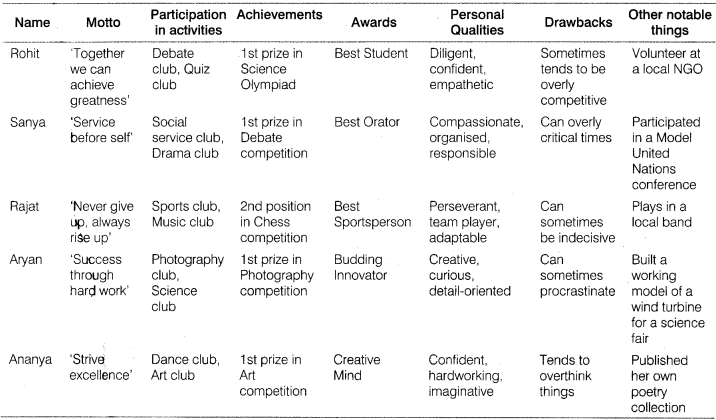
Answer the following questions, based on the table above.

1.Identify the person who is likely to ask many "why" questions, and support your choice with one reason.

2.Which house captain is most likely to struggle the most with handling stress during the school's annual inter-house sports tournament?
A. Rohit
B. Sanya
C. Rajat
D. Ananya

3.Give two justifications for Sanya being the best fit to lead a school-wide initiative to promote mental health and well-being among students.

4.Select the correct option to fill the blank and complete the analogy.
__________: paint brush:: Rajat: tabla
A. Rohit
B. Sanya
C. Aryan
D. Ananya

5.Based on the personal qualities of the House Captains, why is Rajat the most likely to be a collaborative worker?

6.Complete the given sentence with the appropriate reason, with reference to the information in the table.
We can infer that Aryan's overall performance may be negatively impacted by his weakness in time management because _____________.

7.Explain briefly why situation (b), from the three situations given below, showcases Ananya's motto, "Lead by example"?
(a) During a group project, Ananya assigns each team member specific tasks and sets a high standard for the project's quality. She tells them to actively participate in the project and take it to fruition.

(b) During a house debate competition, Ananya notices that a few of her house members are struggling to articulate their arguments effectively. Ananya takes the time to listen to their concerns and provides constructive feedback and support.

(c) During a fundraising event, Ananya volunteers to be in charge of organizing and coordinating the event but she frequently delegates tasks to others and attends to her school assignment while her team completes the task successfully.

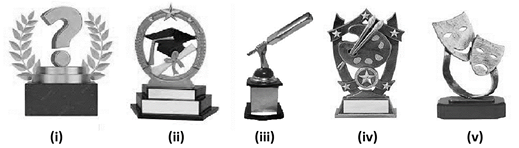
8. Select the option that correctly matches the House Captains (a) -(c), to the trophies (1)-(v).

HOUSE CAPTAINS - (a) RAJAT (b) ANANYA (c) ARYAN
Image

A. (a) (ii), (b) (i), (c) (iii)
B. (a) (i), (b) (v), (c) - (iv)
C. (a)(v), (b) (iii), (c) (ii)
D. (a) (iii), (b)- (iv), (c) (1)

FOR THE VISUALLY IMPAIRED CANDIDATES

Identify the House Captain who fits the saying-Being too hard on oneself
View full solution
1. India’s average temperature has already increased by around 0.7 degrees Celsius during the 1901-2018 period due to Greenhouse gas emissions and by the end of 2100 it is expected to rise by approximately 4.4 degrees Celsius warns the first-ever climate change assessment report by the Indian government.

2. The report Assessment of Climate Change over the Indian Region prepared by the Union Ministry of Earth Sciences (MoES) warned that the rapid changes in the temperature would mean increasing stress on India’s “natural ecosystems, agricultural output and freshwater resources, while also causing escalating damage to infrastructure.” This ultimately means a serious impact on the country’s biodiversity, food, water, energy security and public health.

3. It said that several regions in India are global biodiversity hotspots with numerous endemic species of plants and animals and with the “climate changing more rapidly than usual, they may face increasing threats on account of these changes.”

4. The MoES report cautioned that by the end of 2100, the “frequency of summer (April-June) heat waves over India is projected to be 3 to 4 times higher” and the “average duration of heat-wave events is also projected to approximately double.” According to the report, the Sea Surface Temperature (SST) of the Tropical Indian Ocean has also risen by one degree Celsius, on average, during 1951-2015.

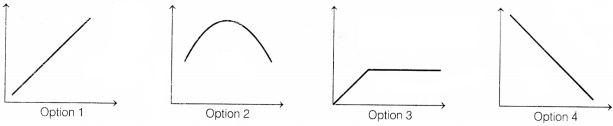
5. The rise in temperature is playing havoc with India’s rainfall which is significant for ‘India’s agriculture sector. The report noted that the summer monsoon precipitation (June to September) over India has declined by around six per cent from 1951 to 2015, with notable decreases over the Indo-Gangetic Plains and the Western Ghats. It stressed that the overall decrease of seasonal summer monsoon rainfall during the last 6-7 decades has led to an increased propensity for droughts in India.

6. “In particular, areas over Central India, South-West coast, Southern peninsula and North-Eastern India have experienced more than two droughts per decade. The area affected by drought has also increased by 1.3 per cent per decade over the same period. Climate model projections indicate a high likelihood of an increase in the frequency, intensity and area under drought conditions in India by the end of the twenty-first century,” said the MoES report.
Image

Answer the following questions, based on the passage above.

(i) Infer 3 reasons for the following, based on information in Paragraph 1. (2)
India’s average temperature has already increased by around 0.7 degrees Celsius during the 1901 – 2018 period.

(ii) Select the appropriate option to fill in the blanks. (1)
From Paragraph 5 we can infer that the ……………… in temperature has wreaked havoc on the rainfall pattern. The overall of seasonal summer monsoon rainfall during the last 6 – 7 decades has led to an increased tendency of droughts.
1. decrease
2. sufficient
3. exaggerated
4. elaborate
5. significant
6. rise Codes
(a) 6 and 1
(b) 2 and 4
(c) 3 and 2
(d) 1 and 6

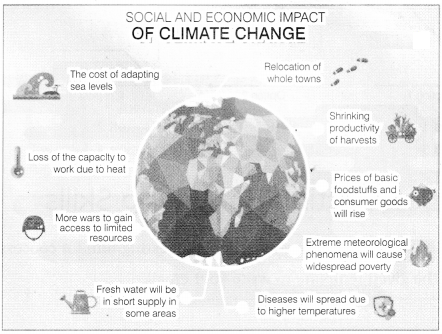
(iii) List any two social and economic impacts of climate change. (2)

(iv) Select the correct option to fill in the blank and compelete the following analogy: (1)
Rainfall : Monsoon : : : Summer
(a) Heatwave
(b) Temperature
(c) Endemic
(d) Drought

(v) List any one point how the temperature rise will affect the summer heat waves. (1)

(vi) Complete the following sentence appropriately: (1)
As per reports, an overall decrease in seasonal summer monsoon rainfall has lead to ………………

(vii) What will be the titles of the Paragraphs 1 – 3 appropriately. (1)

(viii) Select the chart that appropriately represents the drought trend with climate in India from the year 1951 to 2015, as per Paragraph 5. (1)
Image
View full solution

Study the state-wise Literacy Rate in India according to 2021 Census. (10 m)

State/Union TerritoryLiteracy rate in % (Person)Literacy rate in % (Male)Literacy rate in % (Female)
1. Kerala94.096.192.1
2. Lakshadweep91.895.687.9
3. Mizoram91.393.389.3
4. Goa88.792.684.7
5. Tripura87.291.582.7
6. Daman & Diu87.191.579.5
7. Andaman & Nicobar Island86.690.382.4
8. NCT or Delhi86.290.980.8
9. Chandigarh86.090.081.2
10. Puducherry85.891.380.7
11. Himachal Pradesh82.889.575.9
12. Maharashtra82.388.475.9
13. Sikkim81.486.675.6
14. Tamil Nadu80.186.873.4
15. Nagaland79.682.876.1
16. Manipur79.286.172.4
17. Uttarakhand78.887.470.0
18. Gujarat78.085.869.7
19. West Bengal76.381.770.5
20. Dadra & Nagar Haveli76.285.264.3
21. Punjab75.880.470.7
22. Haryana75.684.165.9
23. Karnataka75.482.568.1
24. Meghalaya74.476.072.9
25. Odisha72.981.664.0
26. Assam72.277.866.3
27. Chhattlsgarh70.380.360.2
28. Madhya Pradesh69.378.759.2
29. Uttar Pradesh67.777.357.2
30. Jammu & Kashmir67.276.356.4
31. Andhra Pradesh67.074.959.1
32. Jharkhand66.476.855.4
33. Rajasthan66.179.252.1
34. Arunachal Pradesh65.472.657.2
35. Bihar61.871.251.5

Answer the following questions, based on the table above.

(i) Discuss reasons why male literacy is higher than female literacy in India. (2)

(ii) In which state is the difference between the male literacy rate and female literacy rate highest? (1)
(a) West Bengal
(b) Bihar
(c) Rajashtan
(d) Tamil Nadu

(iii) What does the lower gap between male literacy rate and female literacy rate show? (2)

(iv) Select the correct option to fill in the blank and complete the analogy: (1)
67.2% : Literacy rate : : : Male Literacy rate
(a) 76.3%
(b) 57.2%
(c) 56.4%
(d) 51.5%

(v) Name the States/UTs with female literacy lower from 60%. (1)

(vi) Complete the given sentence appropriately. (1)
The overall literacy rate is 91.3% for ……………..

(vii) Name the State/UTs with the highest female literacy. (1)

(viii) Which of the following can be said for all states? (1)
(a) The female literacy rate is decreasing.
(b) The female literacy rate is improving.
(c) The female literacy rate is stagnant.
(d) The female literacy rate is inconsequential.

View full solution
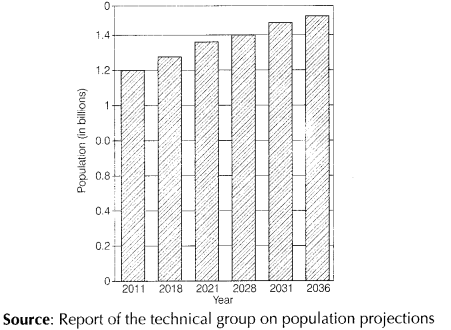
1. India’s population is expected to grow by 25%, with reference to 2011, to 1.52 billion by 2036, according to the final report of the technical group on population projections dated July 2020. The group was constituted by the National Commission on Population (NCP) under the Ministry of Health and Family Welfare with the mandate to provide population projections for the period 2011 to 2036.

2. India’s population growth rate is expected to decline to its lowest since Independence in the 2011-2021 decade, with a decadal growth rate of 12.5%. It will decline further to 8.4% in the 2021-2031 decade, as per the report, which The Wire has seen. According to these projections, India will overtake China as the world’s most populous country around 2031 – almost a decade later than the United Nations projection of 2022. India’s population is projected to increase to 1.52 billion by 2036.


Image
3. The projections have been delayed quite significantly “Ideally, they should have come by 2016. But there were delays in setting up the committee and then more delays at the government’s end even after we submitted the rcporl.We had submitted our report in November 2019,’’ said a member of the committee wishing to remain anonymous. This was confirmed by two other members as well.

4. India’s population was 1.21 billion as per the Census of 2011 and the projections now estimate that the population will grow by 311 million by 2036

5. The report projects that as much as 70% of this increase will be in urban areas. India’s urban population will increase from 377 million ¡n 2011 to 594 million in 2036 – a growth of 57%. So, while 31% of Indians were living in urban India in 2011 ,that will grow to 39% by 2036.

6. Consequently, the proportion of the rural population will decline from 69% to 61% as the urban population is projected to increase more than twice the projected increase in the rural population.

Answer the following questions, based on the passage above.

(i) What does the research in the above passage mention about rural population? (2)

(ii) The purpose of the above report was to give (1)
(a) Population projections for 2036 – 2050
(b) Population projections for 2011 – 2021
(C) Population projections for 2011 – 2036
(d) Population projections for 2031 – 2040

(iii) Infer two facts about India on the basis of your reading of the passage. (2)

(iv) Fill in the blanks with the appropriate option. (1)
This passage contains the decadal ……………… rate for the decade 2011 – 2021, which is 12.5%.
(a) growth
(b) decline
(c) stagnant
(d) fluctuating

(v) “It will decline further to 8.4% in the 2021-2031 dcca&…” What does this statement mean? (1)

(vi) Complete the sentence appropriately. (1)
The number by which the population of India is estimated to grow by 2036 is …………..

(vii) According to the passage, how much delay can be seen in India becoming the most populated country in the world as per the projections made by the UN? (1)

(viii) Why did the projections come in July of 2020? (1)
(a) Delay in setting up the committee
(b) Delay by the government
(c) Delay by the committee
(d) Both (a) and (b)
View full solution

1. Festivals are synonymous with celebration, ceremony and joy. However, festivals bring to for the flip side of celebrations – pollution – air, water, soil and noise. This led to the need of assessing the awareness level among people about ecological pollution during festivals. So, a study was conducted by scholars of an esteemed university in India. This study was titled Awareness Towards Impact of Festivals on Ecology.

2. There were two main objectives of the study. The first one was to assess the awareness level among people about ecological protection during festivities. Exploring solutions to bring awareness about celebrating festivals without harming ecology was the second objective. The method used to collect data was a simple questionnaire containing 6 1 questions, shared with 50 respondents across four selected districts of a state in the Southern region of India.

3. The research began by understanding the socio-economic conditions of the respondents before sharing the questionnaire. Once the responses were received, the data collected was tabulated (Table 1), for analysis.

Table-1: Awareness level among respondents

QuestionsYES%NO%CAN’T SAY%
1. Do you feel that bursting crackers is a must during festivities?46540
2. Do you think most people abuse environmental resources during celebration of festivals?72280
3. Do you think that celebrations and festivities result in uniting people?64324
4. Do you enjoy bursting crackers for amusement?68320
5. Do you feel pressured to burst crackers during festivals as an expectation of your social status?82126
6. Are you aware of waste segregation and disposal guidelines for better ecology?56404

4. The study recommended the imposition of strict rules and regulations as opposed to a total ban on all festive activities which have a drastic impact on our environment. The researchers believed that such measures would help in harnessing some ill-effects that add to the growing pollution and suggested further studies be taken up across the country to assess awareness about ecological degradation.

5. The observations made in the study pointed to the environmental groups and eco-clubs fighting a losing battle due to city traffic issues, disposal of plastics, garbage dumping and all sorts of ecological degradation. The researchers stressed that the need of the hour is increasing awareness among people to reduce ecological pollution which can be facilitated by celebrating all festivals in an eco-friendly manner. (291 words)

Answer the following questions, based on the passage above.

(i) What was the objective of the study mentioned in the passage? (2)
Answer:
The objective of the study mentioned in the passage is to assess how much people knew about ecological protection during festivals and to find ways to bring awareness to people about celebrating festival without harming ecology.

(ii) According to the study, what percentage of people do not enjoy bursting crackers? (1)
(a) More than half
(b) Less than half
(c) A thendred percent
(d) Only adults

(iii) Justify the researcher’s recommendation for limiting the drastic impact of festival pollution on the environment with reference to lines 16 – 21. (1)

(iv) According to the passage, festival is synonymous with ……………… (1)
(a) celebration
(b) ceremony
(c) joy
(d) All of these

(v) Even though a larger number of people say ‘no’ to bursting crackers than those who say ‘yes’, festival pollution persists. How does evidence from table 1 support this statement? (2)

(vi) Complete the sentence given below. (1)
The eco-clubs are losing the battle because ……………..

(vii) Comment on the significance of the second objective of the study with reference to lines 7 – 12. (1)

(viii) Which of the following was NOT recommended by the study? (1)
(a) Imposition of strict rules
(b) A total ban on festive activities
(c) Punishment for the violators of the regulations
(d) Both (a) and (c)

View full solution
View full solution

Write an email to the Principal of your school requesting him for concession in fee. (3) You may copy the given template to write your email.

From : 
To : 
Cc : 
Date : 
Subject:
View full solution

Write an email to the Principal of your school requesting him to grant you five-days leave to attend your sister’s marriage. (3)
You may copy the given template to write your email.

From : 
To : 
Cc : 
Date : 
Subject:
View full solution
Write an application, in not more than 50 words, requesting permission to use the school transport to attend a tree plantation volunteering event. You are Lakshit Pandey, Class X-C, Vice-President, Ecology Club.
View full solution
Write a descriptive paragraph on your role model based on the clues given below, in not more than 100 words.
Name of the role model – why do you admire him/her-his/ her qualities that appeal to you the most-his/ her, traits, achievements etc
View full solution
You are a sports scout. Write a letter to the Governor of your region, drawing attention to the need for creating and upgrading sport facilities and following practices to enable the local / indigenous sporting talent from your city, to hone their skills. Include specific recommendations. Write the letter in not more than 120 words using ideas from Unit 1: Health and Medicine, along with your own.
View full solution
Write a letter to the librarian, City Library, in not more than 120 words, for purchase and addition of popular fiction and non-fiction titles in Braille and also the intake of audio books, to promote inclusion. You are an NGO employee, from the same city. You may use ideas from Unit 2: Education, along with your own ideas to write this letter.
View full solution
Write a letter to the principal of your school to request him/her to introduce co curricular . activities at regular intervals. Write a letter in not more than 120 words using ideas from MCB Unit 2 : Education.
View full solution
Big and lavish Indian weddings have become a common sight. And with that we are used to the large scale wastage of food in a country that hosts one of the biggest armies of starving people in the world. Write a letter to the editor of a local daily on the colossal wastage of food in the lavish Indian weddings based on MCB Unit: 4 Environment. You are Surbhi. (120 words)
View full solution
The main park in your locality is in a state of utter neglect. The gates of the park are broken and the greenery has almost vanished. The employees responsible for the upkeep of the park are seldom seen doing their assigned duties. Write a letter to the Director, Horticulture Department, Meerut, complaining about the problem and requesting him to take appropriate action. You are Brij Kishore/Gopa, a resident of Kishore Nagar, Meerut. You may use ideas from MCB Unit 4 : Environment.
View full solution

Space tourism, though in its early stages, is a reality. As Jagmeet Singh of Class X – D, write an article for your school magazine, in about 150 words, discussing the opportunities and challenges of space tourism, the ethical considerations surrounding it and how it might impact society. Use the given cues, along with your own ideas and those you may have gathered from Unit 3 : Science, to create this article.

• Safety concerns and potential accidents in space tourism 
• Space debris and the need for responsible space traffic management
• Turning space in a commodity : the ethics of commercialising space
• Ensuring equality and access to space tourism opportunities
• Promoting responsible an sustainable practices in space tourism
• Balancing economic opportunities with environmental and social responsibility
View full solution
Some people prefer solo travel, while others enjoy travelling in a group. As Hema Joseph of class X-C, write an article for your school magazine, in about 150 words, discussing the advantages and disadvantages of each preference and examining the factors that influence these choices.
Use the given cues, along with your own ideas and those you may have gathered from Unit 5:
Travel and Tourism, to create this article.
*How can loneliness and safety concerns impact solo travel?
*What are some factors that can make solo travel more expensive?
*How does travelling alone allow for personal growth and discovery?
*"What are some advantages of being able to choose your itinerary and pace?
 
*"How can conflicts and disagreements arise when travelling with others?
*"What are some factors that can limit independence and freedom when travelling with a group?
*"How does travelling with others provide opportunities to make friends?
*"What are some ways that group travel can be more cost-effective?
 
*How can personality type influence travel preferences?
*How does budget impact travel choices?
*"What role does the destination play in determining travel preferences?
View full solution
Now-a-days, students attend coaching classes early in the morning or after school hours. You feel that this trend makes them tired, affects their health and so their grades. Write an article to make the students understand how this is not very helpful in improving their grades and is a waste of their precious time, in about 150 words. You are Ram /Rani. Use the given clues along with your own ideas and those you have gathered from Unit 2 : Education.
  • Trend of coaching classes
  • Lack of proper guidance by schools and parents
  • 111 effects of continously studying in coaching classes
  • No time for recreation or physical activities
View full solution
Write an article on how we can make India a carefree and enjoyable place for women where they can go wherever they like to without any fear of being stared at, molested or discriminated against, in about 150 words. Use the given clues, along with your own ideas and those you have gathered from Unit 6 : National Integration. (8)
  • Women are suppressed
  • Issue of women’s safety
  • Safety issue at home as well as workplace
  • Need of strict laws
View full solution
The recent killing of Avni, the tigress which had two 10-month-old cubs has disturbed you. You realise that human encroachment and the greed of land grabbing companies are the cause of this. Write an article to be published in ‘The National Times’ about your concern and the need to take urgent action to stop the decline in the number of tigers in India, in about 150 words. Use the given clues along with your own ideas and those that you have gathered from Unit 4 : Environment.Clues
  • Human selfishness
  • Illegal killings
  • Lack of awareness
  • Corrupt authorities
  • Need for conservation and preservation
View full solution
Time travel (i)_______ ( ought to /should/ could) become a reality in the near future, (ii)________ (allows/ allowed/ allowing) human beings to experience the thrill of travelling back or forward in time.
However, (iii) ________(most/ many/ much) challenges must be overcome, such as ensuring safety and affordability for all potential time-travellers.
View full solution
The train (i) …………….. (arrive/arrived/will arrive) in Mumbai at three o’clock. Vicky got off (ii) ……………. (a/the/No article) train and (iii) …………….. (hurry/hurrying/hurried) across the platform. He gave his ticket to the TT by the gate and ran out.
View full solution
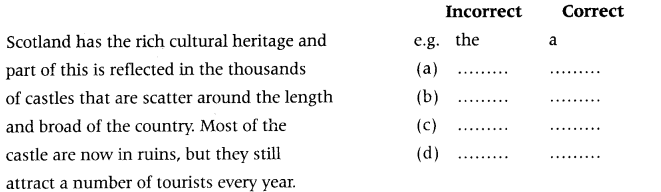
Several studies have found that people who (i) …………….. (regular/regularise/regularly) engage in challenging activites, like reading, doing crossword puzzles or playing chess
(ii) …………….. (seems/seem/seam) less likely to develop dementia (iii) ………………….. (latter/late/later) in life.
View full solution
(i) ……………….. (A/An/The) true sportsman has high sense of team spirit. He (ii) ……………… (will/can/may) never bow down in the face of (iii) …………… (adverse/adversity/adversely).
View full solution
Humans have always (i) ………………. (think/thought/thinking) of the moon as living being. In earlier times, it was seen that it had always been changing. As it was the brightest point in the dark sky, humans watched and wondered why it (ii) ……………….. (change/was changing/changed) Humans (iii) ………………. (was/had/were) always afraid of the dark, so the bright light was both welcome and mysterious.
View full solution

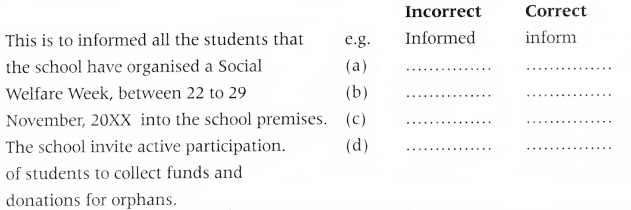
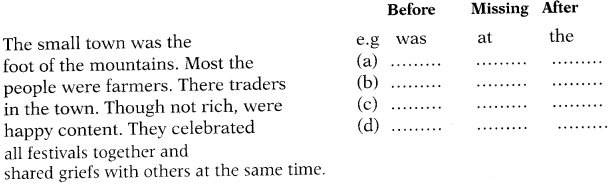
In the following paragraph, one word has been omitted in each line. In your answer sheets, remember to write the missing word along with the word that comes before and after it, as shown below. The first one has been done as an example.

No. Text Word before Omission Word after
e.g. Ever wondered sleep deficit? Well, wondered about sleep
i sleep deficit a common problem among      
  teenagers today, with many staying up late  
ii to use electronic devices. This lead to      
iii difficulty in concentrating, mood swings, even      
v It's important for teens to prioritize sleep      
  to ensure their overall health and well-being.  
View full solution
Did you know that the lack of hydrological resources affects more than 40% of the world population?
No, I didn't. What are hydrological resources?
* WATER RESOURCES, / SURVIVAL / AND PLANT / TO HUMAN, / ANIMAL, / REFER TO / WHICH / ARE VITAL/HYDROLOGICAL RESOURCES
View full solution
Photographer: I want to use a drone for photographing your event.
Customer: Really! Do you usually offer this advice?
Photographer: No. I don't. Your event is in an open and picturesque area and I want to capture the complete scene.
The photographer told the customer that she wanted to use a drone for photographing his event. The customer exclaimed in surprise and asked ________negative and shared that _________The photographer replied in the as his event was in an open and picturesque area.
View full solution
Charlie : Dear Santa, here is a list if what I want.
Patty : How do you suppose Santa Claus can afford to give away all those toys?
Charlie : Promotion! Don’t kid yourself Everything these days is promotion! I will bet if the truth were brought about, you will find that he’s being financed by
some big eastern chain!

While making the list of what Charlie wanted from Santa Claus, he asked Patty how ………………… (a) …………… all those toys. She said that ……………. (b) ……………… and that it was possible as Santa was being financed by some big eastern chain.
View full solution
Mom : Tomorrow is Diwali, so I am going to the market. Do you want anything?
Shreya : Shall I come along, mom?
Mom : No Shreya, I want you to do some cleaning.
Mom told her daughter Shreya that (a) ………………. she also asked Shreya (b) ……………… Shreya asked if she could come along with her, to this Mom replied in negative and added that she wanted her to do the cleaning.
View full solution

Generate a Grammar paper free

Pick question groups from the list above, set marks and difficulty, and export a branded PDF with step-by-step answer keys. First 3 chapters free — no signup.

Download App