MCQ
Substance on the choroid is
  • A
    Japan black
  • Nigrim pigment
  • C
    Carbon black
  • D
    Platinum black

Answer

Correct option: B.
Nigrim pigment
b
The Choroid contains the retinal pigmented epithelial cells which have the Nigrim pigments and they provide oxygen and nourishment to the outer retina

Need a full question paper?

Generate a complete, print-ready paper with questions like this in minutes — across 16+ boards, with answer keys.
Start Generating Free

Similar questions

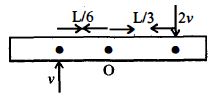
A thin uniform bar of length $L$ and mass $8\,m$ lies on a smooth horizontal table. Two point masses $m$ and $2\,m$ moving in the same horizontal plane from opposite sides of the bar with speeds $2v$ and $v$ respectively. The masses stick to the bar after collision at a distance $\frac{L}{3}$ and $\frac{L}{6}$ respectively from the centre of the bar. If the bar starts rotating about its center of mass as a result of collision, the angular speed of the bar will be
A charged cork of mass $m$ suspended by a light string is placed in uniform electric filed of strength $E= $$(\hat i + \hat j)$ $\times$ $10^5$ $NC^{-1}$ as shown in the fig. If in equilibrium position tension in the string is $\frac{{2mg}}{{(1 + \sqrt 3 )}}$ then angle $‘\alpha ’ $ with the vertical is
A body of mass $2\, kg$ moving on a horizontal surface with an initial velocity of $4 \,m/sec$ comes to rest after $2\, sec$. If one wants to keep this body moving on the same surface with a velocity of $4\, m/sec$, the force required is ........ $N$
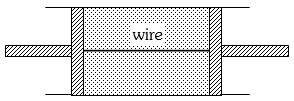
A cylindrical tube of uniform cross-sectional area $A$ is fitted with two air tight frictionless pistons. The pistons are connected to each other by a metallic wire. Initially the pressure of the gas is $P_0$ and temperature is $T_0$, atmospheric pressure is also $P_0$. Now the temperature of the gas is increased to $2T_0$, the tension in the wire will be
Scientists are working hard to develop nuclear fusion reactor. Nuclei of heavy hydrogen, ${ }_1^2 \mathrm{H}$, known as deuteron and denoted by $\mathrm{D}$, can be thought of as a candidate for fusion reactor. The $D-D$ reaction is ${ }_1^2 \mathrm{H}+{ }_1^2 \mathrm{H} \rightarrow{ }_2^3 \mathrm{He}+n+$ energy. In the core of fusion reactor, a gas of heavy hydrogen is fully ionized into deuteron nuclei and electrons. This collection of ${ }_1^2 \mathrm{H}$ nuclei and electrons is known as plasma. The nuclei move randomly in the reactor core and occasionally come close enough for nuclear fusion to take place. Usually, the temperatures in the reactor core are too high and no material wall can be used to confine the plasma. Special techniques are used which confine the plasma for a time $t_0$ before the particles fly away from the core. If $n$ is the density (number/volume) of deuterons, the product $n t_0$ is called Lawson number. In one of the criteria, a reactor is termed successful if Lawson number is greater than $5 \times 10^{14} \mathrm{~s} / \mathrm{cm}^3$.

It may be helpful to use the following: Boltzmann constant $k=8.6 \times 10^{-5} \mathrm{eV} / \mathrm{K}$; $\frac{e^2}{4 \pi \varepsilon_0}=1.44 \times 10^9 \mathrm{eVm}$.

$1.$ In the core of nuclear fusion reactor, the gas becomes plasma because of

$(A)$ strong nuclear force acting between the deuterons

$(B)$ Coulomb force acting between the deuterons

$(C)$ Coulomb force acting between deuteron-electron pairs

$(D)$ the high temperature maintained inside the reactor core

$2.$ Assume that two deuteron nuclei in the core of fusion reactor at temperature $T$ are moving towards each other, each with kinetic energy $1.5 \mathrm{kT}$, when the separation between them is large enough to neglect Coulomb potential energy. Also neglect any interaction from other particles in the core. The minimum temperature $T$ required for them to reach a separation of $4 \times 10^{-15} \mathrm{~m}$ is in the range

$(A)$ $1.0 \times 10^9 \mathrm{~K}$ $(B)$ $2.0 \times 10^9 \mathrm{~K}$ $(C)$ $3.0 \times 10^9 \mathrm{~K}$ $(D)$ $4.0 \times 10^9 \mathrm{~K}$

$3.$ Results of calculations for four different designs of a fusion reactor using $D-D$ reaction are given below. Which of these is most promising based on Lawson criterion?

$(A)$ deuteron density $=2.0 \times 10^{12} \mathrm{~cm}^{-3}$, confinement time $=5.0 \times 10^{-3} \mathrm{~s}$

$(B)$ deuteron density $=8.0 \times 10^{14} \mathrm{~cm}^{-3}$, confinement time $=9.0 \times 10^{-1} \mathrm{~s}$

$(C)$ deuteron density $=4.0 \times 10^{23} \mathrm{~cm}^{-3}$, confinement time $=1.0 \times 10^{-11} \mathrm{~s}$

$(D)$ deuteron density $=1.0 \times 10^{24} \mathrm{~cm}^{-3}$, confinement time $=4.0 \times 10^{-12} \mathrm{~s}$

Give the answer question $1,2,$ and $3.$

Match List $- I$ (Electromagnetic wave type) with List $- II$ (Its association/application) and select the correct option from the choices given below the lists

  લિસ્ટ$-I$   લિસ્ટ$-II$
$a$. Infrared waves $i$. To treat muscular strain
$b$. Radio waves $ii$. For broadcasting
$c$. $X-$rays $iii$. To detect fracture of bones
$d$. Ultraviolet rays $iv$. Absorbed by the ozone layer of the atmosphere

$a$         $b$         $c$         $d$

A reaction between a proton and $_8{O^{18}}$ that produces $_9{F^{18}}$ must also liberate
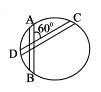
A disc arranged in a vertical plane has two groves of same length directed along the vertical chord $AB$ and $CD$ as shown in the fig. The same particles slide down along $AB$ and $CD$. The ratio of the time $t_{AB}/t_{CD}$ is
The wavelength $\lambda_e$ of an electron and $\lambda_p$ of a photon of same energy $E$ are related by 
The maximum velocity of a particle, executing simple harmonic motion with an amplitude $7\ mm$, is $4.4\ m/s$. The period of oscillation is .... $sec$