MCQ
Successive alkanes differ by
  • $>C{H_2}$
  • B
    $>CH$
  • C
    $ - \,\,C{H_3}$
  • D
    ${C_2}{H_4}$

Answer

Correct option: A.
$>C{H_2}$
a
successive members differ in mass by an extra methylene bridge $\left(- CH _2-\right.$ unit) inserted in the chain.

Need a full question paper?

Generate a complete, print-ready paper with questions like this in minutes — across 16+ boards, with answer keys.
Start Generating Free

Similar questions

Name the two type of the structure of silicate in which one oxygen atom of $[SiO_4]^{4-}$ is shared ?
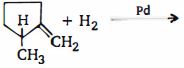
Product of the above reaction will be
Which of the following compounds has a zero dipole moment ?
The $IUPAC$ name of $\begin{matrix}
   \,\,\,\,\,\,\,\,\,\,\,\,\,\,\,\,\,\,\,\,\,\,\,\,\,\,\,\,\,\,\,\,\,\,\,\,\,\,\,\,\,\,\,\,\,\,\,\,\,\,\,\,\,\,\,\,\,C{{H}_{3}}\,  \\
   \,\,\,\,\,\,\,\,\,\,\,\,\,\,\,\,\,\,\,\,\,\,\,\,\,\,\,\,\,\,\,\,\,\,\,\,\,\,\,\,\,\,\,\,\,\,\,\,\,\,|  \\
   C{{H}_{3}}-C{{H}_{2}}-CH-CH-C-C{{H}_{3}}  \\
   \,\,\,\,\,\,\,\,\,\,\,\,\,\,\,\,\,\,\,\,\,|\,\,\,\,\,\,\,\,\,\,\,\,\,|\,\,\,\,\,\,\,\,\,\,\,\,|\,  \\
   \,\,\,\,\,\,\,\,\,\,\,\,\,\,\,\,\,\,\,\,\,\,\,Cl\,\,\,\,\,\,\,\,C{{H}_{3}}\,\,\,OH  \\
\end{matrix}$ is
Products of the following reaction   $C{H_3}C \equiv \,C\,C{H_2}C{H_3}\mathop {\xrightarrow[{(2)\;Hydrolysis}]{}}\limits^{(1)\;\;{O_3}} $   ....... are
When acetylene reacts with arsenic trichloride in the presence of anhydrous aluminium chloride, it produces
Which of the following statement(s) is/are correct with reference to $Fe^{2+}$ and $Fe^{3+}$ ions ?

$(1)$ $Fe^{3+}$ gives brown colour with potassium ferricyanide

$(2)$ $Fe^{2+}$ gives blue colour with potassium ferricyanide

$(3)$ $Fe^{3+}$ gives red colour with potassium thiocyanate

$(4)$ $Fe^{2+}$ gives brown colour with ammonium thiocyanate
The electron affinity of $Be$ is similar to :-
Rearrange the following ( $I$ to $IV$ ) in the order of increasing masses
$(I)\,0.5$ mole of $O_3$
$(II)\,0.5\,gm$ atoms of oxygen
$(III)\,3.011 \times 10^{23}$ molecules of $O_2$
$(IV)\,5.6$ litre of $CO_2$ at $STP$
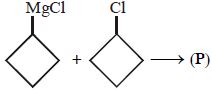
Compound $(P)$ is