Question
Suggest a method to produce a rainbow in your house.

Answer

A rainbow can be produced using a prism. Another way of producing a rainbow is to dip a mirror inside water, keeping it inclined along the wall of a tumbler. The light coming from water after reflecting from the mirror will give a rainbow.

Need a full question paper?

Generate a complete, print-ready paper with questions like this in minutes — across 16+ boards, with answer keys.

Start Generating Free

Similar questions

On the basis of energy band theory, write the difference between conductor, insulator and semiconductor.
The potential difference across the terminals of a battery of emf 12V and internal resistance $2\Omega$ drops to 10V when it is connected to a silver voltameter. Find the silver deposited at the cathode in half an hour. Atomic weight of silver is 107.9g/mole.
A plane electromagnetic wave travels in vacuum along z-direction. What can you say about the directions of its electric and magnetic field vectors? If the frequency of the wave is 30 MHz, what is its wavelength?
Explain the effect of dielectric on the capacitance of parallel plate capacitor and derive the equation of dielectric constant.
Let $\vec{\text{a}}=4\vec{\text{i}}+3\vec{\text{j}}$ and $\vec{\text{b}}=3\vec{\text{i}}+4\vec{\text{j}}.$ (a) Find the magnitudes of:

  1. $\vec{\text{a}}$

  2. $\vec{\text{b}}$

  3. $\vec{\text{a}}+\vec{\text{b}}$

  4. $\vec{\text{a}}-\vec{\text{b}}$

A driver takes 0.20s to apply the brakes after he sees a need for it. This is called the reaction time of the driver. If he is driving a car at a speed of 54km/h and the brakes cause a deceleration of 6.0m/s2, find the distance travelled by the car after he sees the need to put the brakes on.
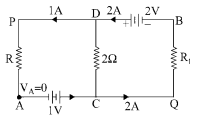
In the given figure, point A is at zero potential. Use Kirchhoff's rules to find out the potential at B.
Image
A spherical surface of radius 30cm separates two transparent media A and B with refractive indices 1.33 and 1.48 respectively. The medium A is on the convex side of the surface. Where should a point object be placed in medium A so that the paraxial rays become parallel after refraction at the surface?
Describe/Explain single slit diffraction using a simple day to day life example.
###
Describe a simple experiment (/activity) to see single slit diffraction.
Plot a graph showing variation of de-Broglie wavelength $\lambda$ versus $\frac{1}{\sqrt{V}} ,$ where V is accelerating potential for two particles A and B carrying same charge but of masses m1, m2 (m1 > m2). Which one of the two represents a particle of smaller mass and why?