Question
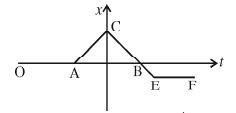
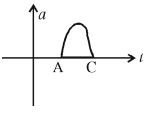
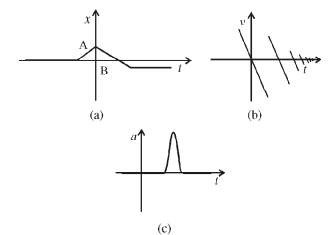
Suggest a suitable physical situation for each the following graphs (Fig.).
Image

Need a full question paper?

Generate a complete, print-ready paper with questions like this in minutes — across 16+ boards, with answer keys.
Start Generating Free

Similar questions

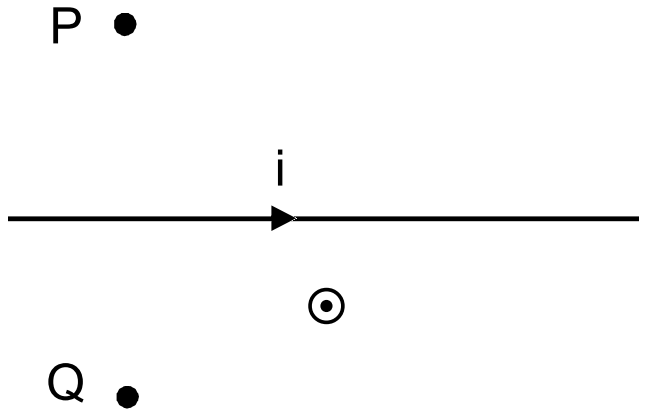
A long, straight wire carrying a current of 1.0A is placed horizontally in a uniform magnetic field B = 1.0 × 10⁻⁵T pointing vertically upward figure. Find the magnitude of the resultant magnetic field at the points Pand Q, both situated at a distance of 2.0cm from the wire in the same horizontal plane.

The time taken by Mars to revolve round the sun is 1.88 years. Find the ratio of average distance between Mars and the sun to that between the earth and the sun.
Experiments show that the frequency (n) of a tuning fork depends upon the length (l) of the prong, the density (d) and the Young's modulus (Y) of its material. From dimensional considerations, find a possible relation for the frequency of a tuning fork.
A man has to go 50m due north, 40m due east and 20m due south to reach a field.
  1. What distance he has to walk to reach the field?
  2. What is his displacement from his house to the field?
A hydraulic automobile lift is designed to lift cars with a maximum mass of 3000kg. The area of cross-section of the piston carrying the load is 425cm2. What maximum pressure would the smaller piston have to bear?
When an apple falls from a tree what happens to its gravitational potential energy just as it reaches the ground? After it strikes the ground?
100 g of water is supercooled to -10°C. At this point, due to some disturbance mechanised or otherwise some of it suddenly freezes to ice. What will be the temperature of the resultant mixture and how much mass would freeze?
[Sw = 1cal/ g/°C and LWFusion = 80cal/ g]
A block of metal of mass 50 g when placed over an inclined plane at an angle of $15^{\circ}$ slides down without acceleration. If the inclination is increased by $15^{\circ}$, what would be the acceleration of the block?
A particle starts rotating from rest and displaces according to the formula.
$\theta=\frac{3\text{t}^3}{20}-\frac{\text{t}^2}{3}$
Calculate the angular velocity and angular acceleration at the end of 5sec.
Consider two pairs of neutrons. In each pair, the separation between the neutrons is the same. Can the force between the neutrons have different magnitudes for the two pairs?