Question
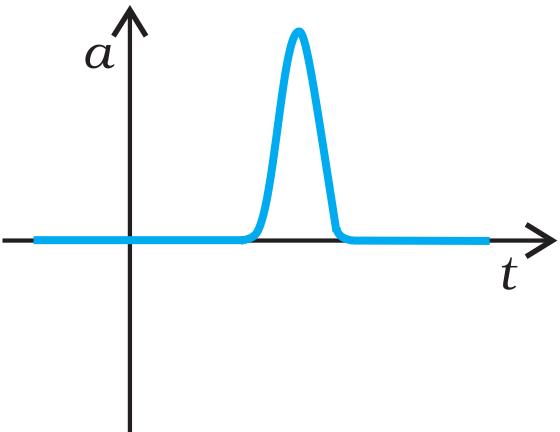
Suggest a suitable physical situation for of the following graphs.

Answer

The given a-t graph reveals that initially the body is moving with a certain uniform velocity. Its acceleration increases for a short interval of time, which again drops to zero. This indicates that the body again starts moving with the same constant velocity. A similar physical situation arises when a hammer moving with a uniform velocity strikes a nail.

Need a full question paper?

Generate a complete, print-ready paper with questions like this in minutes — across 16+ boards, with answer keys.
Start Generating Free

Similar questions

What is the energy required for 1gm of ice to become steam?
A man moves on a straight horizontal road with a block of mass 2kg in his hand. If he covers a distance of 40m with an acceleration of 0.5m/s2, find the work done by the man on the block during the motion.
A hammer of mass 1kg strikes on the head of a nail with a velocity of 10m s-17.It drives the nail 1cm into a wooden block. Calculate the force applied by the hammer and the time of impact.
The potential difference between the terminals of a 6.0V battery is 7.2V when it is being charged by a current of 2.0A. What is the internal resistance of the battery?
If the temperature of a substance is $-50^{\circ}\text C $ centigrade scale, then find its tempeature on (i) Fahrenheit and (ii) Kelvin scale.
Two particles of equal mass 'm' go round a circle of radius R, under the action of their mutual gravitational attraction. What is the speed of each particle?
In which of the following examples of motion, can the body be considered approximately a point object:
A railway carriage moving without jerks between two stations.
A famous relation in physics relates 'moving mass' $m$ to the 'rest mass' $m_0$ of a particle in terms of its speed $v$ and the speed of light, $c$. (This relation first arose as a consequence of special relativity due to Albert Einstein). A boy recalls the relation almost correctly but forgets where to put the constant $c$. He writes :
$
m=\frac{m_0}{\left(1-v^2\right)^{1 / 2}}
$
Guess where to put the missing $c$.
What is the physical reason to take both +1 and -1 as the cosine maxima in beats formation?
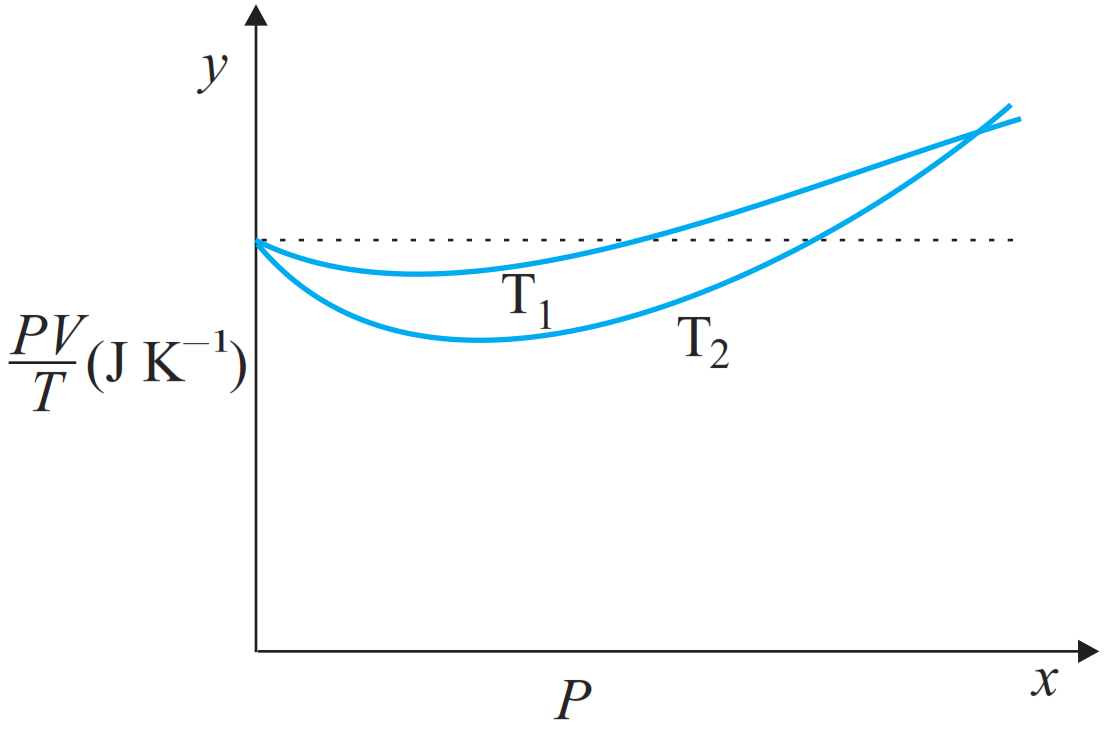
Shows plot of $\frac{\text{PV}}{\text{T}}$ versus P for 1.00 × 10⁻³kg of oxygen gas at two different temperatures:
Which is true, T1 > T2 or T1 < T2?