MCQ
Suppose A and B are the coefficients of $30^{\text {th }}$ and $12^{\text {th }}$ terms respectively in the binomial expansion of $(1+x)^{2 n-1}$. If $2 A=5 B$, then $n$ is equal to:
- A22
- ✓21
- C20
- D19
Generate a complete, print-ready paper with questions like this in minutes — across 16+ boards, with answer keys.
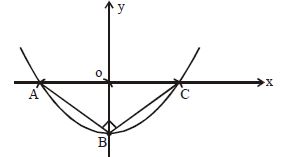
$\Delta ABC$ is right angled osceles triangle with hypotenuse $AC = 4\sqrt 2\ units$ then minimum value of $ax^2 + bx + c$ is