MCQ 14 Marks
Let the position vectors of three vertices of a triangle be $4 \overrightarrow{\mathrm{p}}+\overrightarrow{\mathrm{q}}-3 \overrightarrow{\mathrm{r}},-5 \overrightarrow{\mathrm{p}}+\overrightarrow{\mathrm{q}}+2 \overrightarrow{\mathrm{r}}$ and $2 \vec{p}-\vec{q}+2 \vec{r}$. If the position vectors of the orthocenter and the circumcenter of the triangle are $\frac{\overrightarrow{\mathrm{p}}+\overrightarrow{\mathrm{q}}+\overrightarrow{\mathrm{r}}}{4}$ and $\alpha \overrightarrow{\mathrm{p}}+\beta \overrightarrow{\mathrm{q}}+\gamma \overrightarrow{\mathrm{r}}$ respectively, then $\alpha+2 \beta+5 \gamma$ is equal to:
Answer(A)
Sol. We know that
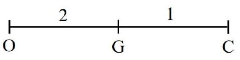
O (orthocentre) $\frac{\overrightarrow{\mathrm{p}}+\overrightarrow{\mathrm{q}}+\overrightarrow{\mathrm{r}}}{4}$
C (circum centre) $\alpha \overrightarrow{\mathrm{p}}+\beta \overrightarrow{\mathrm{q}}+\gamma \overrightarrow{\mathrm{r}}$
$C($ centroid $)=\frac{\overrightarrow{\mathrm{p}}+\overrightarrow{\mathrm{q}}+\overrightarrow{\mathrm{r}}}{3}$
by relation
$\Rightarrow 2(\alpha \overrightarrow{\mathrm{p}}+\beta \overrightarrow{\mathrm{q}}+\gamma \overrightarrow{\mathrm{r}})+\frac{\overrightarrow{\mathrm{p}}+\overrightarrow{\mathrm{q}}+\overrightarrow{\mathrm{r}}}{4}=3\left(\frac{\overrightarrow{\mathrm{p}}+\overrightarrow{\mathrm{q}}+\overrightarrow{\mathrm{r}}}{3}\right)$
$\Rightarrow 8(\alpha \vec{p}+\beta \overrightarrow{\mathrm{q}}+\gamma \overrightarrow{\mathrm{r}})=3(\overrightarrow{\mathrm{p}}+\overrightarrow{\mathrm{q}}+\overrightarrow{\mathrm{r}})$
$\Rightarrow 8 \alpha=3,8 \beta=3,8 \gamma=3$
$\alpha=\frac{3}{8}, \beta=\frac{3}{8}, \gamma=\frac{3}{8}$
$\therefore \alpha+2 \beta+3 \gamma$
$\frac{3}{8}+\frac{6}{8}+\frac{15}{8}=\frac{24}{8}=3$ View full question & answer→MCQ 24 Marks
Let $\mathrm{f}:(0, \infty) \rightarrow \mathbf{R}$ be a function which is differentiable at all points of its domain and satisfies the condition $x^{2} f^{\prime}(x)=2 x f(x)+3$, with $f(1)=4$. Then $2 f(2)$ is equal to:
Answer(C)
Sol. $x^{2} f^{\prime}(x)-2 x f(x)=3$
$\left(\frac{x^{2} f^{\prime}(x)-2 x f(x)}{\left(x^{2}\right)^{2}}\right)=\frac{3}{\left(x^{2}\right)^{2}}$
$\Rightarrow \frac{\mathrm{d}}{\mathrm{dx}}\left(\frac{\mathrm{f}(\mathrm{x})}{\mathrm{x}^{2}}\right)=\frac{3}{\mathrm{x}^{4}}$
Integrating both sides
$\frac{f(x)}{x^{2}}=-\frac{1}{x^{3}}+C$
$f(x)=-\frac{1}{x}+C x^{2}$
put $\mathrm{x}=1$
$4=-1+C \Rightarrow C=5$
$f(x)=-\frac{1}{x}+5 x^{2}$
Now $2 \times f(2)=2 \times\left[-\frac{1}{2}+5 \times 2^{2}\right]$
$=39$
View full question & answer→MCQ 34 Marks
If $\alpha>\beta>\gamma>0$, then the expression
$\cot ^{-1}\left\{\beta+\frac{\left(1+\beta^{2}\right)}{(\alpha-\beta)}\right\}+\cot ^{-1}\left\{\gamma+\frac{\left(1+\gamma^{2}\right)}{(\beta-\gamma)}\right\}$
$+\cot ^{-1}\left\{\alpha+\frac{\left(1+\alpha^{2}\right)}{(\gamma-\alpha)}\right\}$ is equal to:
Answer(D)
Sol. $\Rightarrow \cot ^{-1}\left(\frac{\alpha \beta+1}{\alpha-\beta}\right)+\cot ^{-1}\left(\frac{\beta \gamma+1}{\beta-\gamma}\right)+\cot ^{-1}\left(\frac{\alpha \gamma+1}{\gamma-\alpha}\right)$
$\Rightarrow \tan ^{-1}\left(\frac{\alpha-\beta}{1+\alpha \beta}\right)+\tan ^{-1}\left(\frac{\beta-\gamma}{1+\beta \gamma}\right)+\pi+\tan ^{-1}\left(\frac{\gamma-\alpha}{1+\gamma \alpha}\right)$
$\Rightarrow\left(\tan ^{-1} \alpha-\tan ^{-1} \beta\right)+\left(\tan ^{-1} \beta-\tan ^{-1} \gamma\right)+\left(\pi+\tan ^{-1} \gamma-\tan ^{-1} \alpha\right)$
$\Rightarrow \pi$
View full question & answer→MCQ 44 Marks
The function $f:(-\infty, \infty) \rightarrow(-\infty, 1)$, defined by $f(x)=\frac{2^{x}-2^{-x}}{2^{x}+2^{-x}}$ is :
Answer(A)
Sol. $f(x)=\frac{2^{2 x}-1}{2^{2 x}+1}$
$=1-\frac{2}{2^{2 \mathrm{x}}+1}$
$f^{\prime}(x)=\frac{2}{\left(2^{2 x}+1\right)^{2}} \cdot 2 \cdot 2^{2 x} \cdot \ln 2$ i.e always $+v e$
so $f(x)$ is $\uparrow$ function
$\therefore \mathrm{f}(-\infty)=-1$
$f(\infty)=1$
$\therefore \mathrm{f}(\mathrm{x}) \in(-1,1) \neq$ co-domain
so function is one-one but not onto
View full question & answer→MCQ 54 Marks
The equation of the chord, of the ellipse $\frac{\mathrm{x}^{2}}{25}+\frac{\mathrm{y}^{2}}{16}=1$, whose mid-point is $(3,1)$ is :
- ✓
$48 x+25 y=169$
- B
$4 x+122 y=134$
- C
$25 x+101 y=176$
- D
$5 x+16 y=31$
AnswerCorrect option: A. $48 x+25 y=169$
(A)
Sol. Equation of chord with given middle point
$\mathrm{T}=\mathrm{S}_{1}$
$\Rightarrow \frac{3 \mathrm{x}}{25}+\frac{\mathrm{y}}{16}-1=\frac{9}{25}+\frac{1}{16}-1$
$48 x+25 y=144+25$
$48 x+25 y=169$ Ans.
View full question & answer→MCQ 64 Marks
Let $[\mathrm{x}]$ denote the gereatest integer function, and let m and n respectively be the numbers of the points, where the function $f(x)=[x]+|x-2|$, $-2<x<3$, is not continuous and not differentiable.
Answer(C)
Sol. $\mathrm{f}(\mathrm{x})=[\mathrm{x}]+|\mathrm{x}-2| \quad-2<\mathrm{x}<3$
$f(x)=\left\{\begin{array}{cc}-x, & -2<x<-1 \\ -x+1, & -1 \leq x<0 \\ -x+2, & 0 \leq x<1 \\ -x+3, & 1 \leq x<2 \\ x, & 2 \leq x<3\end{array}\right.$
So $f(x)$ is not continuous at 4 points and not differentiable at 4 point
So $m+n=4+4=8$
View full question & answer→MCQ 74 Marks
If the equation of the parabola with vertex $V\left(\frac{3}{2}, 3\right)$ and the directrix $x+2 y=0$ is $\alpha x^{2}+\beta y^{2}-\gamma x y-30 x-60 y+225=0$, then $\alpha+\beta+\gamma$ is equal to:
Answer(D)
Sol. Equation of axis
$
\begin{aligned}
& y-3=2\left(x-\frac{3}{2}\right) \\
& y-2 x=0
\end{aligned}
$
foot of directrix
$
y-2 x=0
$
\&
$
\Rightarrow(0,0)
$
$2 y+x=0$
View full question & answer→MCQ 84 Marks
Let $\mathrm{A}=\left[\mathrm{a}_{\mathrm{ij}}\right]$ be a square matrix of order 2 with entries either 0 or 1 . Let E be the event that A is an invertible matrix. Then the probability $\mathrm{P}(\mathrm{E})$ is :
- A
$\frac{5}{8}$
- B
$\frac{3}{16}$
- C
$\frac{1}{8}$
- ✓
$\frac{3}{8}$
AnswerCorrect option: D. $\frac{3}{8}$
(D)
Sol. C-I $\left|\begin{array}{ll}1 & 1 \\ 0 & 1\end{array}\right| \rightarrow 4$ ways
C-II $\left|\begin{array}{ll}1 & 0 \\ 0 & 1\end{array}\right| \&\left|\begin{array}{ll}0 & 1 \\ 1 & 0\end{array}\right| \rightarrow 2$ ways
$\mathrm{P}=\frac{\text { favourable }}{\text { total }}=\frac{6}{16}=\frac{3}{8}$
View full question & answer→MCQ 94 Marks
The number of real solution(s) of the equation
$x^{2}+3 x+2=\min \{|x-3|,|x+2|\}$ is :
Answer(A)
Sol.
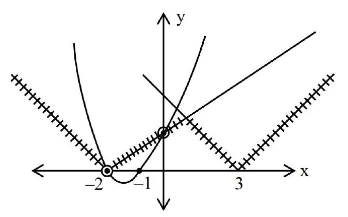
Only 2 solutions.
View full question & answer→MCQ 104 Marks
The area of the region enclosed by the curves $\mathrm{y}=\mathrm{e}^{\mathrm{x}}, \mathrm{y}=\left|\mathrm{e}^{\mathrm{x}}-1\right|$ and y -axis is:
AnswerCorrect option: D. $1-\log _{\mathrm{e}} 2$
(D)
Sol.
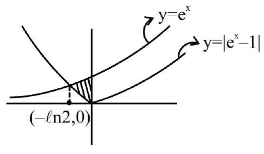
For Area $\int_{-\ln 2}^{0}\left[e^{x}-\left(1-e^{x}\right)\right] d x$
$\int_{-\ln 2}^{0}\left(2 e^{x}-1\right) d x=\left[2 e^{x}-x\right]_{-\ln 2}^{0}$
$=(2-(1+\ell \mathrm{n} 2))$
$=1-\ln 2$ View full question & answer→MCQ 114 Marks
Group A consists of 7 boys and 3 girls, while group B consists of 6 boys and 5 girls. The number of ways, 4 boys and 4 girls can be invited for a picnic if 5 of them must be from group A and the remaining 3 from group $B$, is equal to:
Answer(C)
Sol.
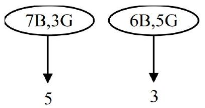
C-I $\quad(3 G \& 2 B) \&(1 G \& 2 B)$
C-II $\quad(2 \mathrm{G} \& 3 \mathrm{~B}) \&(2 \mathrm{G} \& 1 \mathrm{~B})$
C-III $\quad(1 \mathrm{G} \& 4 \mathrm{~B}) \&(3 \mathrm{G} \& 0 \mathrm{~B})$
Total $=\mathrm{C}-\mathrm{I}+\mathrm{C}-\mathrm{II}+\mathrm{C}-\mathrm{III}$
$={ }^{7} \mathrm{C}_{2} \cdot{ }^{3} \mathrm{C}_{3} \cdot{ }^{6} \mathrm{C}_{2} \cdot{ }^{5} \mathrm{C}_{1}+{ }^{7} \mathrm{C}_{3} \cdot{ }^{3} \mathrm{C}_{2} \cdot{ }^{6} \mathrm{C}_{1}{ }^{5} \mathrm{C}_{2}+{ }^{7} \mathrm{C}_{4} \cdot{ }^{3} \mathrm{C}_{1} \cdot{ }^{6} \mathrm{C}_{0} \cdot{ }^{5} \mathrm{C}_{3}$
$=8925$ View full question & answer→MCQ 124 Marks
For some $a, b$, let
$f(x)=\left|\begin{array}{ccc}a+\frac{\sin x}{x} & 1 & b \\ a & 1+\frac{\sin x}{x} & b \\ a & 1 & b+\frac{\sin x}{x}\end{array}\right|, \quad x \neq 0$,
$\lim _{x \rightarrow 0} f(x)=\lambda+\mu a+v b$. Then $(\lambda+\mu+v)^{2}$ is equal to:
Answer(D)
Sol. $\quad \lim _{x \rightarrow 0} f(x)=\left|\begin{array}{ccc}a+1 & 1 & b \\ a & 1+1 & b \\ a & 1 & b+1\end{array}\right|$
$=(a+1)(2(b+1)-b)+1(a b-a(b+1))+b a$
$=(a+1)(b+2)-a+a b$
$=b+a+2=\lambda+\mu a+\nu b$
$\lambda=2, \mu=1, v=1 \Rightarrow(\lambda+\mu+v)^{2}=16$
View full question & answer→MCQ 134 Marks
Let $\vec{a}=3 \hat{i}-\hat{j}+2 \hat{k}, \vec{b}=\vec{a} \times(\hat{i}-2 \hat{k})$ and $\vec{c}=\vec{b} \times \hat{k}$.
Then the projection of $\overrightarrow{\mathbf{c}}-2 \hat{\mathrm{j}}$ on $\overrightarrow{\mathrm{a}}$ is:
- A
$3 \sqrt{7}$
- B
$\sqrt{14}$
- ✓
$2 \sqrt{14}$
- D
$2 \sqrt{7}$
AnswerCorrect option: C. $2 \sqrt{14}$
(C)
Sol. $\dot{b}=\vec{a} \times(\hat{i}-3 \hat{k})$
$=\left|\begin{array}{ccc}\hat{i} & \hat{j} & \hat{k} \\ 3 & -1 & 2 \\ 1 & 0 & -2\end{array}\right|=2 \hat{i}+8 \hat{j}+\hat{k}$
$\overrightarrow{\mathrm{c}}=\overrightarrow{\mathrm{b}} \times \hat{\mathrm{k}}=8 \hat{\mathrm{i}}-2 \hat{\mathrm{j}}$
$\overrightarrow{\mathrm{c}}-2 \hat{\mathrm{j}}=8 \hat{\mathbf{i}}-4 \hat{\mathrm{j}}$
Projection of $(\hat{\mathrm{i}}-2 \hat{\mathrm{j}})$ on $\overrightarrow{\mathrm{a}}$
$(\overrightarrow{\mathrm{c}}-2 \hat{\mathrm{j}}) \cdot \hat{\mathrm{a}}=\frac{\langle 8,-4,0\rangle \cdot\langle 3,-1,2\rangle}{\sqrt{14}}$
$=\frac{28}{\sqrt{14}}=2 \sqrt{14}$
View full question & answer→MCQ 144 Marks
Suppose A and B are the coefficients of $30^{\text {th }}$ and $12^{\text {th }}$ terms respectively in the binomial expansion of $(1+x)^{2 n-1}$. If $2 A=5 B$, then $n$ is equal to:
Answer(B)
Sol. $\mathrm{A}={ }^{2 \mathrm{n}-1} \mathrm{C}_{29} \quad \mathrm{~B}={ }^{2 \mathrm{n}-1} \mathrm{C}_{11}$
$2{ }^{2 n-1} C_{29}=5{ }^{2 n-1} C_{11}$
$2 \frac{(2 n-1)!}{29!(2 n-30)!}=5 \frac{(2 n-1)!}{(2 n-12)!11!}$
$\frac{1}{29 \ldots 12 \cdot 5}=\frac{1}{(2 n-12)(2 n-13) \ldots(2 n-29)^{2}}$
$\frac{1}{30 \cdot 29 \ldots 12}=\frac{1}{(2 n-12)(2 n-13) \ldots(2 n-29) 12}$
$2 \mathrm{n}-12=30$
$\mathrm{n}=21$
View full question & answer→MCQ 154 Marks
Let $(2,3)$ be the largest open interval in which the function $f(x)=2 \log _{c}(x-2)-x^{2}+a x+1$ is strictly increasing and ( $b, c$ ) be the largest open interval, in which the function $g(x)=(x-1)^{3}(x+2-a)^{2}$ is strictly decreasing. Then $100(a+b-c)$ is equal to:
Answer(B)
Sol. $\quad f^{\prime}(x)=\frac{2}{x-2}-2 x+a \geq 0$
$\mathrm{f}^{\prime \prime}(\mathrm{x})=\frac{-2}{(\mathrm{x}-2)^{2}}-2<0$
$\mathrm{f}^{\prime}(\mathrm{x}) \downarrow$
$\mathrm{f}^{\prime}(3) \geq 0$
$2-6+a \geq 0$
$a \geq 4$
$\mathrm{a}_{\text {min }}=4$
$g(x)=(x-1)^{3}(x+2-a)^{2}$
$\mathrm{g}(\mathrm{x})=(\mathrm{x}-1)^{3}(\mathrm{x}-2)^{2}$
$\mathrm{g}^{\prime}(\mathrm{x})=(\mathrm{x}-1)^{3} 2(\mathrm{x}-2)+(\mathrm{x}-2)^{2} 3(\mathrm{x}-1)^{2}$
$=(x-1)^{2}(x-2)(2 x-2+3 x-6)$
$=(x-1)^{2}(x-2)(5 x-8)<0$
$x \in\left(\frac{8}{5}, 2\right)$
$100(a+b-c)=100\left(4+\frac{8}{5}-2\right)=360$
View full question & answer→MCQ 164 Marks
If the system of equations
$x+2 y-3 z=2$
$2 x+\lambda y+5 z=5$
$14 x+3 y+\mu z=33$
has infinitely many solutions, then $\lambda+\mu$ is equal to:
Answer(D)
Sol. $\quad D=\left|\begin{array}{ccc}1 & 2 & -3 \\ 2 & \lambda & 5 \\ 14 & 3 & \mu\end{array}\right|=0, \lambda \mu+42 \lambda-4 \mu+107=0$
$D_{1}=2 \lambda \mu+99 \lambda-10 \mu+255$
$D_{2}=13-\mu$
$\mathrm{D}_{3}=5 \lambda+5$
$D_{2}=0 \Rightarrow \mu=13 \& D_{3}=0 \Rightarrow \lambda=-1$
check \& verify for these values $\mathrm{D} \& \mathrm{D}_{2}=0$
View full question & answer→MCQ 174 Marks
If $7=5+\frac{1}{7}(5+\alpha)+\frac{1}{7^{2}}(5+2 \alpha)+\frac{1}{7^{3}}(5+3 \alpha)+$ $\infty$, then the value of $\alpha$ is:
- A
- B
$\frac{6}{7}$
- ✓
- D
$\frac{1}{7}$
Answer(C)
Sol. Let $\mathrm{S}=5+\frac{1}{7}(5+\alpha)+\frac{1}{7^{2}}(5+2 \alpha)+\ldots$
$\frac{1}{7} \mathrm{~S}=\frac{1}{7}(5)+\frac{1}{7^{2}}(5+\alpha)+\ldots \infty$
$\frac{6}{7}(S)=5+\frac{1}{7} \alpha\left(\frac{1}{1-\frac{1}{7}}\right)$
$6=5+\frac{\alpha}{6} \Rightarrow \alpha=6$
View full question & answer→MCQ 184 Marks
In an arithmetic progression, if $\mathrm{S}_{40}=1030$ and $\mathrm{S}_{12}=57$, then $\mathrm{S}_{30}-\mathrm{S}_{10}$ is equal to:
Answer(B)
Sol. Let a \& d are first term and common diff of an AP.
$\mathrm{S}_{40}=\frac{40}{2}[2 \mathrm{a}+39 \mathrm{~d}]=1030$
$\mathrm{S}_{12}=\frac{12}{2}[2 \mathrm{a}+11 \mathrm{~d}]=57$
by (1) \& (2)
$\mathrm{a}=-\frac{7}{2} \quad \mathrm{~d}=\frac{3}{2}$
$\therefore \mathrm{S}_{30}-\mathrm{S}_{10}=\frac{30}{2}[2 \mathrm{a}+29 \mathrm{~d}]-\frac{10}{2}[2 \mathrm{a}+9 \mathrm{~d}]$
$=20 \mathrm{a}-390 \mathrm{~d}$
$=515$
View full question & answer→MCQ 194 Marks
Let the points $\left(\frac{11}{2}, \alpha\right)$ lie on or inside the triangle with sides $\mathrm{x}+\mathrm{y}=11, \mathrm{x}+2 \mathrm{y}=16$ and $2 \mathrm{x}+3 \mathrm{y}=29$. Then the product of the smallest and the largest values of $\alpha$ is equal to :
Answer(C)
Sol.
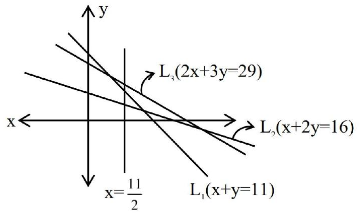
Point of intersection of $x=\frac{11}{2}$ with $L_{1} \& L_{3}$ gives, $\alpha_{\min }=\frac{11}{2}$
and $\alpha_{\text {max }}=6$
$\therefore \alpha_{\min } \cdot \alpha_{\max }=\frac{11}{2} \times 6=33$ View full question & answer→MCQ 204 Marks
Let
$
A=\left\{x \in(0, \pi)-\left\{\frac{\pi}{2}\right\}: \log _{(2 / \pi)}|\sin x|+\log _{(2 / \pi)}|\cos x|=2\right\}
$
and
$B=\{x \geq 0: \sqrt{x}(\sqrt{x}-4)-3|\sqrt{x}-2|+6=0\}$. Then $\mathrm{n}(\mathrm{A} \cup \mathrm{B})$ is equal to:
Answer(C)
Sol. $\mathrm{A}: \log _{2 \pi}|\sin \mathrm{x}|+\log _{2 \pi}|\cos \mathrm{x}|=2$
$\Rightarrow \log _{2 \pi}(|\sin x . \cos x|)=2$
$\Rightarrow|\sin 2 \mathrm{x}|=\frac{8}{\pi^{2}}$
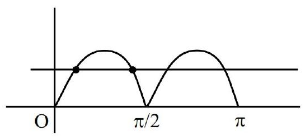
Number of solution 4
B : let $\sqrt{\mathrm{x}}=\mathrm{t}<2$
Then $\sqrt{\mathrm{x}}(\sqrt{\mathrm{x}}-4)+3(\sqrt{\mathrm{x}}-2)+6=0$
$\Rightarrow \mathrm{t}^{2}-4 \mathrm{t}+3 \mathrm{t}-6+6=0$
$\Rightarrow \mathrm{t}^{2}-\mathrm{t}=0, \mathrm{t}=0, \mathrm{t}=1$
$\mathrm{x}=0, \mathrm{x}=1$
again let $\sqrt{\mathrm{x}}=\mathrm{t}>2$
then $\mathrm{t}^{2}-4 \mathrm{t}-3 \mathrm{t}+6+6=0$
$\Rightarrow \mathrm{t}^{2}-7 \mathrm{t}+12=0$
$\Rightarrow \mathrm{t}=3,4$
$\mathrm{x}=9,16$
Total number of solutions
$\mathrm{n}(\mathrm{A} \cup \mathrm{B})=4+4=8$ View full question & answer→