MCQ
Suppose $A B C D$ is a trapezium whose sides and height are integers and $A B$ is parallel to $C D$. If the area of $A B C D$ is $12$ and the sides are distinct, then $|A B-C D|$
- Ais $2$
- ✓is $4$
- Cis $8$
- Dcannot be determined from the data
We have,
$A B C D$ is a trapezium.
$A B$ is parallel to $C D$.
Area of trapezium $=12$
$\frac{1}{2} \times h(A B+C D)=12$
$A B+C D=\frac{24}{h}$
Sides and height of trapezium are integer.
$\therefore h$ is a factor of $24$
$h=1,2,3,4,6,8,12,24$
$A B+C D=24,12,8,6,4,3,2,1$
But $A B+C D > h$
$A B+C D=24,12,8,6$
In $\triangle B E C$,
$B E C$ is a right angled triangle.
$\therefore h$ must be $3$ and $4$
When $h=3, B E=4, C E=5$
$A B+C D=8$
$A E+B E+A E=8$
$2 A E=8-B E=8-4$
$A E=2$
$\therefore A B=4+2=6, C D=2$
$\therefore|A B-C D|=|6-2|=4$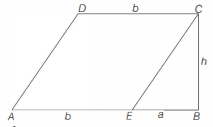
Generate a complete, print-ready paper with questions like this in minutes — across 16+ boards, with answer keys.
$A=\left\{(x, y) \in R \times R \mid 2 x^{2}+2 y^{2}-2 x-2 y=1\right\}$
$B=\left\{(x, y) \in R \times R \mid 4 x^{2}+4 y^{2}-16 y+7=0\right\} \text { and }$
$C=\left\{(x, y) \in R \times R \mid x^{2}+y^{2}-4 x-2 y+5 \leq r^{2}\right\}$
Then the minimum value of $|r|$ such that $A \cup B \subseteq C$ is equal to: