Question
Suppose an attractive nuclear force acts between two protons which may be written as $\text{F}=\text{Ce}^{-\text{kr}}/\text{r}^2.$
  1. Write down the dimensional formulae and appropriate $SI$ units of $C$ and $k.$
  2. Suppose that $k = 1 \text{fermi}^{-1}$ and that the repulsive electric force between the protons is just balanced by the attractive nuclear force when the separation is $5$ fermi. Find the value of $C.$
Answer

Expression of electrical force $\text{F}=\text{C}\times\text{e}^{\frac{-\text{kr}}{\text{r}^2}}$
Since $e^{-kr}$ is a pure number.
So, dimensional formulae of $\text{F}=\frac{\text{dimensional formulae of C}}{\text{dimensional formulae of r}^2}$
Or, $\big[\text{MLT}^{-2}\big]\big[\text{L}^2\big]=$ dimensional formulae of $\text{C}=\big[\text{ML}^3\text{T}^{-2}\big]$
Unit of $C =$ unit of force $\times$ unit of $r^2 =$ Newton $\times m^2 =$ Newton$-m^2$
Since $-kr$ is a number hence dimensional formulae of
$\text{k}=\frac{1}{\text{dim entional formulae of r}}$
​​​​​​​$=\big[\text{L}^{-1}\big]$ Unit of $k = m^{-1}$

Need a full question paper?

Generate a complete, print-ready paper with questions like this in minutes — across 16+ boards, with answer keys.

Start Generating Free

Similar questions

A block of mass $100g$ is moved with a speed of $5.0m/s$ at the highest point in a closed circular tube of radius $10cm$ kept in a vertical plane. The cross-section of the tube is such that the block just fits in it. The block makes several oscillations inside the tube and finally stops at the lowest point. Find the work done by the tube on the block during the process.
Show that moment of a couple does not depend on the point about which you take the moments.
The surface density (mass/ area) of a circular disc of radius a depends on the distance from the centre as p(r) = A + Br. Find its moment of inertia about the line perpendicular to the plane of the disc through its centre.
What would be the effect on a vector if all its components are reversed in direction?
Water is filled in a rectangular tank of size $3m \times 2m \times 1m$.
  1. Find the total force exerted by the water on the bottom surface of the tank.
  2. Consider a vertical side of area $2m \times 1m$. Take a horizontal strip of width $ox$ metre in this side, situated at a depth of $x$ metre from the surface of water. Find the force by the water on this strip.
  3. Find the torque of the force calculated in part.$(b)$ about the bottom edge of this side.
  4. Find the total force by the water on this side.
  5. Find the total torque by the water on the side about.
The bottom edge. Neglect the atmospheric pressure and take $g = 10m/s^2$.
If the radius of the Earth were increased by a factor of 3, by what factor would its density have to be changed to keep 'g' the same?
A particle goes in a circle of radius 2.0cm. A concave mirror of focal length 20cm is placed with its principal axis passing through the centre of the circle and perpendicular to its plane. The distance between the pole of the mirror and the centre of the circle is 30cm. Calculate the radius of the circle formed by the image.
A vessel contains two non$-$reactive gases: neon $($monoatomic$)$ and oxygen $($diatomic$)$. The ratio of their partial pressures is $3: 2$. Estimate the ratio of $(i)$ number of molecules, $(ii)$ mass density of neon and oxygen in the vessel. Atomic mass of $\mathrm{Ne}=20.2 \mathrm{u}$, molecular mass of $\mathrm{O}_2=32.0 \mathrm{u}$.
A parallel-plate capacitor of plate-area A and plate separation d is joined to a battery of emf $\in$ and internal resistance R at t = 0. Consider a plane surface of area $\frac{\text{A}}{2}$ parallel to the plates and situated symmetrically between them. Find the displacement current through this surface as a function of time.
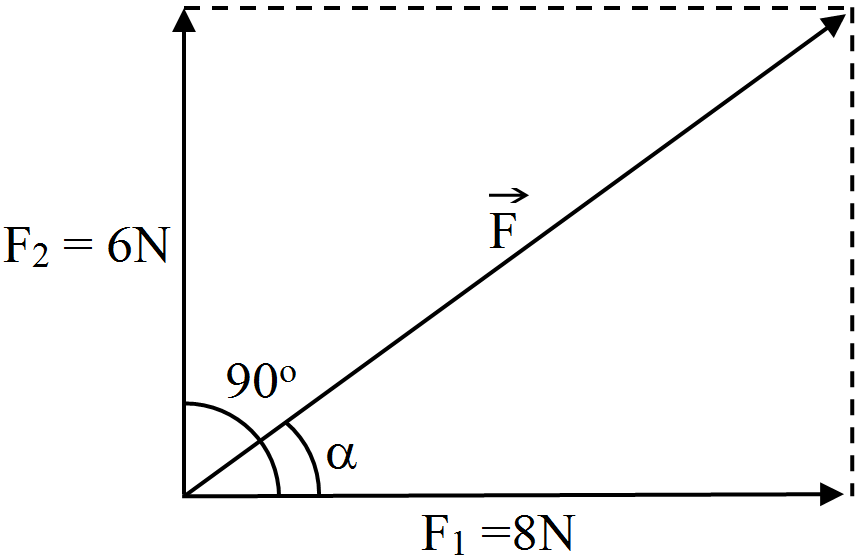
Two mutually perpendicular forces of $8N$ and $6N$ acts on the same body of mass $10\ kg$. Calculate
  1. Net force acting on the body,
  2. Magnitude of the acceleration of the body,
  3. Direction of acceleration of the body.