Question
What would be the effect on a vector if all its components are reversed in direction?

Answer

Consider a vector $\vec{\text{F}}.$ $\vec{\text{F}}=\text{F}_\text{x}\hat{\text{i}}+\text{F}_\text{y}\hat{\text{j}}+\text{F}_\text{z}\hat{\text{k}}$ When x, y and z components are reversed, we get $\text{F}_\text{x}(-\hat{\text{i}})+\text{F}_\text{y}(-\hat{\text{j}})+\text{F}_\text{z}(-\hat{\text{k}})$ $-[\text{F}_\text{x}\hat{\text{i}}+\text{F}_\text{y}\hat{\text{j}}+\text{F}_\text{z}\hat{\text{k}}]=-\vec{\text{F}}$ Therefore, the vector itself is reversed.

Need a full question paper?

Generate a complete, print-ready paper with questions like this in minutes — across 16+ boards, with answer keys.
Start Generating Free

Similar questions

The volume of air bubble increases $15$ times when it rises from bottom to the top of a lake. Calculate the depth of the lake if density of lake water is $1.02 \times 10^3 \mathrm{~kg} / \mathrm{m}^3$ and atmospheric pressure is $75$ cm of mercury.
Do all the thermocouples have a neutral temperature?
If mercury and glass had equal coefficient of volume expansion, could we make a mercury thermometer in a glass tube?
Show that the projection angle $\theta_0$ for a projectile launched from the origin is given by, $\theta_0=\tan^{-1}\Big(\frac{4\text{H}}{\text{R}}\Big)$ where, H is the maximum height attained by the projectile and R is the range of the projectile.
If in a case of motion, displacement is directly proportional to the square of the time elapsed, what do you think about its acceleration i.e. constant or variable? Explain. $OR$
An object is in uniform motion, along a straight line. What will be the position time graph for the motion of the object, when
i. $x_0=+v e, v=-v e(v) \rightarrow$ constant
ii. $\mathrm{x}_0=-\mathrm{ve}, \mathrm{v}=+\mathrm{ve}(\mathrm{v}) \rightarrow$ constant
A cyclist goes round a circular track of 440 metres length in 20 seconds. Find the angle that the cycle makes with the vertical.
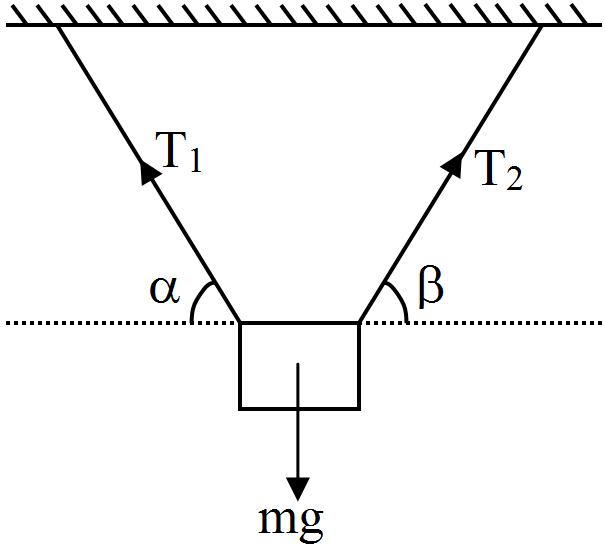
A body of mass m is suspended by two strings making angles $\alpha$ and $\beta$ with the horizonal as shown in Fig. Calculate the tensions in the two strings.
A steel wire has a length of $12.0m$ and a mass of $2.10kg$. What should be the tension in the wire so that speed of a transverse wave on the wire equals the speed of sound in dry air at $20^\circ C = 343m s^{–1}$.
A wheel of mass 10kg and radius 20cm is rotating at an angular speed of 100rev/min when the motor is turned off. Neglecting the friction at the axle, calculate the force that must be applied tangentially to the wheel to bring it to rest in 10 revolutions.
Find an expression for the maximum speed of circular motion of a car in a circular horizontal track of radius 'R'. The coefficient of static friction between the car tyres and the road along the surfaces is $\mu\text{s}.$