Question
Suppose in an imaginary world the angular momentum is quantized to be even integral multiples of $\frac{\text{h}}{2\pi}$ What is the longest possible wavelength emitted by hydrogen atoms in visible range in such a world according to Bohr's model?

Answer

Even quantum numbers are allowed,
$\text{n}_1=2,\text{n}_2=4\xrightarrow{\ \ \ }$ For minimum energy or for longest possible wavelength.
$\text{E}=13.6\bigg(\frac{1}{\text{n}^2_1}-\frac{1}{\text{n}^2_2}\bigg)$
$\text{E}=13.6\Big(\frac{1}{2^2}-\frac{1}{4^2}\Big)=2.55$
$2.55=\frac{\text{hc}}{\lambda}$
$\lambda=\frac{\text{hc}}{2.55}=\frac{1242}{2.55}$
$\lambda=487.05\text{nm}=487\text{nm}$

Need a full question paper?

Generate a complete, print-ready paper with questions like this in minutes — across 16+ boards, with answer keys.

Start Generating Free

Similar questions

(a) What will be the charge on $12.5 \times 10^8$ electrons?(b) Which is larger between 1 Coulomb charge and 1 electron charge? How many electronic charges will there be in one Coulomb charge?
Radio waves are produced by the accelerated motion of charges in conducting wires. Microwaves are produced by special vacuum tubes. Infrared waves are produced by hot bodies and molecules also known as heat waves. UV rays are produced by special lamps and very hot bodies like Sun.

  1. Solar radiation is:
  1. Transverse electromagnetic wave.
  2. Longitudinal electromagnetic waves.
  3. Both longitudinal and transverse electromagnetic waves.
  4. None of these.
  1. What is the cause of greenhouse effect?
  1. Infrared rays.
  2. Ultraviolet rays
  3. X-rays.
  4. Radiowaves.
  1. Biological importance of ozone layer is:
  1. It stops ultraviolet rays.
  2. It layer reduces greenhouse effect.
  3. It reflects radiowaves.
  4. None of these.
  1. Ozone is found in.
  1. Stratosphere.
  2. Ionosphere.
  3. Mesosphere.
  4. Troposphere.
  1. Earth's atmosphere is richest in.
  1. Ultraviolet.
  2. Infrared.
  3. X-rays.
  4. Microwave.
Draw the graph of deviation angle $(\delta)$ versus incidence angle (i) and derive the formula for refractive index $n_{21}=\frac{\sin \left(\frac{A+D_m}{2}\right)}{\sin \left(\frac{A}{2}\right)}$ for the material of prism.
A bar magnet takes $\frac{\pi}{10}$ second to complete one oscillation in an oscillation magnetometer. The moment of inertia of the magnet about the axis of rotation is 1.2 × 10⁻⁴ kg-m2 and the earth's horizontal magnetic field is $30\mu \text{T}.$ Find the magnetic moment of the magnet.
A metallic loop is placed in a nonuniform magnetic field. Will an emf be induced in the loop?
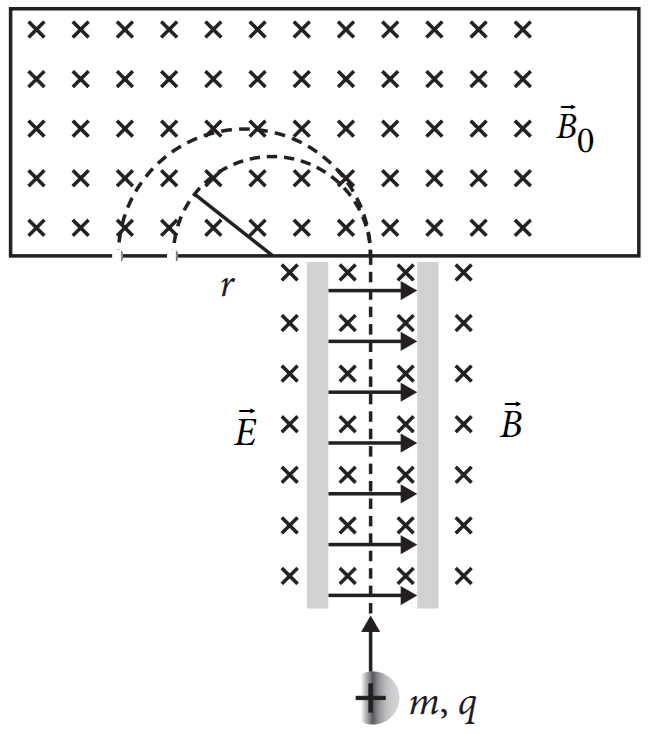
Various methods can be used to measure the mass of an atom. One possibility is through the use of a mass spectrometer. The basic feature of a Banbridge mass spectrometer is illustrated in figure. A particle carrying a charge +q is first sent through a velocity selector and comes out with velocity $\text{v}=\frac{\text{E}}{\text{B}}.$
The applied electric and magnetic fields satisfy the relation E = vB so that the trajectory of the particle is a straight line. Upon entering a region where a second magnetic field $\vec{\text{B}}_0$ pointing into the page has been applied, the particle will move in a circular path with radius rand eventually strike the photographic plate.

  1. In mass spectrometer, the ions are sorted out in which of the following ways?
  1. By accelerating them through electric field.
  2. By accelerating them through magnetic field.
  3. By accelerating them through electric and magnetic field.
  4. By applying a high voltage.
  1. Radius of particle in second magnetic field B0 is:
  1. $\frac{2\text{mv}}{\text{qE}_0}$
  2. $\frac{\text{mv}}{\text{qE}_0}$
  3. $\frac{\text{mv}}{\text{qB}_0}$
  4. $\frac{2\text{mE}_0\text{v}}{\text{qB}_0}$
  1. Which of the following will trace a circular trajectory with largest radius?
  1. Proton
  2. ct-particle
  3. Electron
  4. A particle with charge twice and mass thrice that of electron.
  1.  Mass of the particle in terms q, B0, B, rand E is:
  1. $\frac{\text{qbr}}{\text{E}}$
  2. $\frac{\text{qbr}}{\text{E}}$
  3. $\frac{\text{qbr}}{\text{E}}$
  4. $\frac{\text{qbr}}{\text{E}}$ 
  1. The particle comes out of velocity selector along a straight line, because:
  1. Electric force is less than magnetic force.
  2. Electric force is greater than magnetic force.
  3. Electric and magnetic force balance each other.
  4. Can't say.
A silver ball of radius 4.8cm is suspended by a thread in a vacuum chamber. Ultraviolet light of wavelength 200 run is incident on the ball for some time during which a total light energy of 1.0 × 10⁻⁷J falls on the surface. Assuming that on the average one photon out of every ten thousand is able to eject a photoelectron, find the electric potential et the surface of the bell assuming zero potential at infinity. What is the potential at the centre of the bell?
Derive the formula of electric potential at a point due to electric dipole.
The power averaged over one full cycle of a.c. is known as average power. It is also known as true power.
$\text{P}_\text{av}=\text{V}_\text{rms}\text{I}_\text{rms}\cos\phi=\frac{\text{V}_0\text{I}_0}{2}\cos\phi$
Root mean square or simply rms watts refer to continuous power.
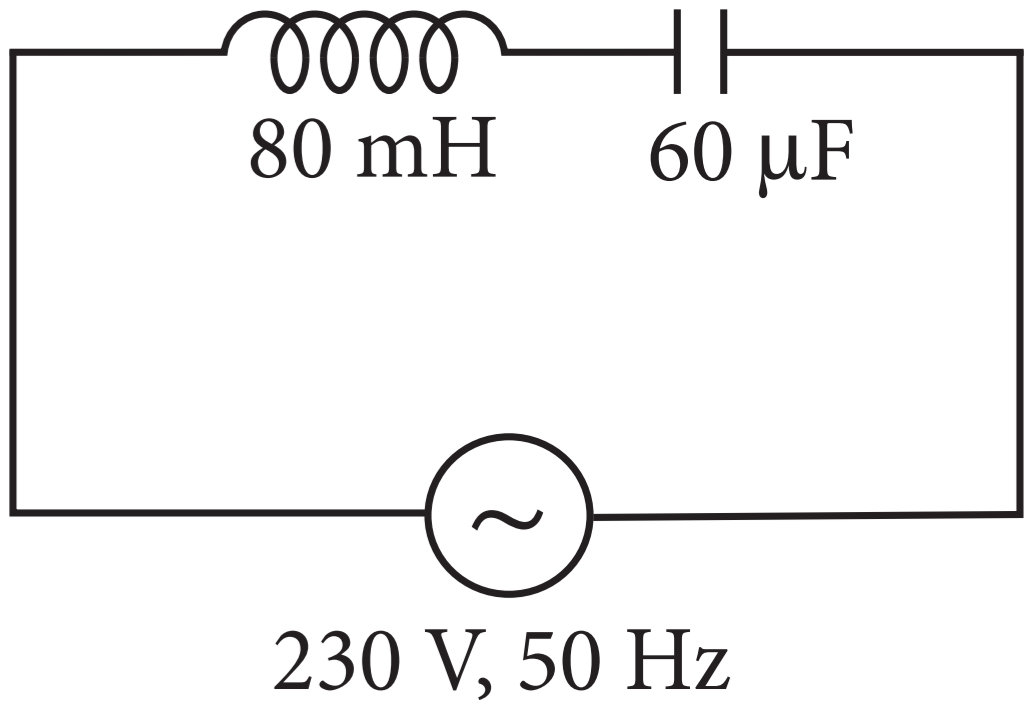
A circuit containing a 80mH inductor and a $60\mu\text{F}$ capacitor in series is connected to a 230V, 50Hz supply. The resistance of the circuit is negligible.

  1. The value of current amplitude is:
  1. 15A
  2. 11.63A
  3. 17.65A
  4. 6.33A
  1. Find rms value.
  1. 6A
  2. 5.25A
  3. 8.23A
  4. 7.52A
  1. The average power transferred to inductor is:
  1. Zero
  2. 7W
  3. 2.5W
  4. 5W
  1. The average power transferred to the capacitor is:
  1. 5W
  2. Zero
  3. 11W
  4. 15W
  1. What is the total average power absorbed by the circuit?
  1. Zero
  2. 10W
  3. 2.5W
  4. 15W