Question
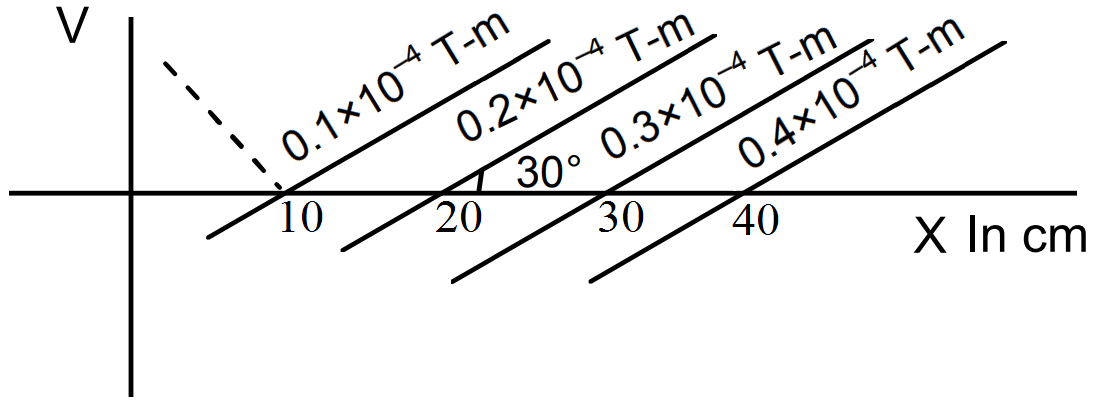
A metallic loop is placed in a nonuniform magnetic field. Will an emf be induced in the loop?

Answer

As the magnetic field is non uniform thus it will induce only small electric field in different directions so there would be no net current in the loop.

Need a full question paper?

Generate a complete, print-ready paper with questions like this in minutes — across 16+ boards, with answer keys.

Start Generating Free

Similar questions

Mention the changes occurring in the geomagnetic components.
The friction coefficient between an athelete's shoes and the ground is 0.90. Suppose a superman wears these shoes and races for 50m. There is no upper limit on his capacity of running at high speeds.
  1. Find the minimum time that he will have to take in completing the 50m starting from rest.
  2. Suppose he takes exactly this minimum time to complete the 50m, what minimum time will he take to stop?
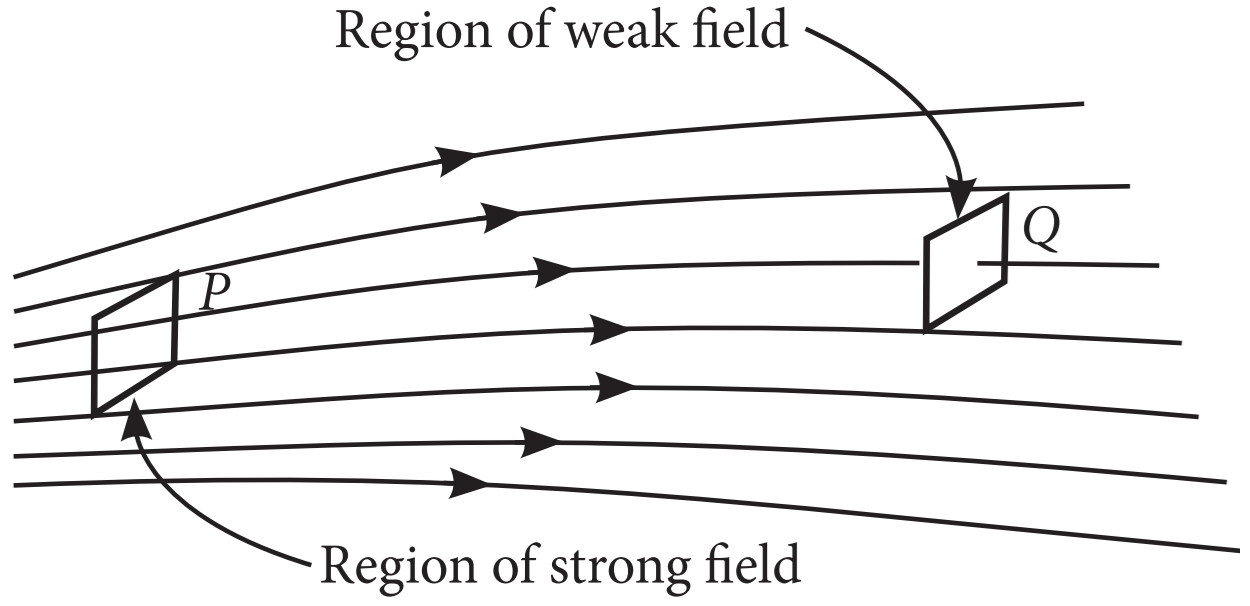
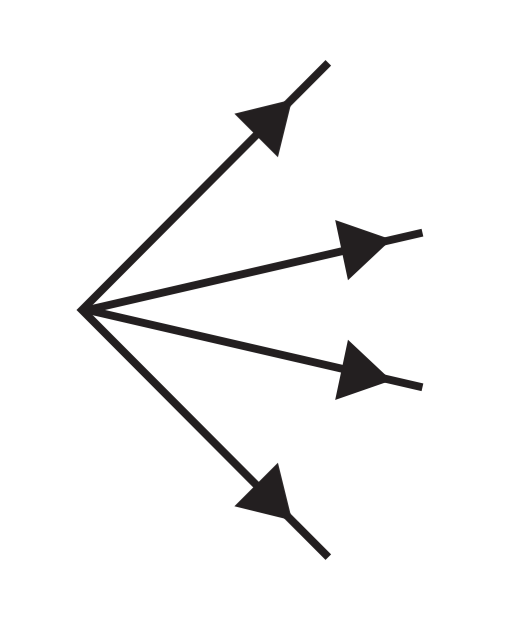
Electric field strength is proportional to the density of lines of force i.e., electric field strength at a point is proportional to the number of lines of force cutting a unit area element placed normal to the field at that point. As illustrated in the given figure, the electric field at P is stronger that at Q.

  1. Electric lines of force about a positive point charge are:
  1. Radially outwards.
  2. Circular clockwise.
  3. Radially inwards.
  4. Parallel straight lines.
  1. Which of the following is false for electric lines of force?
  1. They always start from positive charges and terminate on negative charges.
  2. They are always perpendicular to the surface of a charged conductor.
  3. They always form closed loops.
  4. They are parallel and equally spaced in a region of uniform electric field.
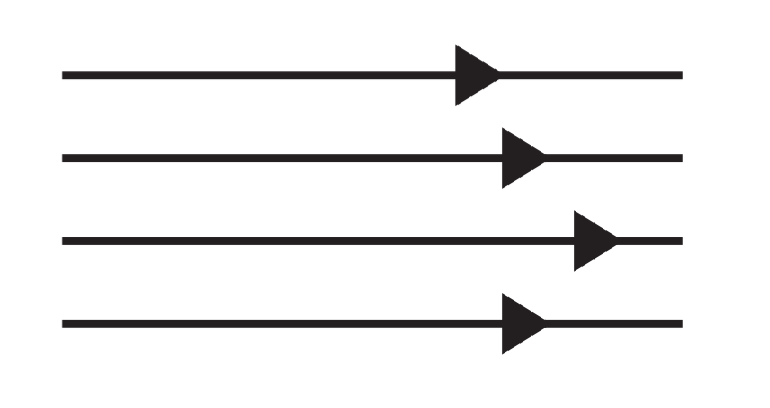
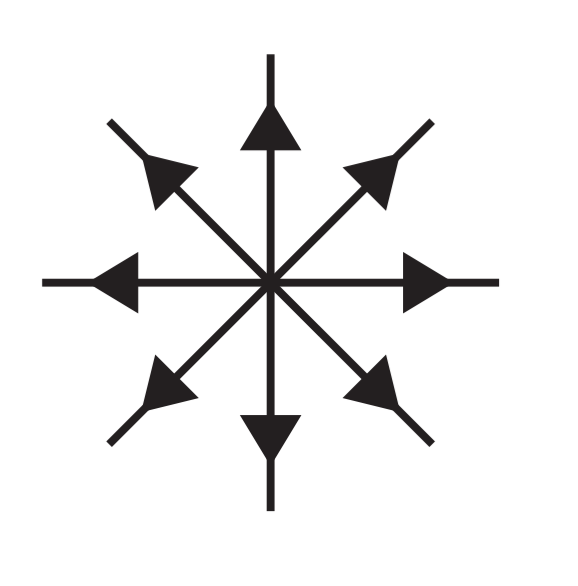
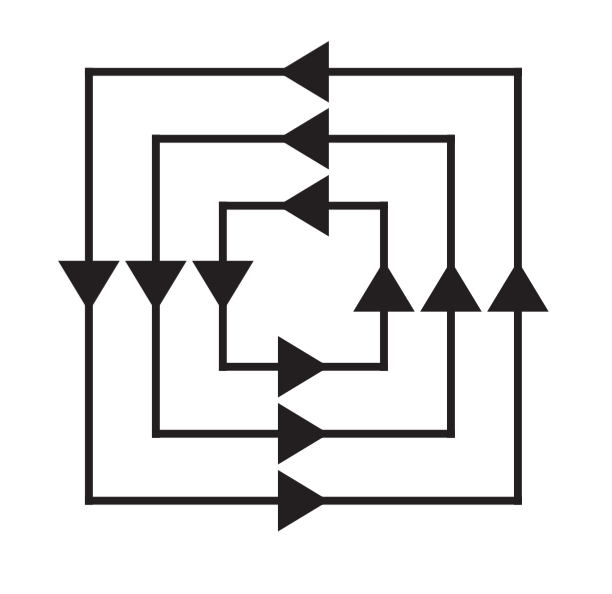
  1. Which one of the following pattern of electric line of force in not possible in filed due to stationary charges?
  1.  

  1.  

  1.  

  1.  

  1. Electric lines of force are curved:
  1. In the field of a single positive or negative charge.
  2. In the field of two equal and opposite charges.
  3. In the field of two like charges.
  4. Both (b) and (c).
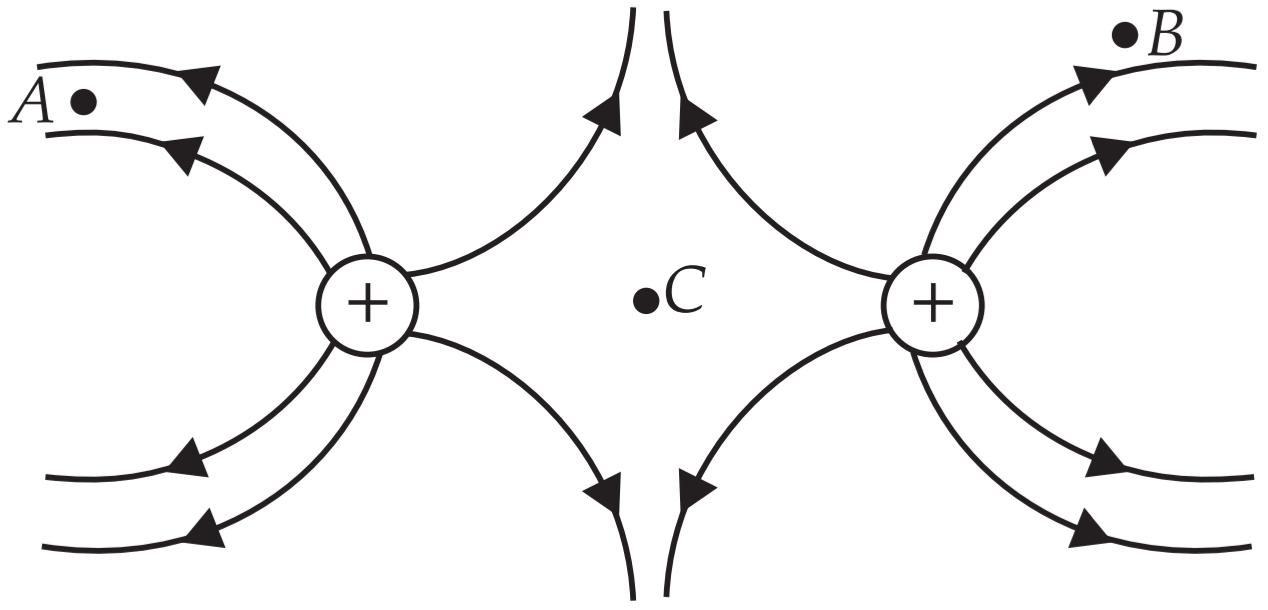
  1. The figure below shows the electric field lines due to two positive charges. The magnitudes EA, EB and EC of the electric fields at points A, Band C respectively are related as:

  1. EA > EB > EC
  2. EB > EA > EC
  3. EA = EB > EC
  4. EA > EB = EC
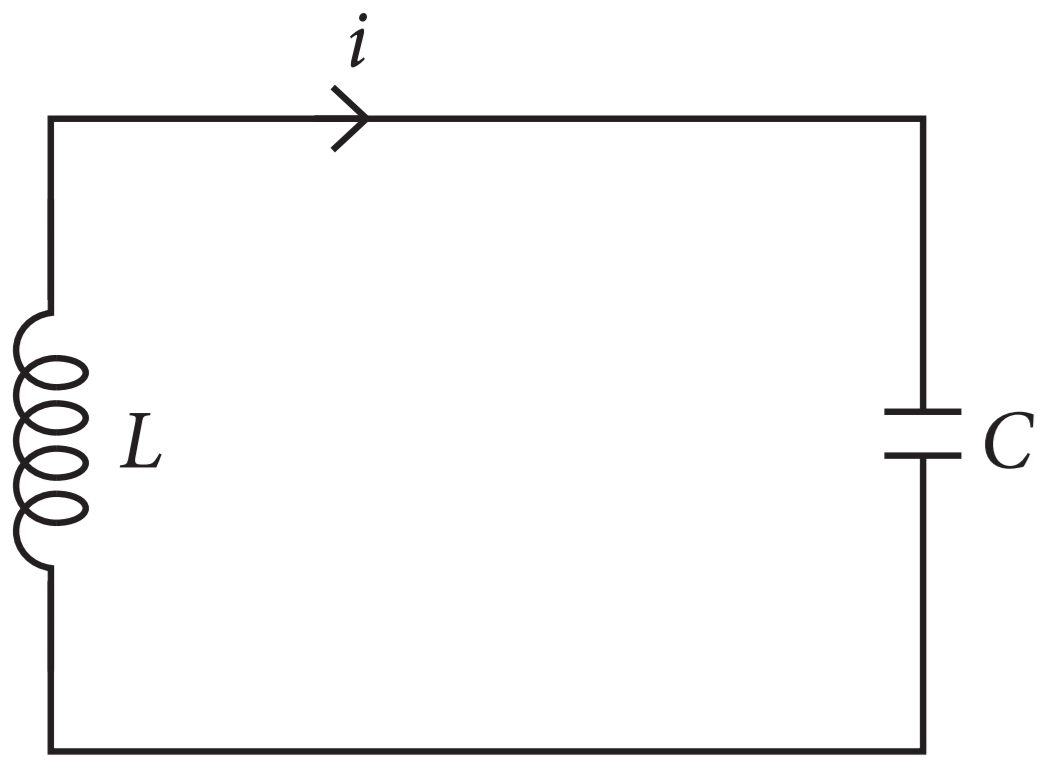
An LC circuit also called a resonant circuit, tank circuit or tuned circuit is an electric circuit consisting of an inductor represented by the letter Land a capacitor, represented by the letter C connected together. An LC circuit is an idealized model since it assumes there is no dissipation of energy due to resistance. An LC circuit contains a 20mH inductor and a $50\mu\text{F}$ capacitor with an initial charge of 10mC. The resistance of the circuit is negligible. Let the instant the circuit is closed bet = 0.

  1. The total energy stored initially is:
  1. 5J
  2. 3J
  3. 10J
  4. 1J
  1. The natural frequency of the circuit is:
  1. 159.24Hz
  2. 200.12Hz
  3. 110.25Hz
  4. 95Hz
  1. At what time is the energy stored completely electrical?
  1. $0, 5\text{T}, 9\text{T}$
  2. $0,\text{T}, 2\text{T}, 3\text{T}$
  3. $\frac{\text{T}}{2},\frac{\text{5T}}{2},\frac{\text{9T}}{2}$
  4. $0,\frac{\text{T}}{2},{\text{T}},\frac{\text{3T}}{2}$
  1. At what time is the energy stored completely magnetic?
  1. $\frac{\text{T}}{2},\frac{\text{3T}}{2},\frac{\text{T}}{4}$
  2. $\frac{\text{T}}{3},\frac{\text{T}}{9},\frac{\text{T}}{12}$
  3. $0, 2\text{T}, 3\text{T}$
  4. $\frac{\text{T}}{4},\frac{\text{3T}}{4},\frac{\text{5T}}{4}$
  1. The value of XL is:
  1. $20\Omega$
  2. $40\Omega$
  3. $60\Omega$
  4. $50\Omega$
Write the equation of average power for $L - C - R$ series AC circuit and discuss its special cases.
Consider a coin of Example 1.20. It is electrically neutral and contains equal amounts of positive and negative charge of magnitude 34.8kC. Suppose that these equal charges were concentrated in two point charges seperated by,
  1. 1cm $\Big(\sim\frac{1}{2}\times\text{diagonalof theone paisa coin}\Big)$,
  2. 100m (~ length of a long building), and
  3. 106m (radius of the earth). Find the force on each such point charge in each of the three cases. What do you conclude from these results?
When subatomic particles undergo reactions, energy is conserved, but mass is not necessarily conserved. However, a particle's mass “contributes” to its total energy, in accordance with Einstein's famous equation, E = mc2 In this equation, E denotes the energy carried by a particle because of its mass. The particle can also have additional energy due to its motion and its interactions with other particles. Consider a neutron at rest and well separated from other particles. It decays into a proton, an electron and an undetected third particle as given here: Neutron → proton + electron + ???

The given table summarizes some data from a single neutron decay. Electron volt is a unit of energy. Column 2 shows the rest mass of the particle times the speed of light squared.

Particle
Mass × c2 (MeV)
Kinetic energy (MeV)
Neutron
940.97
0.00
Proton
939.67
0.01
Electron
0.51
0.39
  1. From the given table, which properties of the undetected third particle can be calculate?
  1. Total energy, but not kinetic energy.
  2. Kinetic energy, but not total energy.
  3. Both total energy and kinetic energy.
  4. Neither total energy nor kinetic energy.
  1. Assuming the table contains no major errors, what can we conclude about the (mass × c2) of the undetected third particle?
  1. It is 0. 79 MeV
  2. It is 0.39 MeV
  3. It is less than or equal to 0.79 MeV; but we cannot be more precise.
  4. It is less than or equal to 0.40 MeV; but we cannot be more precise.
  1. Could this reaction occur?

Proton → neutron + other particles

  1. Yes, if the other particles have much more kinetic energy than mass energy.
  2. Yes, but only if the proton has potential energy (due to interactions with other particles). 
  3. No, because a neutron is more massive than a proton.
  4. No, because a proton is positively charged while a neutron is electrically neutral.
  1. How much mass has to be converted into energy to produce electric power of 500MW for one hour?
  1. 2 × 10-5kg
  2. 1 × 10⁻⁵kg
  3. 3 × 10⁻⁵kg
  4. 4 × 10⁻⁵kg
  1. The equivalent energy of 1g of substance is.
  1. 9 × 10¹³J
  2. 6 × 10¹²J
  3. 3 × 10¹³J
  4. 6 × 10¹³J
A prism is a portion of a transparent medium bounded by two plane faces inclined to each other at a suitable angle. A ray of light suffers two refractions on passing through a prism and hence deviates through a certain angle from its original path. The angle of deviation of a prism is, $\delta=(\mu-1)\text{A},$ through which a ray deviates on passing through a thin prism of small refracting angle A.
If $\mu$ is refractive index of the material of the prism, then prism formula is, $\mu=\frac{\frac{\sin(\text{A}\delta_\text{m})}{2}}{\frac{\sin\text{A}}{2}}$
  1. For which colour, angle of deviation is minimum?
  1. Red
  2. Yellow
  3. Violet
  4. Blue
  1. When white light moves th rough vacuum:
  1. All colours have same speed.
  2. Different colours have different speeds.
  3. Violet has more speed than red.
  4. Red has more speed than violet.
  1. The deviation through a prism is maximum when angle of incidence is:
  1. 45º
  2. 70º
  3. 90º
  4. 60c
  1. What is the deviation produced by a prism of angle 6º? (Refractive index of the material of the prism is 1.644).
  1. 3.864º
  2. 4.595º
  3. 7.259º
  4. 1.252º
  1. A ray of light falling at an angle of 50º is refracted through a prism and suffers minimum deviation. If the angle of prism is 60º, then the angle of minimum deviation is:
  1. 45º
  2. 75º
  3. 50º
  4. 40º