Question
Suppose in an imaginary world the angular momentum is quantized to be even integral multiples of $\frac{\text{h}}{2\pi}$ What is the longest possible wavelength emitted by hydrogen atoms in visible range in such a world according to Bohr's model?

Answer

Even quantum numbers are allowed,$\text{n}_1=2,\text{n}_2=4\xrightarrow{\ \ \ }$ For minimum energy or for longest possible wavelength.
$\text{E}=13.6\bigg(\frac{1}{\text{n}^2_1}-\frac{1}{\text{n}^2_2}\bigg)$
$\text{E}=13.6\Big(\frac{1}{2^2}-\frac{1}{4^2}\Big)=2.55$
$2.55=\frac{\text{hc}}{\lambda}$
$\lambda=\frac{\text{hc}}{2.55}=\frac{1242}{2.55}$
$\lambda=487.05\text{nm}=487\text{nm}$

Need a full question paper?

Generate a complete, print-ready paper with questions like this in minutes — across 16+ boards, with answer keys.

Start Generating Free

Similar questions

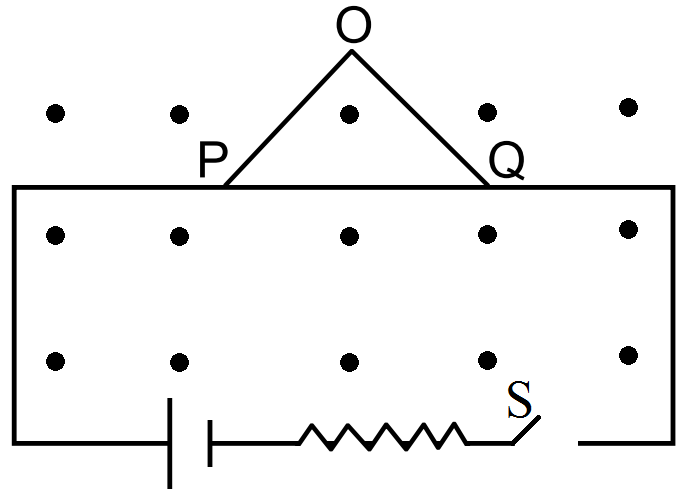
Shows a rod PQ of length 20.0cm and mass 200g suspended through a fixed point O by two threads of lengths 20.0cm each. A magnetic field of strength 0.500T exists in the vicinity of the wire PQ, as shown in the figure. The wires connecting PQ with the battery are loose and exert no force on PQ.
  1. Find the tension in the threads when the switch S is open.
  2. A current of 2.0A is established when the switch S is closed. Find the tension in the threads now.
Read the passage given below and answer the following questions from 1 to 5. Power is defined as the time rate at which work is done or energy is transferred. The average power of a force is defined as the ratio of the work, W, to the total time t taken $P_{av}= W/t$ The instantaneous power is defined as the limiting value of the average power as time interval approaches zero. P = dw/dt The work dW done by a force F for a displacement dr is dW = F.dr. The instantaneous power can also be expressed as P = F.dr/dt P = F.v Where v is the instantaneous velocity when the force is F. Power, like work and energy, is a scalar quantity. Its dimensions are $[ML^2 T^{-3}]$. In the SI, its unit is called a watt (W). The watt is $1 J s^{-1}$. The unit of power is named after James Watt, one of the innovators of the steam engine in the eighteenth century. There is another unit of power, namely the horse-power (hp) 1 hp = 746W This unit is still used to describe the output of automobiles, motorbikes.
  1. The time rate at which work is done or energy is transferred is called as:
  1. Energy
  2. Force
  3. Power
  4. None of these
  1. Limiting value of power as time interval approaches zero is called as:
  1. Average power
  2. Instantaneous power
  3. Both a and b
  4. None of these
  1. Power is directly proportional to:
  1. Force
  2. Velocity
  3. Both
  4. None of these
  1. Define instantaneous power. Give its SI unit and dimensions.
  1. 1 horse power is equal to how many watt?
Read the passage given below and answer the following questions from 1 to 5. In general, the errors in measurement can be broadly classified as (a) systematic errors and (b) random errors. Systematic errors: The systematic errors are those errors that tend to be in one direction, either positive or negative. Some of the sources of systematic errors are: (a) Instrumental errors that arise from the errors due to imperfect design or calibration of the measuring instrument, zero error in the instrument, etc. For example, the temperature graduations of a thermometer may be inadequately calibrated (it may read 104 °C at the boiling point of water at STP whereas it should read 100 °C); in a vernier calipers the zero mark of vernier scale may not coincide with the zero mark of the main scale, or simply an ordinary metre scale may be worn off at one end. (b) Imperfection in experimental technique or procedure to determine the temperature of a human body, a thermometer placed under the armpit will always give a temperature lowers than the actual value of the body temperature. (c) Personal errors that arise due to an individual’s bias, lack of proper setting of the apparatus or individual’s carelessness in taking observations without observing proper precautions, etc. For example, if you, by habit, always hold your head a bit too far to the right while reading the position of a needle on the scale, you will introduce an error due to parallax.Systematic errors can be minimized by improving experimental techniques, selecting better instruments and removing personal bias as far as possible. For a given set-up, these errors may be estimated to a certain extent and the necessary corrections may be applied to the readings. Random errors:The random errors are those errors, which occur irregularly and hence are random with respect to sign and size. These can arise due to random and unpredictable fluctuations in experimental conditions (e.g. unpredictable fluctuations in temperature, voltage), personal (unbiased) errors by the observer taking readings, etc. For example, when the same person repeats the same observation, it is very likely that he may get different readings every time. Least count error: The smallest value that can be measured by the measuring instrument is called its least count. All the readings or measured values are good only up to this value. The least count error is the error associated with the resolution of the instrument.
  1. The errors due to imperfect design or calibration of the measuring instrument:
  1. Instrumental error
  2. Random error
  3. Least count error
  4. None of the above
  1. The errors which occur irregularly
  1. Instrumental error
  2. Personal error
  3. Random error
  4. None of these
  1. Write a note on least count error
  1. Write a note on random error
  1. Write a note on systematic error
Suppose the bent part of the frame of the previous problem has a thermal conductivity of $780 \mathrm{Js}^{-1} \mathrm{~m}^{-1°} \mathrm{C}^{-1}$ whereas it is $390 \mathrm{Js}^{-1} \mathrm{~m}^{-1°} \mathrm{C}^{-1}$ for the straight part. Calculate the ratio of the rate of heat flow through the bent part to the rate of heat flow through the straight part.
Certain collisions are referred to as elastic collisions. Elastic collisions are collisions in which both momentum and kinetic energy are conserved. The total system kinetic energy before the collision equals the total system kinetic energy after the collision. If total kinetic energy is not conserved, then the collision is referred to as an inelastic collision.
The coefficient of restitution, denoted by (e), is the measure of degree elasticity of collision. It is defined as the ratio of the final to inital relative speed between two objects after they collide. It normally ranges from 0 to 1 where 1 would be a perfectly elastic collision. A perfectly inelastic collision has a coefficient of 0 . In real life most of the collisions are neither perfectly elastic nor perfectly inealstic and $0< e <1$.

1. The following are the data of a collision between a truck and a car.
Mass of the car $=1000 kg$
Mass of the truck $=3000 kg$
Mass of the truck Before collision:
Speed of the car $=20 m / s$
Momentum of the car $=20000 kg m / s$
Speed of the truck $=20 m / s$
Momentum of the truck $=60000 kg m / s$
After collision:
Speed of the car $=40 m / s$ in the opposite direction
Momentum of the car $=40000 kg m / s$ in the opposite direction
Speed of the truck $=0$
Momentum of the truck $=0$
The collision is
(a) Both elastic since kinetic energy and momentum is conserved
(b) Elastic since momentum is conserved
(c) Inelastic since kinetic energy is conserved
(d) Elastic since kinetic energy is conserved
2. The coefficient of restitution is the measure of
(a) Malleability of a substance    (b) Conductivity of a substance
(c) degree of elasticity of collision    (d) Elasticity of a substance
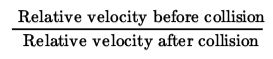
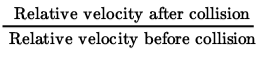
3. Coefficient of restitution is defined as
(a) 
Image
(b) Relative velocity after collision x relative velocity before collision
(c) Relative velocity after collision + relative velocity before collision
(d) 
Image
OR
In real life most of the collisions are
(a) Range of coefficient of restitution is 0 < e < 1
(b) both neither perfectly nor perfectly inelastic and range of coefficient of restitution is 0 < e < 1.
(c) neither perfectly elastic nor perfectly inelastic
(d) perfectly inelastic
4. For perfectly elastic and perfectly inelastic collision, the value of coefficient of restitution are respectively
(a) $+1,-1$    (b) 0,1    (c) $0,-1$    (d) 1,0
Read the passage given below and answer the following questions from (i) to (v). Maximum absolute error in the sum or difference of two quantities is equal to sum of the absolute error in the individual quantities, i.e. Z = A + B, then, $\pm\triangle\text{Z}=\pm\triangle\text{A}\pm\text{B}$ Maximum fractional error in a product or division of quantities is equal to the sum of fractional errors in the individual quantities i.e. AB or $\frac{\text{A}}{\text{B}},$ then, $\frac{\triangle\text{Z}}{\text{Z}}=\pm\frac{\triangle\text{A}}{\text{A}}+\frac{\triangle\text{B}}{\text{B}}$ Two resistors of resistances $\text{R}_1=100\pm3\Omega$ are connected (a) in series and (b) in parallel.
  1. The percentage error in the value of $R_1$ is:
  1. 3%
  2. 4%
  3. 6%
  4. 0.3%
  1. The fractional error in the value of $R_2$ is:
  1. $\frac{1}{40}$
  2. $\frac{1}{50}$
  3. $\frac{1}{100}$
  4. $\frac{1}{200}$
  1. Find the equivalent resistance of the series combination.
  1. $(250\pm7)\Omega$
  2. $(320\pm6)\Omega$
  3. $(300\pm7)\Omega$
  4. $(300\pm1)\Omega$
  1. The percentage error in equivalent resistance in series combination is:
  1. 2%
  2. 2.3%
  3. 2.5
  4. 3%
  1. Find the equivalent resistance of the parallel combination having error of $1.8\Omega.$
  1. $(66\pm1)\Omega$
  2. $(66.7\pm1.18)\Omega$
  3. $(66.3\pm2)\Omega$
  4. $(67\pm3)\Omega$
TV signals broadcast by Delhi studio cannot be directly received at Patna which is about 1000km away. But the same signal goes some 36000km away to a satellite, gets reflected and is then received at Patna. Explain.
Read the passage given below and answer the following questions from (i) to (v). Pressure of an Ideal Gas: according to kinetic theory of gases pressure is given by $\text{P}=\frac{1}{3}\text{ nmv}^2$
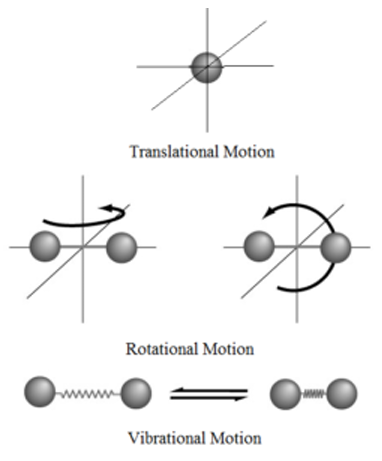
Where, n is number of molecules per unit volume, m is mass and $v^2$ is mean squared speed. Though we choose the container to be a cube, the shape of the vessel really is immaterial. The average kinetic energy of a molecule is proportional to the absolute temperature of the gas; it is independent of pressure, volume or the nature of the ideal gas. This is a fundamental result relating temperature, a macroscopic measurable parameter of a gas (a thermodynamic variable as it is called) to a molecular quantity, namely the average kinetic energy of a molecule. The two domains are connected by the Boltzmann constant and given by $E = k_bT$. Where kb is Boltzmann constant having value of $1.38 \times 10^{-23}$ joule per Kelvin. We have seen that in thermal equilibrium at absolute temperature T, for each translational mode of motion, the average energy is $\frac{1}{2}\text{K}_\text{b}\text{t}$. The most elegant principle of classical statistical mechanics (first proved by Maxwell) states that this is so for each mode of energy: translational, rotational and vibrational. That is, in equilibrium, the total energy is equally distributed in all possible energy modes, with each mode having an average energy equal to $\frac{1}{2}\text{K}_\text{b}\text{t}$. This is known as the law of equipartition of energy. Accordingly, each translational and rotational degree of freedom of a molecule contributes $\frac{1}{2}\text{K}_\text{b}\text{t}$ to the energy, while each vibrational frequency contributes $2\times\frac{1}{2}\text{Kb T}=\text{K}_\text{b}\text{T}$ since a vibrational mode has both kinetic and potential energy modes.
  1. Boltzmann constant has value of:
  1. 1.38 × 10 - 23 joule per Kelvin.
  2. 1.38 × 10 - 28 joule per Kelvin.
  3. 1.38 × 10 - 30 joule per Kelvin.
  4. None of these.
  1. SI unit of Boltzmann constant is given by:
  1. Joules per meter
  2. Joules per Kelvin
  3. Joules per Newton
  4. None of these
  1. According to kinetic theory give formula for pressure of idea gas.
  2. According to kinetic theory what is average kinetic energy of molecules of ideal gas?
  3. What is law of equipartition of energy?
Read the passage given below and answer the following questions from 1 to 5. If A is vector given by $A = Ax\ i + Ay\j$ where The quantities $A_x$ and $A_y$ are called x, and y- components of the vector A. Note that Ax is itself not a vector, but $A_x$ i is a vector, and so is $A_y\ j$. Using simple trigonometry, we can express $A_x$ and $A_y$ in terms of the magnitude of A and the angle \theta it makes with the x-axis. $\text{Ax} = \text{A} \cos(\theta)$
$\text{Ay} = \text{A} \text{ \sin}(\theta)$ If A and $\theta$ are given, Ax and Ay can be obtained using If Ax and Ay are given, A and $\theta$ can be obtained as follows – $\text{A}^2_\text{x}+\text{A}^2_\text{y}=(\text{A}\cos\theta)^2+(\text{A}\sin\theta)^2$ $\text{A}^2_\text{x}+\text{A}^2_\text{y}=\text{A}^2\cos^2\theta+\text{A}^2\sin^2\theta$ $\Rightarrow\text{A}^2_\text{x}+\text{A}^2_\text{y}=\text{A}^2(\cos^2\theta+\sin^2\theta)$ ${A}^2_\text{x}+\text{A}^2_\text{y}=\text{A}^2(\because\sin^2\theta+\cos^2\theta=1)$ $\text{A}^2=\text{A}^2_\text{y}+\text{A}^2_\text{y}$ $\Rightarrow\text{A}=\sqrt{\text{A}^2_\text{x}+\text{A}^2_\text{y }}...$ $\text{Dividing}\text{ A}_\text{y}\text{ by} \text{ A}_\text{y},\text{we get}$ $\frac{\text{A}_\text{y}}{\text{A}_\text{x}}=\frac{\text{A}\sin\theta}{\text{A}\cos\theta}$ $\Rightarrow\frac{\text{A}_\text{y}}{\text{A}_\text{x}}=\tan\theta$ $\tan\theta=\frac{\text{A}_\text{y}}{\text{A}_\text{x}}$ $\theta=\tan^{-1}\Big[\frac{\text{A}_\text{y}}{\text{A}_\text{x}}\Big]$
Position vector-The position vector r of a particle P located in a plane with reference to the origin of an x-y reference frame is given by $r = x i + y j$ where x and y are components of r along x-, and y- axes or simply they are the coordinates of the object. Suppose a particle moves along the Then, the displacement is: $\triangle r = r_2-r_1.$ We can write this in a component form: $\triangle r = (x’ i + y’ j) – ( x i + y j) = i\triangle x – j\triangle y$ Where $\triangle x = x’ – x, \triangle y = y – y.$
The average velocity (v) of an object is the ratio of the displacement and the corresponding time Interval. $\text{V}=\frac{\triangle\text{r}}{\triangle\text{t}}$
$=\frac{\text{i}\triangle\text{x}-\text{j}\triangle\text{y}}{\triangle\text{t}}$
$=\text{i}\times\frac{\triangle\text{x}}{\triangle\text{t}}+\text{j}\times\frac{\triangle\text{y}}{\triangle\text{t}}$
$=\text{V}_\text{x}\text{i}+\text{V}_\text{y}\text{j}$ So, if the expressions for the coordinates x and y are known as functions of time, we can use these equations to find vx and vy. The magnitude of v is then $V = ( v_x^2+ v_y^2)$ and the direction of v is given by the angle q and given by $\tan(\theta)=\frac{\text{vx}}{\text{vy}}$
  1. If A is vector given by A = Ax i + Ay j .if the magnitude of vector is A and the angle $\theta$ it makes with the x-axis Ax can be given by:
  1. Ax = A cos(q)
  2. Ax = A sin(q)
  3. Ax = A tan(q)
  4. None of the above
  1. If A is vector given by A = Ax i + Ay j .if the magnitude of vector is A and the angle $\theta$ it makes with the x-axis Ay can be given by:
  1. Ax = A cos(q)
  2. Ax = A sin(q)
  3. Ax = A tan(q)
  4. None of the above
  1. Write a note on position vector and displacement of object:
  1. Write a note on average velocity:
  1. If A is vector given by A = Ax i + Ay j where obtain expression for resultant amplitude of vector and its angle with x axis: