Question
TV signals broadcast by Delhi studio cannot be directly received at Patna which is about 1000km away. But the same signal goes some 36000km away to a satellite, gets reflected and is then received at Patna. Explain.

Answer

To receive TV signals transmitted from Delhi in Patna directly, one has to use antennas of great height, which will cost much. On the other hand, transmission of signals With the help of satellites requires only high frequency waves and can be done easily.

Need a full question paper?

Generate a complete, print-ready paper with questions like this in minutes — across 16+ boards, with answer keys.
Start Generating Free

Similar questions

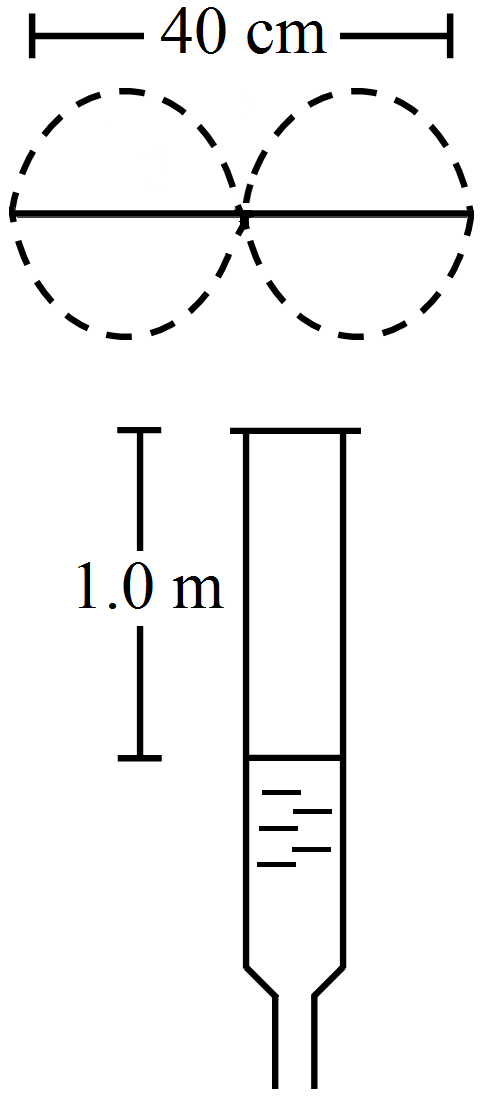
Consider the situation shown in figure. The wire which has a mass of $4.00g$ oscillates in its second harmonic and sets the air column in the tube into vibrations in its fundamental mode. Assuming that the speed of sound in air is $340m/s$, find the tension in the wire.
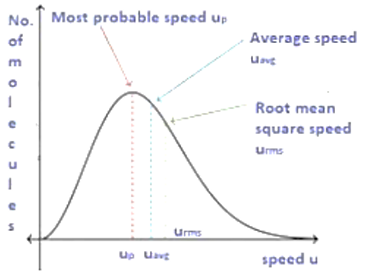
Root mean square velocity (RMS value)is the square root of the mean of squares of the velocity of individual gas molecules and the Average velocity is the arithmetic mean of the velocities of different molecules of a gas at a given temperature.
Image
1. Moon has no atmosphere because:
(a) the escape velocity of the moon’s surface is more than the r.m.s velocity of all molecules
(b) it is far away from the surface of the earth
(c) the r.m.s. velocity of all the gas molecules is more than the escape velocity of the moon’s surface
(d) its surface temperature is $10^{\circ} C$
2. For an ideal gas, $\frac{C_P}{C_V}$ is
(a) $\leq 1$    (b) none of these    (c) $>1$    (d) $<1$
3. The root means square velocity of hydrogen is $\sqrt{5}$ times that of nitrogen. If $T$ is the temperature of the gas then:
(a) $T\left(H_2\right)=T\left(N_2\right)$    (b) $T \left( H _2\right)< T \left( N _2\right)$
(c) $T \left( H _2\right) \neq T \left( N _2\right)$    (d) $T \left( H _2\right)> T \left( N _2\right)$
4. Suppose the temperature of the gas is tripled and $N _2$ molecules dissociate into an atom. Then what will be the rms speed of atom:
(a) $v_0 \sqrt{2}$    (b) $v_0 \sqrt{6}$    (c) $v_0 \sqrt{3}$    (d) $v_0$
OR
The velocities of the molecules are $v , 2 v , 3 v , 4 v \& 5 v$. The RMS speed will be:
(a) 11 v    (b) $v (12)^{11}$   (c) v    (d) $v (11)^{12}$
Read the passage given below and answer the following questions from i to v. If an object moving along the straight line covers equal distances in equal intervals of time, it is said to be in uniform motion along a straight line. Distance and displacement are two quantities that seem to mean the same but are different with different meanings and definitions. Distance is the measure of actual path length travelled by object. It is scalar quantity having SI unit of metre while displacement refers to the shortest distance between initial and final position of object. It is vector quantity. The magnitude of the displacement for a course of motion may be zero but the corresponding path length is not zero. using this data answer following questions.
  1. Can path length be zero for motion of body from one point to other point?
  1. Yes
  2. No
  1. For any given motion from point A to B, displacement =10m and distance = 5m. Is it possible?
  1. Yes
  2. No
  1. For rectilinear motion displacement can be
  1. Positive only
  2. Negative only
  3. Can be zero
  4. All of the above
  1. Define distance and displacement of particle.
  1. Write difference between distance and displacement.
A collision experiment is done on a horizontal table kept in an elevator. Do you expect a change in the results if the elevator is accelerated up or down because of the noninertial character of the frame?
While watering a distant plant, a gardener partially water than in fresh closes the exit hole of the pipe by putting his finger on it. Explain why this results in the water stream goirig to a larger distance.
The ear-ring of a lady shown in has a 3cm long light suspension wire.
  1. Find the time period of small oscillations if the lady is standing on the ground.
  2. The lady now sits in a merry-go-round moving at 4m/s in a circle of radius 2m. Find the time period of small oscillations of the ear-ring.
Find the acceleration due to gravity of the moon at a point 1000 km above the moon's surface. The mass of the moon is $7.4 \times 10^{22} \mathrm{~kg}$ and its radius is 1740 km .
Read the passage given below and answer the following questions from (i) to (v). The velocity of an object, in general, changes during its course of motion. Initially, at the time of Galileo, it was thought that, this change m could be described by the rate of change of velocity with distance. But, through his studies of motion of freely falling objects and motion of objects on an inclined plane, Galileo concluded that, the rate of change of velocity with time is a constant of motion for all objects in free fall. This led to the concept of acceleration as the rate of change of velocity with time. The motion in which the acceleration remains constant is known as to be uniformly accelerated motion. There are certain equations which are used to relate the displacement (x), time taken (t), initial velocity (u), final velocity (v) and acceleration (a) a for such a motion and are known as kinematics equations for uniformly accelerated motion.
  1. The displacement of a body in 8s starting from rest with an acceleration of $20\ cms^{-2}$ is:
  1. $64m$
  2. $640m$
  3. $64cm$
  4. $0.064m$
  1. A particle starts with a velocity of $2ms^{-1}$ and moves in a straight line with a retardation of $0.1ms^{-2}$. The first time at which the particle is $15\ m$ from the starting point is:
  1. $10s$
  2. $20s$
  3. $30s$
  4. $40s$
  1. If a body starts from rest and travels $120cm$ in 6th second, then what is its acceleration?
  1. $0.20 ms^{-2}$
  2. $0.027ms^{-2}$
  3. $0.218ms^{-2}$
  4. $003. ms^{-2}$
  1. An object starts from rest and moves with uniform acceleration a. The final velocity of the particle in terms of the distance x covered by it is given as:
  1. $\sqrt{2\text{ax}}$
  2. $2\text{ax}$
  3. $\sqrt{\frac{\text{ax}}{2}}$
  4. $\sqrt{\text{ax}}$
  1. A body travelling with uniform acceleration crosses two points A and B with velocities $20ms^{-1}$ and $30ms^{-1}$​​​​​​​, respectively. The speed of the body at mid-point of A and B is:
  1. $25\text{ms}^{-1}$
  2. $25.5\text{ms}^{-1}$
  3. $24\text{ms}^{-1}$
  4. $10\sqrt{6}\text{ms}^{-1}$
A moving-coil galvanometer has a 50-turn coil of size 2cm × 2cm. It is suspended between the magnetic poles producing a magnetic field of 0.5T. Find the torque on the coil due to the magnetic field when a current of 20mA passes through it.
Read the passage given below and answer the following questions from (i) to (v). Vectors
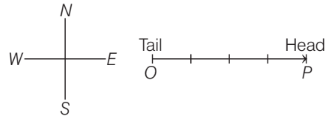
Vectors are the physical quantities which have both magnitudes and directions and obey the triangle/parallelogram laws of addition and subtraction. It is specified by giving its magnitude by a number and its direction. e.g. Displacement, acceleration, velocity, momentum, force, etc. A vector is represented by a bold face type and also by an arrow placed over a letter, i.e. F, a, b or $\overrightarrow{\text{F}},\overrightarrow{\text{a}},\overrightarrow{\text{b}}.$ The length of the line gives the magnitude and the arrowhead gives the direction. The point P is called head or terminal point and pointO is called tail or initial point of the vector OP.
  1. Amongst the following quantities, which is not a vector quantity?
  1. Force
  2. Acceleration
  3. Temperature
  4. Velocity
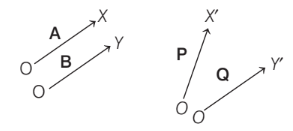
  1. Set of vectors A and B, P and Q are as shown below

Length of A and B is equal, similarly length of P and Q is equal. Then, the vectors which are equal, are:
  1. A and P
  2. P and Q
  3. A and B
  4. B and Q
  1. $\mid\lambda\text{A}\mid=\lambda\mid\text{A}\mid,$ if:
  1. $\lambda>0$
  2. $\lambda,<0$
  3. $\lambda,=0$
  4. $\lambda,\neq0$
  1. Among the following properties regarding null vector which is incorrect?
  1. A + 0 = A
  2. $\lambda0=\lambda$
  3. 0A = 0
  4. A - A = 0
  1. The x and y components of a position vector P have numerical values 5 and 6, respectively. Direction and magnitude of vector P are:
  1. $\tan^{-1}\big(\frac{6}{5}\big)\text{and}\sqrt{61}$
  2. $\tan^{-1}\big(\frac{5}{6}\big)\text{and}\sqrt{61}$
  3. 60° and 8
  4. 30° and 9