Question
When electric dipole is placed in uniform electric field, its two charges experience equal and opposite forces, which cancel each other and hence net force on electric dipole in uniform electric field is zero. However, these forces are not collinear, so they give rise to some torque on the dipole. Since net force on electric dipole in uniform electric field is zero, so no work is done in moving the electric dipole in uniform electric field. However, some work is done in rotating the dipole against the torque acting on it.
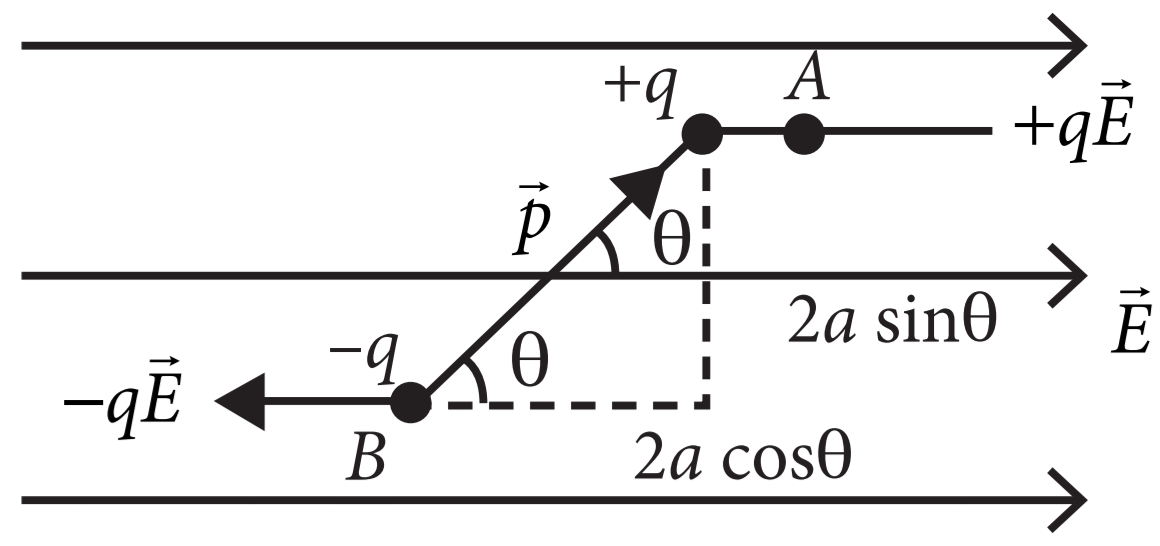
  1. The dipole moment of a dipole in a uniform external field $\vec{\text{E}}$ is $\vec{\text{P}}.$ Then the torque 'i acting on the dipole is:
  1. $\vec{\tau}=\vec{\text{P}}\times\vec{\text{E}}$

  2. $\vec{\tau}=\vec{\text{P}}\cdot\vec{\text{E}}$

  3. $\vec{\tau}=2(\vec{\text{P}}+\vec{\text{E}})$

  4. $\vec{\tau}=(\vec{\text{P}}+\vec{\text{E}})$

  1. An electric dipole consists of two opposite charges, each of magnitude $1.0\mu\text{C}$ separated by a distance of 2.0cm. The dipole is placed in an external field of 105N C-1. The maximum torque on the dipole is:
  1. 0.2 × 10-3Nm
  2. 1 × 10⁻³Nm
  3. 2 × 10-3Nm
  4. 4 × 10⁻³Nm
  1. Torque on a dipole in uniform electric field is minimum when $\theta$ is equal to:
  1. 90º
  2. 180º
  3. Both (a) and (c)
  1. When an electric dipole is held at an angle in a uniform electric field, the net force F and torque t on the dipole are:
  1. $\text{F}=0, \tau=0$

  2. $\text{F}\not=0, \tau\not=0$

  3. $\text{F}=0, \tau\not=0$

  4. $\text{F}\not=0, \tau=0$

  1. An electric dipole of moment pis placed in an electric field of intensity E. The dipole acquires a position such that the axis of the dipole makes an angle $\theta$ with the direction of the field. Assuming that the potential energy of the dipole to be zero when $\theta=90^\circ$ the torque and the potential energy of the dipole will respectively be:
  1. $\text{pE}\sin\theta,-\text{pE}\cos\theta$

  2. $\text{pE}\sin\theta,-2\text{pE}\cos\theta$

  3. $\text{pE}\sin\theta,2\text{pE}\cos\theta$

  4. $\text{pE}\cos\theta,-2\text{pE}\sin\theta$
Answer

  1. (a) $\vec{\tau}=\vec{\text{P}}\times\vec{\text{E}}$

Explanation:

As $\tau=$ either force × perpendicular distance between the two forces.

$=\text{qaE}\sin\theta\text{ or }\tau=\text{PE}\sin\theta$

$(\because\text{qa}=\text{P})$

Or $\vec{\tau}=\vec{\text{P}}\times\vec{\text{E}}$

  1. (c) 2 × 10-3Nm

​​​​​​​​​​​​​​Explanation:

The maximum torque on the dipole in an external electric field is given by

$\tau=\text{pE}=\text{q}(\text{2a})\times\text{E}$

Here, $\text{q}=1\mu\text{C}=10^{-6}\text{C,}$

2a = 2cm = 2 × 10-2m,

E = 105N C-1,

$\tau=?$

$\therefore\tau=10^{-6}\times2\times10^{-2}\times10^5$

$=2\times10^{-3}\text{Nm}$

  1. (d) Both (a) and (c)

​​​​​​​​​​​​​​​​​​​​​​​​​​​​​​​​​​​Explanation:

When $\theta$ is 0 or 180º, the $\tau$ minimum, which means the dipole moment should be parallel to the direction of the uniform electric field.

  1. (c) $\text{F}=0, \tau\not=0$

​​​​​​​​​​​​​​​​​​​​​​​​​​​​​​​​​​​Explanation:

Net force is zero and torque acts on the dipole, trying to align p with E.

  1. (a) $\text{pE}\sin\theta,-\text{pE}\cos\theta$

​​​​​​​​​​​​​​​​​​​​​​​​​​​​​​​​​​​Explanation:

Torque, $\tau=\text{pE}\sin\theta$ and potential energy, $\text{U}=-\text{pE}\cos\theta.$​​​​​​​

Need a full question paper?

Generate a complete, print-ready paper with questions like this in minutes — across 16+ boards, with answer keys.

Start Generating Free

Similar questions

A sample contains a mixture of 108Ag and 110Ag isotopes each having an activity of 8.0 × 10⁸ disintegration per second. 110Ag is known to have larger half-life than 108Ag. The activity A is measured as a function of time and the following data are obtained.
Time (s) Activity (A) (108 disinte- grations s-1)
Time (s) Activity (A) (108 disinte-grations s-1)
20 11.799 200 3.0828
40 9.1680 300 1.8899
60 7.4492 400 1.1671
80 6.2684 500 0.7212
100 5.4115    
  1. Plot ln $\Big(\frac{\text{A}}{\text{A}_0}\Big)$ versus time.
  2. See that for large values of time, the plot is nearly linear. Deduce the half-life of 110Ag from this portion of the plot.
  3. Use the half-life of 110Ag to calculate the activity corresponding to 108Ag in the first 50s.
  4. Plot In $\Big(\frac{\text{A}}{\text{A}_0}\Big)$ versus time for 108Ag for the first 50s.
  5. Find the half-life of 108Ag.
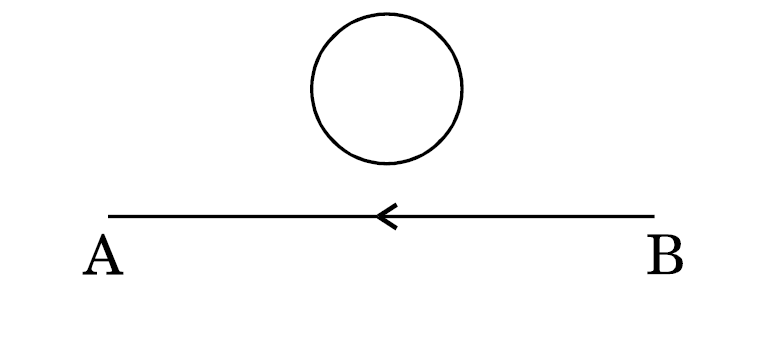
The electric current flowing in a wire in the direction from B to A is decreasing. Find out the direction of the induced current in the metallic loop kept above the wire as shown.

The electron mobility characterises how quickly an electron can move through a metal of semiconductor when pulled by an electric field. There is an analogous quality for holes, called hole mobility. A block of pure silicon at 300K has a length of 10cm and an area of 1.0cm2. A battery of emf 2V is connected across it. The mobility of electron is 0.14m2 V-1s-1 and their number density is 1.5 × 1016m-3. The mobility of holes is 0.05m2 V-1s-1.
  1. The electron current is:
  1. 6.72 × 10-4A
  2. 6.72 × 10-5A
  3. 6.72 × 10-6A
  4. 6.72 × 10⁻⁷A
  1. The hole current is:
  1. 2.0 × 10-7A
  2. 2.2 × 10-7A
  3. 2.4 × 10-7A
  4. 2.6 × 10-7A
  1. The number density of donor atoms which are to be added up to pure silicon semiconductor to produce an n-type semiconductor of conductivity $6.4\Omega^{-1}\text{cm}^{-1}$ is approximately (neglect the contribution of holes to conductivity).
  1. 3 × 1022m-3
  2. 3 × 1023m-3
  3. 3 × 1024m-3
  4. 3 × 1021m-3
  1. When the given silicon semiconductor is doped with indium, the hole concentration increases to 4.5 × 1023m-3. The electron concentration in doped silicon is:
  1. 3 × 109m-3
  2. 4 × 109m-3
  3. 5 × 109m-3
  4. 6 × 109m-3
  1. Pick out the statement which is not correct.
  1. At a low temperature, the resistance of a semiconductor is very high.
  2. Movement of holes is restricted to the valence band only.
  3. Width of the depletion region increases as the forward bias voltage increases in case of a p-n junction diode.
  4. ln a forward bias condition, the diode heavily conducts.
 A magnetic field can be produced by moving, charges or electric currents. The basic equation governing the magnetic field due to a current distribution is the Biot-Savart law. Finding the magnetic field resulting from a current distribution involves the vector product, and is inherently a calculas problem when the distance from the current to the field point is continuously changing. According to this law, the magnetic field at a point due to a current element of length $\text{d}\vec{\text{I}}$ carrying current I, at a distance r from the element is $\text{dB}=\frac{\mu_0}{4\pi}\frac{\text{I}(\text{d}{\vec{\text{I}}\times\vec{\text{r}}})}{\text{r}^3}$

Biot-Savart law has certain similarities as well as difference with Coloumb's law for electrostatic field e.g., there is an angle dependence in Biot-Savart law which is not present in electrostatic case.

  1. The direction of magnetic field $\text{d}\vec{\text{B}}$ due to a current element $\text{Id}\vec{\text{l}}$ at a point of distance $\vec{\text{r}}$ from it, when a current I passes through a long conductor is in the direction
  1. Of position vector $\vec{\text{r}}$ of the point.
  2. Of current element $\text{Id}\vec{\text{l}}$
  3. Perpendicular to both $\text{d}\vec{\text{l}}$ and $\vec{\text{r}}$
  4. Perpendicular to $\text{d}\vec{\text{l}}$ only.
  1. The magnetic field due to a current in a straight wire segment of length Lat a point on its perpendicular bisector at a distance r (r >> L)
  1. Decreases as $\frac{1}{\text{r}}$

  2. Decreases as $\frac{1}{\text{r}^2}$

  3. Decreases as $\frac{1}{\text{r}^3}$

  4. approaches a finite limit as $\text{r}\rightarrow\infty$
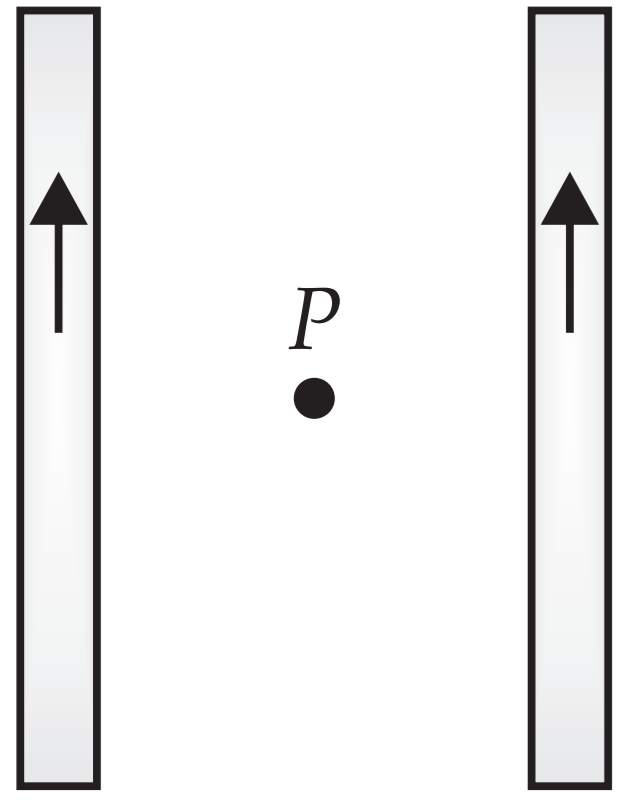
  1. Two long straight wires are set parallel to each other. Each carries a current i in the same direction and the separation between them is 2r. The intensity of the magnetic field midway between them is:

  1. $\mu_0\frac{\text{i}}{\text{r}}$

  2. $4\mu_0\frac{\text{i}}{\text{r}}$

  3. $\text{Zero}$

  4. $\mu_0\frac{\text{i}}{\text{4r}}$

  1. A long straight wire carries a current along the z-axis for any two points in the x - y plane. Which of the following is always false?
  1. The magnetic fields are equal.
  2. The directions of the magnetic fields are the same.
  3. The magnitudes of the magnetic fields are equal.
  4. The field at one point is opposite to that at the other point.
  1. Biot-Savart law can be expressed alternatively as:
  1. Coulomb's Law.
  2. Ampere's circuital law.
  3. Ohm's Law.
  4. Gauss's Law. 
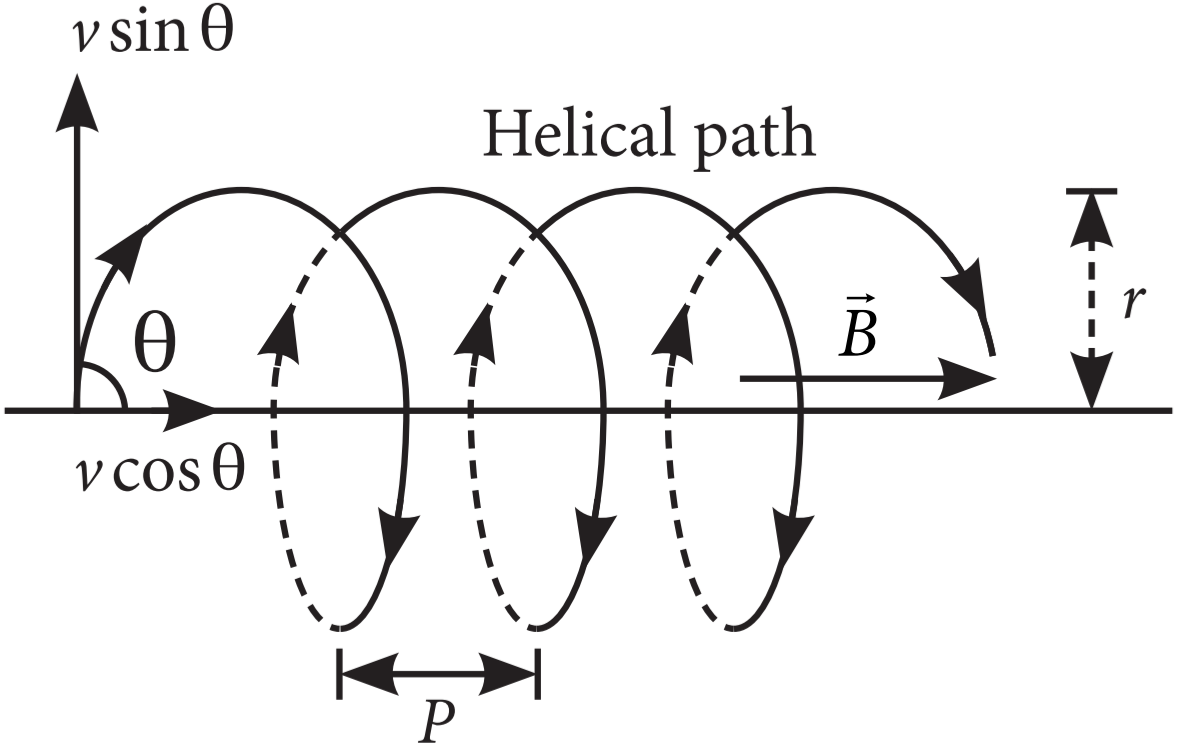
The path of a charged particle in magnetic field depends upon angle between velocity and magnetic field. If velocity $\vec{\text{v}}$ is at angle $\theta$ to $\vec{\text{B}},$ component of velocity parallel to magnetic field $(\text{v}\cos\theta)$ remains constant and component of velocity perpendicular to magnetic field $(\text{v}\sin\theta)$ is responsible for circular motion, thus the charge particle moves in a helical path.

The plane of the circle is perpendicular to the magnetic field and the axis of the helix is parallel to the magnetic field. The charged particle moves along helical path touching the line parallel to the magnetic field passing through the starting point after each rotation.

Radius of circular path is $\text{r}=\frac{\text{mv}\sin\theta}{\text{qB}}$

Hence the resultant path of the charged particle will be a helix, with its axis along the direction of $\vec{\text{B}}$ as shown in figure.

  1. When a positively charged particle enters into a uniform magnetic field with uniform velocity, its trajectory can b:
  1. A straight line.
  2. A circle.
  3. A helix.
  1. (i) Only
  2. (i) or (ii)
  3. (i) or (iii)
  4. Any one of (i), (ii) and (iii)
  1. Two charged particles A and B having the same charge, mass and speed enter into a magnetic field in such a way that the initial path of A makes an angle of 30º and that of B makes an angle of 90º with the field. Then the trajectory of:
  1. B will have smaller radius of curvature than that of A.
  2. Both will have the same curvature.
  3. A will have smaller radius of curvature than that of B.
  4. Both will move along the direction of their original velocities.
  1. An electron having momentum 2.4 × 10⁻²³kg m/ s enters a region of uniform magnetic field of 0.15T. The field vector makes an angle of 30º with the initial velocity vector of the electron. The radius of the helical path of the electron in the field shall be:
  1. mm
  2. 1mm
  3. $\frac{\sqrt{3}}{2}\text{mm}$

  4. 0.5mm
  1. The magnetic field in a certain region of space is given by $\vec{\text{B}}=8.35\times10^{-2}\hat{\text{i}}\text{T}.$ A proton is shot into the field with velocity $\vec{\text{v}}=(2\times10\hat{\text{i}}+4\times10^5\hat{\text{j}.}$ The proton follows a helical path in the field. The distance moved by proton in the x-direction during the period ofone revolution in the yz-plane will be:

(Mass of proton = 1.67 × 10⁻²⁷kg)

  1. 0.053m
  2. 0.136m
  3. 0.157m
  4. 0.236m
  1. The frequency of revolution of the particle is:
  1. $\frac{\text{m}}{\text{pB}}$

  2. $\frac{\text{qB}}{2\pi\text{m}}$

  3. $\frac{2\pi\text{R}}{\text{v}\cos\theta}$

  4. $\frac{2\pi\text{R}}{\text{v}\sin\theta}$ 

  1. A small compass needle of magnetic moment ‘m’ is free to turn about an axis perpendicular to the direction of uniform magnetic field ‘B’. The moment of inertia of the needle about the axis is ‘I’. The needle is slightly disturbed from its stable position and then released. Prove that it executes simple harmonic motion. Hence deduce the expression for its time period.
  2. A compass needle, free to turn in a vertical plane orients itself with its axis vertical at a certain place on the earth. Find out the values of (i) horizontal component of earth’s magnetic field and (ii) angle of dip at the place.
Ram is a  student of class X in a village school. His uncle gifted him a bicycle with a dynamo fitted in it. He was very excited to get it. While cycling during night, he could light the bulb and see the objects on the road. He however, did not know this device works. He asked this question to his teacher. the teacher considered it an opportunity to explain the working to the whole class.
Answer the following question:
  1. State the principle and working of a dynamo.
  2. Write two values each displayed by Ram and his school teacher.
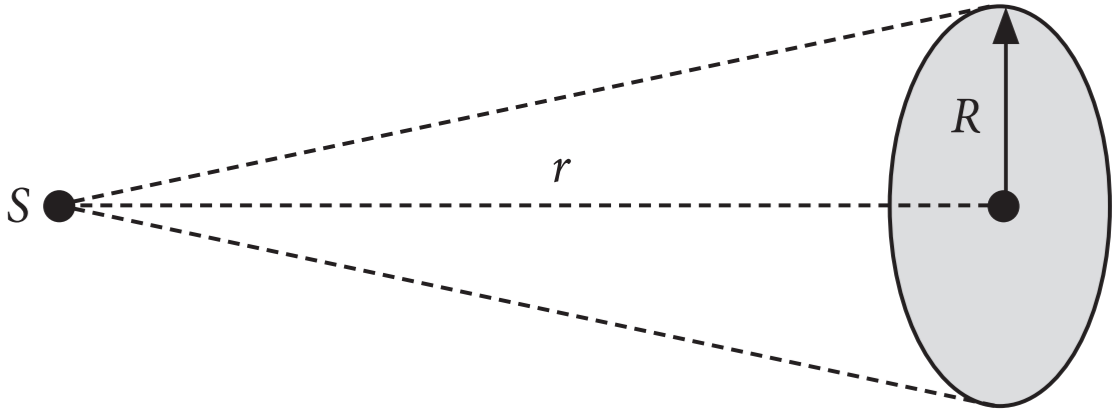
A point sources of power 6.4 × 10⁻³W emits mono energetic photons each of energy 6.0eV. The source is located at a distance of 0.8m from the centre of a stationary metallic sphere of work function 3.0eV and of radius 1.6 × 10⁻³m mas shown in figure. The sphere is isolated and initially neutral and photoelectrons are instantly taken away from sphere after emission. The efficiency of photoelectric emission is one for very 105 incident photons.

  1. The power received by the sphere through radiations is:
  1. $\frac{\text{R}^2}{\text{Pr}}$
  2. $\frac{\text{PR}^2}{4\text{r}^2}$
  3. $\frac{\text{P}^2\text{R}}{2\pi\text{r}}$
  4. $\frac{\text{PR}}{4\text{r}}$
  1. Number of photons striking the metal sphere per second is:
  1. 6.7 × 109
  2. 3.3 × 10⁹
  3. 6.7 × 1010
  4. 3.3 × 10¹⁰
  1. The number of photoelectrons emitted per second is about.
  1. 3.3 × 10⁴
  2. 6.7 × 104
  3. 6.7 × 1015
  4. 3.3 × 10¹⁵
  1. The photoelectric emission stops when the sphere acquires a potential about.
  1. 2V
  2. 3V
  3. 4V
  4. 6V
  1. If the distance of source becomes double from the centre of the metal sphere then the power received by the sphere.
  1. $\frac{\text{PR}^2}{4\text{r}^2}$
  2. $\frac{\text{PR}^2}{16\text{r}^2}$
  3. $\frac{\text{PR}^2}{4\text{r}}$
  4. $\frac{\text{P}^2\text{R}^2}{16\text{r}^2}$

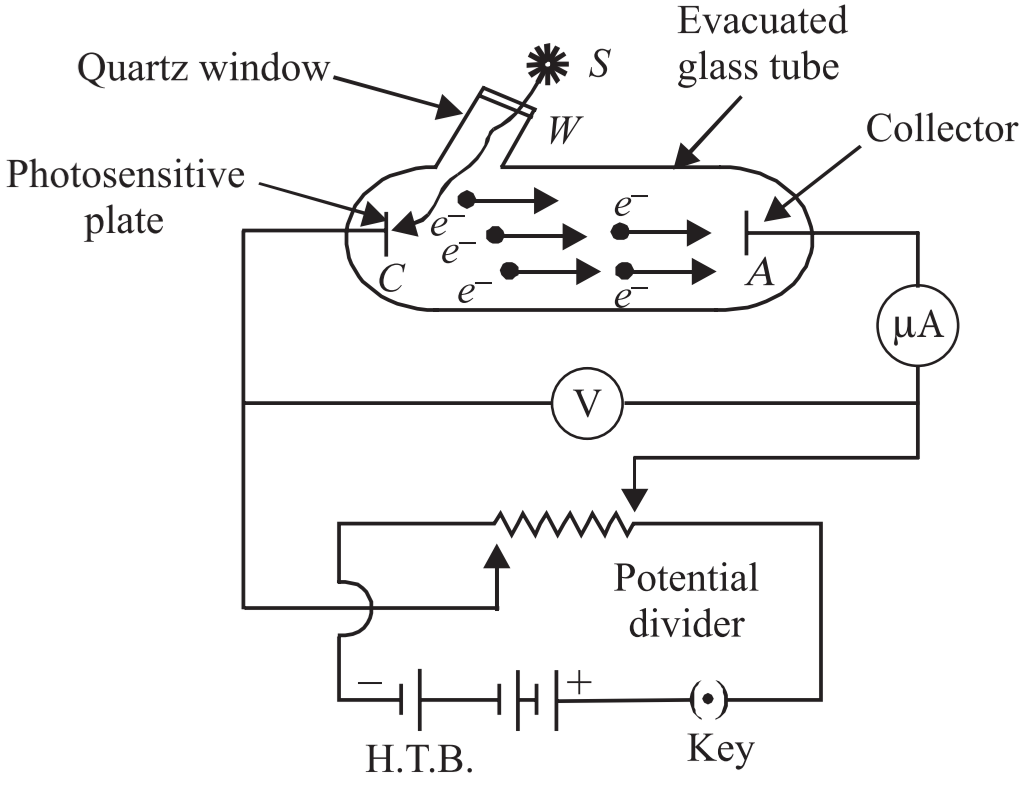
To study photoelectric effect, an emitting electrode C of a photosensitive material is kept at negative potential and collecting electrode A is kept at positive potential in an evacuated tube. When light of sufficiently high frequency falls on emitting electrode, photoelectrons are emitted which travel directly to collecting electrode and hence an electric current called photoelectric current starts flowing in the circuit, which is directly proportional to the number of photoelectrons emitted by emitting electrode C.

While demonstrating the existence of electromagnetic waves, Hertz found that high voltage sparks passed across the metal electrodes of the detector loop more easily when the cathode was illuminated by ultraviolet light from an arc lamp. The ultraviolet light falling on the metal surface caused the emission of negatively charged particles, which are now known to be electrons, into the surrounding space and hence enhanced the high voltage sparks.

  1. Cathode rays were discovered by:
  1. Maxwell Clerk James.
  2. Heinrich Hertz.
  3. William Crookes.
  4. J. J. Thomson.
  1. Cathode rays consists of:
  1. Photons
  2. Electrons
  3. Pistons
  4. $\alpha$-particles

  1. Who discovered the charge on an electron for the frist time?
  1. Millikan
  2. Thomson
  3. Kelvin
  4. Coulomb
  1. The dual nature oflight is exhibited by:
  1. Diffraction and photoelectric effect.
  2. Photoelectric effect.
  3. Refraction and interference.
  4. Diffraction and reflection.
  1. ln the phenomenon of electric discharge through gases at low pressure, the coloured glow in the tube appears as a result of:
  1. Collisions between the charged particles emitted from the cathode and the atoms of the gas.
  2. Collision between different electrons of the atoms of the gas.
  3. Excitation of electrons in the atoms.
  4. Collision between the atoms of the gas.
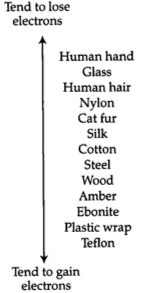
The triboelectric series is a list that ranks materials according to their tendency to gain or lose electrons. The process of electron transfer as a result of two objects coming into contact with one another and then separating is called triboelectric charging. During such an interaction, one of the two objects will always gain electrons (becoming negatively charged) and the other object will lose electrons (becoming positively charged). The relative position of the two objects on the triboelectric series will define which object gains electrons and which object loses electrons.
In triboelectric series, materials are ranked from high to low in terms of the tendency for the material to lose electron. If an object high up on this list (Glass, for example) is rubbed with an object low down on the list (Teflon, for example), the glass will lose electrons to the teflon. The glass will, in this case, become positively charged and the teflon will become negatively charged. Materials in the middle of the list (steel and wood, for example) are items those do not have a strong tendency to give up or accept electrons.
Image
(i) Materials in the upper position have ________ tendency to become positively charged
(a) no (b) medium (c) high (d) low
(ii) Name two materials which do not have a strong tendency to give up or accept electrons.
(a) Steel, wood (b) Plastic wrap, Teflon (c) Ebonite, Nylon (d) Nylon, cat fur
(iii) if human hair is rubbed with amber, how those will be charged?
(a) Hair will be negatively charged, Amber will be positively charged.
(b) Both positive
(c) Hair will be positively charged, Amber will be negatively charged.
(d) Both negative
(iv) Triboelectric charging is the process of electron transfer between two objects
(a) By contact (b) Without contact (c) By anyone of these (d) By none of these

OR

The object which loses electron becomes ________ charged and the object gains electron becomes ________ charged.
(a) positively, positively
(b) negatively, positively
(c) negatively, negatively
(d) positively, negatively