Question
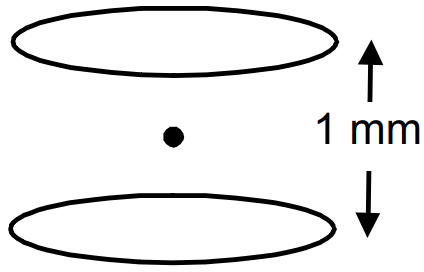
Suppose, one wishes to construct a 1.0 farad capacitor using circular discs. If the separation between the discs be kept at 1.0mm, what would be the radius of the discs?
Answer

Let the radius of the disc = R

$\therefore$ Area $=\pi\text{R}^2$
$\text{C}=1\text{f}$
$\text{D}=1\text{mm}=10^{-3}\text{m}$
$\therefore\text{C}=\frac{\epsilon_0\text{A}}{\text{d}}$
$\Rightarrow1=\frac{8.85\times10^{-12}\times\pi\text{r}^2}{10^{-3}}$
$\Rightarrow\text{r}^2=\frac{10^{-3}\times10^{12}}{8.85\times\pi}=\frac{10^9}{27.784}$
$=5998.5\text{m}=6\text{Km}$

Need a full question paper?

Generate a complete, print-ready paper with questions like this in minutes — across 16+ boards, with answer keys.

Start Generating Free

Similar questions

The first excited energy of a $He^+$ ion is the same as the ground state energy of hydrogen. Is it always true that one of the energies of any hydrogen$-$like ion will be the same as the ground state energy of a hydrogen atom?
A hydrogen atom in ground state absorbs a photon of ultraviolet radiation of wavelength 50nm. Assuming that the entire photon energy is taken up by the electron with what kinetic energy will the electron be ejected?
A healthy youngman standing at a distance of $7m$ from a $11.8m$ high building sees a kid slipping from the top floor. With what speed $($assumed uniform$)$ should he run to catch the kid at the arms height $(1.8m)$?
When an apple falls from a tree what happens to its gravitational potential energy just as it reaches the ground? After it strikes the ground?
The electric field associated with a monochromatic beam becomes zero $1.2 \times 10^{15}$ times per second. Find the maximum kinetic energy of the photoelectrons when this light falls on a metal surface whose work function is $2.0\ eV.$
There are energy bands in a solid. Do we have really continuous energy variation in a band or do we have very closely spaced but still discrete energy levels?
In $H _2$ atom, $r_0$ is radius of first Bohr's orbit. What will be the radius of second orbit? What will be the radius of single ionized helium atom?
Can an electromagnetic wave be polarised?
Explain barrier potential of $p-n$ junction.
  1. Derive the expression for the electric potential due to an electric dipole at a point on its axial line.
  2. Depict the equipotential surfaces due to an electric dipole.