Question
Explain barrier potential of $p-n$ junction.

Answer


Image
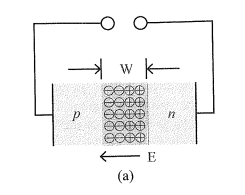
The loss of electrons from the $n$-region and the gain of electron by the $p$-region causes a difference of potential across the junction of the two regions.
Image
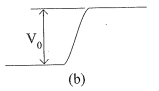
The polarity of this potential is such as to oppose further flow of carriers so that a condition of equilibrium exists.
Fig. shows $p-n$ junction at equilibrium and the potential across the junction.
Since the potential tends to prevent the movement of electron from the $n$-region into the $p$-region, it is often called a barrier potential.

Need a full question paper?

Generate a complete, print-ready paper with questions like this in minutes — across 16+ boards, with answer keys.
Start Generating Free

Similar questions

With the help of a circuit diagram, explain how two p-n junction diodes along with a centre tapped transformer can be used as a full wave rectifier.
Water is boiled in a container having a bottom of surface area $25\ cm^2,$ thickness $1.0\ mm$ and thermal conductivity $50\text{wm}^{-1}{^{\circ}}\text{C}^{-1}. 100g$ of water is converted into steam per minute in the steady state after the boiling starts. Assuming that no heat is lost to the atmosphere, calculate the temperature of the lower surface of the bottom. Latent heat of vaporization of water $=0.26\times10^6\text{Jkg}^{-1}.$
Derive the formula for conductivity and resistivity of metals by obtaining the relationship between drift velocity and current density.
Suppose Swarglok (heaven) is in constant motion at a speed of 0.9999c with respect to the earth. According to the earth's frame, how much time passes on the earth before one day passes on Swarglok?
Plot a graph showing the variation of photoelectric current with intensity of light. The work function for the following metals is given:
$Na : 2.75\ eV$ and $Mo : 4.175\ eV.$
Which of these will not give photoelectron emission from a radiation of wavelength $3300 \mathring A$ from a laser beam? What happens if the source of laser beam is brought closer?
An amount $Q$ of heat is added to a monatomic ideal gas in a process in which the gas performs a work $\frac{\text{Q}}{2}$ on its surrounding. Find the molar heat capacity for the process.
Suppose while sitting in a parked car, you notice a jogger approaching towards you in the side view mirror of $R=2 m$. If the jogger is running at a speed of $5 m s ^{-1}$, how fast the image of the jogger appear to move when the jogger is (a) $39 m$, (b) $29 m$, (c) $19 m$, and (d) $9 m$ away.
  1. When an AC source is connected to an ideal capacitor, show that the average power supplied by the source over a complete cycle is zero.
  2. A bulb is connected in series with a variable capacitor and an A.C. source as shown. What happens to the brightness of the bulb when the key is `the capacitor is gradually reduced?
A circular coil of wire consisting of $100$ turns, each of radius $8.0 \ cm$ carries a current of $0.40 A.$ What is the magnitude of the magnetic field $B$ at the centre of the coil?
A small flat search coil of area $5 \ cm^2$ with $140$ closely wound turns is placed between the poles of a powerful magnet producing magnetic field $0.09 T$ and then quickly removed out of the field region. Calculate
$a.$ change of magnetic flux through the coil, and
$b.$ emf induced in the coil.