MCQ
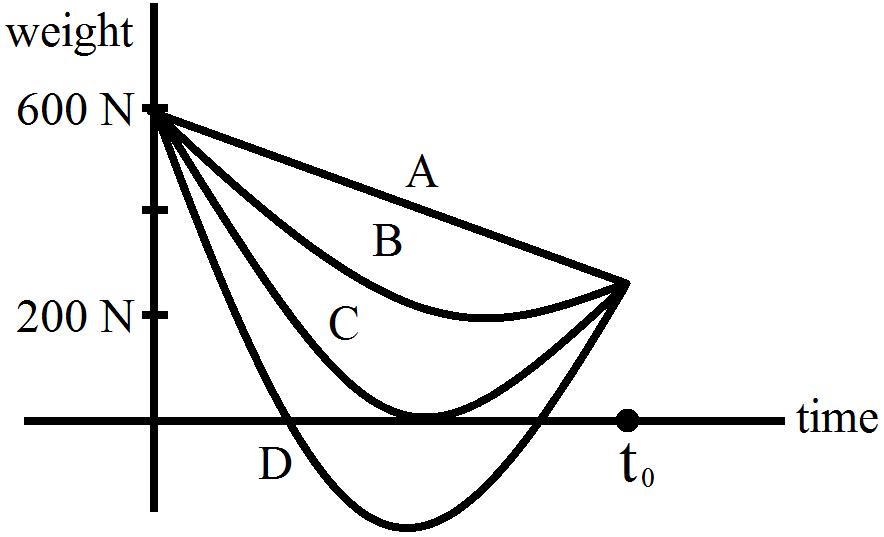
Suppose, the acceleration due to gravity at the earth's surface is $10 \mathrm{~ms}^{-2}$ and at the surface of Mars it is $4.0 \mathrm{~ms}^{-2}$. A $60 \ kg$ passenger goes from the earth to the Mars in a spaceship moving with a constant velocity. Neglect all other objects in the sky. Which part of best represents the weight $($net gravitational force$)$ of the passenger as a function of time?
  • A
    $A$
  • B
    $B$
  • $C$
  • D
    $D$

Answer

Correct option: C.
$C$
At one point between the Earth and Mars, the gravitational field intensity is zero. So, at that point, the weight of the passenger is zero. The curve $C$ indicates that the weight of the passenger is zero at a point between the Earth and Mars.

Need a full question paper?

Generate a complete, print-ready paper with questions like this in minutes — across 16+ boards, with answer keys.

Start Generating Free

Similar questions

The horizontal range is four times the maximum height attained by a projectile. The angle of projection is  .......... $^o$
Which one of the following represents displacement time graph of two objects $A$ and $B$ moving with zero relative velocity ?
When a capillary is dipped in water, water rises $0.015$ min it. If the surface tension of water is $75×10^{-3}\, N/m$, the radius of capillary is ....... $mm$
The figure shows a man of mass $m$ standing at the end $A$ of a trolley of mass $M$ placed at rest on a smooth horizontal surface. The man starts moving towards the end $B$ with a velocity $u_{rel}$ with respect to the trolley. The length of the trolley is $L$. As the man walks on the trolley, the centre of mass of the system (man $+$ trolley)
Sometimes it is convenient to construct a system of units so that all quantities can be expressed in terms of only one physical quantity. In one such system, dimensions of different quantities are given in terms of a quantity $X$ as follows: [position $]=\left[X^\alpha\right] ;[$ speed $]=\left[X^\beta\right]$; [acceleration $]=\left[X^{ p }\right]$; [linear momentum $]=\left[X^{ q }\right]$; [force $]=\left[X^{ I }\right]$. Then -

$(A)$ $\alpha+p=2 \beta$

$(B)$ $p+q-r=\beta$

$(C)$ $p-q+r=\alpha$

$(D)$ $p+q+r=\beta$

In the expansion of a gas in the adiabatic process:
A gaseous mixture consists of $16g$ of helium and $16g$ of oxygen. The ratio $\text{CP/ CV}$ of the mixture is:
A cyclist on a level road takes a sharp circular turn of radius $3 \;m \;\left( g =10 \;ms ^{-2}\right)$. If the coefficient of static friction between the cycle tyres and the road is $0.2$, at which of the following speeds will the cyclist not skid while taking the turn?
A body falls from a height $h = 200\,m$ (at New Delhi). The ratio of distance travelled in each $2\, sec$ during $t = 0$ to $t = 6$ second of the journey is
Heat is being supplied at a constant rate to the sphere of ice which is melting at the rate of $0.1 \,gm / s$. It melts completely in $100 \,s$. The rate of rise of temperature thereafter will be ............ $^{\circ} C / s$