Question
Suppose the ceiling in the previous problem is that of an elevator which is going up with an acceleration of 2.0m/s2. Find the elongations.

Answer

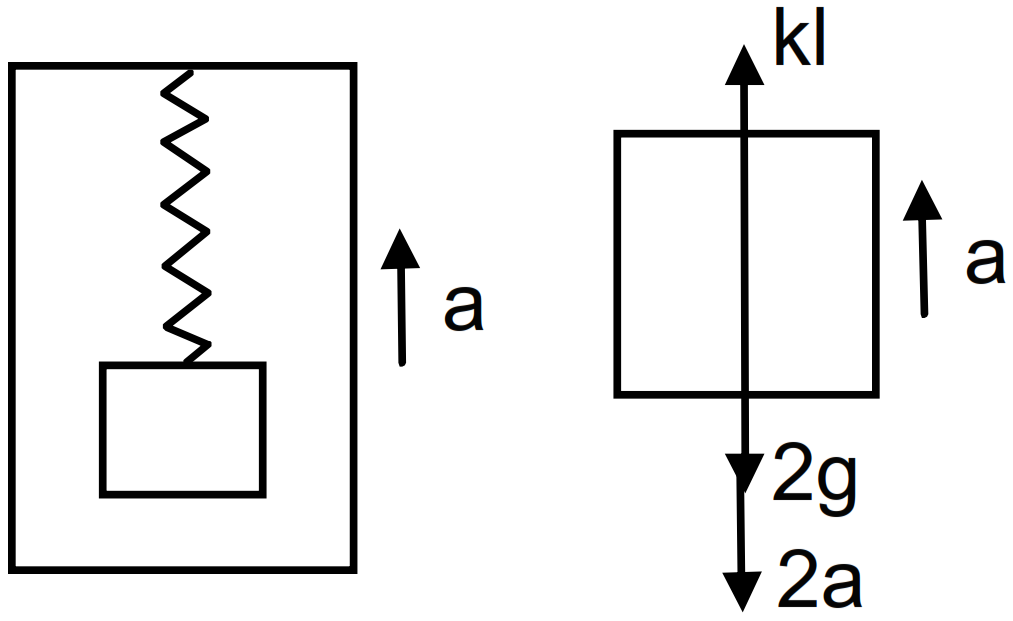
a = 2m/s2

kl - (2g + 2a) = 0

⇒ kl = 2g + 2a

= 2 × 9.8 + 2 × 2 = 19.6 + 4 = 23.6

$\Rightarrow\text{I}=\frac{23.6}{100}=0.236\text{m}=0.24\text{m}$
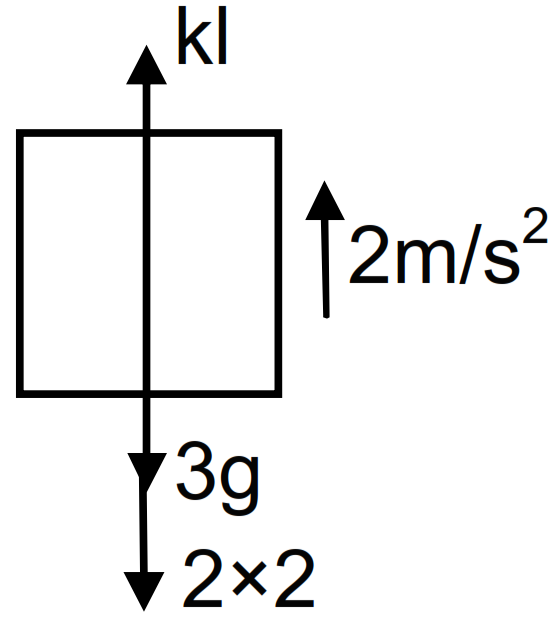
When 1kg body is added total mass (2 + 1)kg = 3kg.

elongation be l1

kl1 = 3g + 3a = 3 × 9.8 + 6 = 33.4

$\Rightarrow\text{I}_1=\frac{33.4}{100}=0.0334=0.36$

Further elongation = l1 - l = 0.36 - 0.24 = 0.12m.
Need a full question paper?

Generate a complete, print-ready paper with questions like this in minutes — across 16+ boards, with answer keys.
Start Generating Free

Similar questions

Obtain the answers to (a) and (b) in Exercise 7.15 if the circuit is connected to a 110V, 12kHz supply? Hence, explain the statement that a capacitor is a conductor at very high frequencies. Compare this behaviour with that of a capacitor in a dc circuit after the steady state.
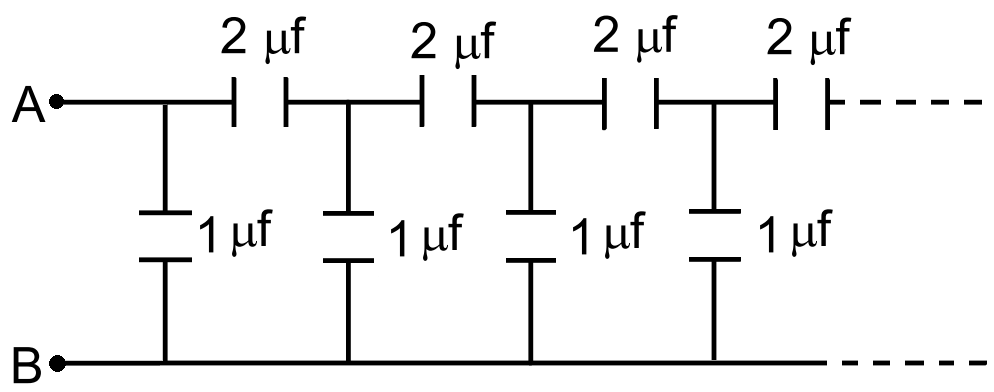
Find the equivalent capacitance of the infinite ladder shown in figure between the points A and B.

Two parallel wires seprated by a distance of 10cm carry currents of 10A and 40A along-the same direction. Where should a third current be placed so that it experiences no magnetic force?
A $5.0\mu\text{F}$ capacitor is charged to 12V. The positive plate of this capacitor is now connected to the negative terminal of a 12V battery and vice versa. Calculate the heat developed in the connecting wires.
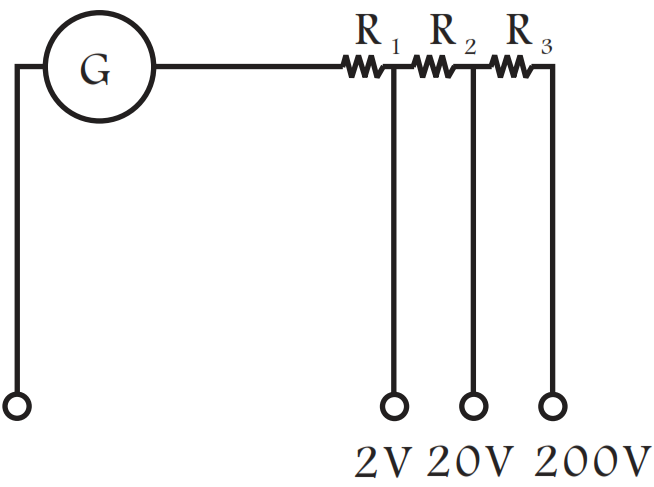
A multirange voltmeter can be constructed by using a galvanometer circuit as shown in Fig. We want to construct a voltmeter that can measure 2V, 20V and 200V using a galvanometer of resistance 10Ω and that produces maximum deflection for current of 1mA. Find R1, R2 and R3 that have to be used.

When an electron goes from the valence band to the conduction band in silicon, its energy is increased by 1.1eV. The average energy exchanged in a thermal collision is of the order of kT which is only 0.026eV at room temperature. How is a thermal collision able to take some of the electrons from the valence band to the conduction band?
Figure. shows a large closed cylindrical tank containing water. Initially the air trapped above the water surface has a height h0 and pressure 2p0 where p0 is the atmospheric pressure. There is a hole in the wall of the tank at a depth h1 below the top from which water comes out. A long vertical tube is connected as shown.
  1. Find the height h2 of the water in the long tube above the top initially.
  2. Find the speed with which water comes out of the hole.
  3. Find the height of the water in the long tube above the top when the water stops coming out of the hole.

A particle of mass m and charge q is released from the origin in a region in which the electric field and magnetic field are given by
$\overrightarrow{\text{B}}=-\text{B}_0\overrightarrow{\text{j}}$ and $\overrightarrow{\text{E}}=\text{E}_0\overrightarrow{\text{k}}.$ Find the speed of the particle as a function of its z-coordinate.
A rod of length L has a total charge Q distributed uniformly along its length. It is bent in the shape of a semicircle. Find the magnitude of the electric field at the centre of curvature of the semicircle.
The energy of a silver atom with a vacancy in K shell is 25.31keV, in L shell is 3.56keV and in M shell is 0.530keV higher than the energy of the atom with no vacancy. Find the frequency of $\text{K}_\alpha\text{K}_\beta$ and $\text{L}_\alpha$ X-rays of silver.