Question
Suppose the ceiling in the previous problem is that of an elevator which is going up with an acceleration of 2.0m/s2. Find the elongations.

Answer

a = 2m/s2

kl - (2g + 2a) = 0

⇒ kl = 2g + 2a

= 2 × 9.8 + 2 × 2 = 19.6 + 4 = 23.6

$\Rightarrow\text{I}=\frac{23.6}{100}=0.236\text{m}=0.24\text{m}$
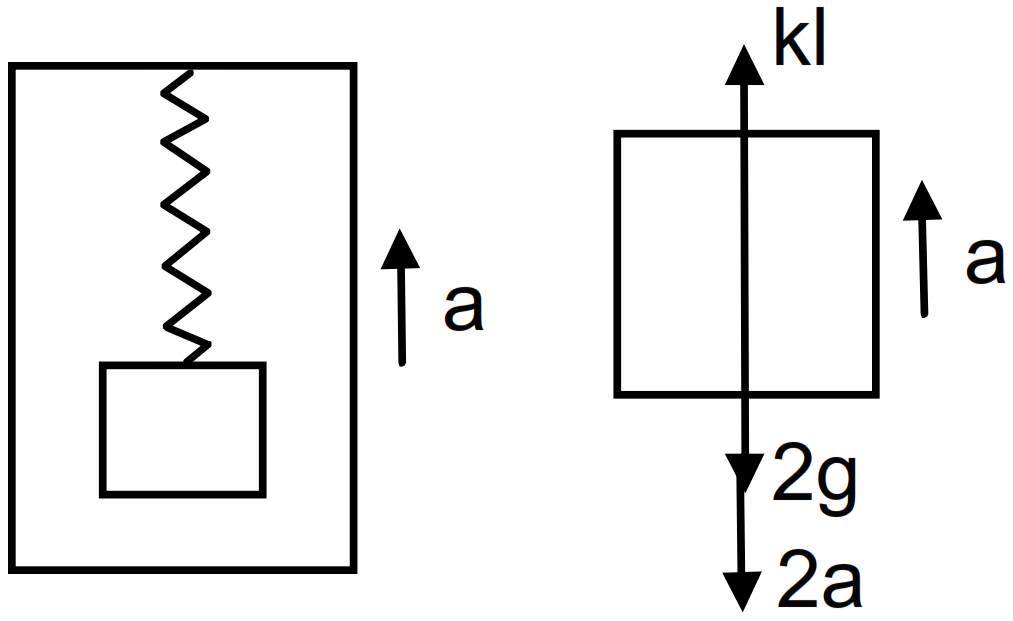
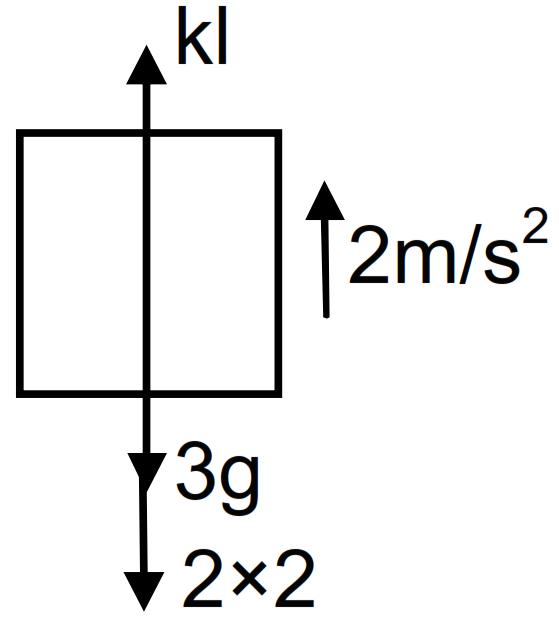
When 1kg body is added total mass (2 + 1)kg = 3kg.

elongation be l1

kl1 = 3g + 3a = 3 × 9.8 + 6 = 33.4

$\Rightarrow\text{I}_1=\frac{33.4}{100}=0.0334=0.36$

Further elongation = l1 - l = 0.36 - 0.24 = 0.12m.
Need a full question paper?

Generate a complete, print-ready paper with questions like this in minutes — across 16+ boards, with answer keys.
Start Generating Free

Similar questions

Consider N = n1n2 identical cells, each of emf $\in$ and internal resistance r. Suppose n1 cells are joined in series to form a line and n2 such lines are connected in parallel. The combination drives a current in an external resistance R. (a) Find the current in the external resistance. (b) Assuming that n1 and n2 can be continuously varied, find the relation between n1, n2, R and r for which the current in R is maximum.
Two metre scales, one of steel and the other of aluminium, agree at 20°C. Calculate the ratio aluminium-centimetre/ steel-centimetre at:
  1. 0°C,
  2. 40°C
  3. 100C. $\alpha$ for steel = 1.1 × 10-5 °C-1 and for aluminium= 2.3 × 10⁻⁵ °C-1.
What is a transformer? It is of how many types? Explain the principle, construction and working of any transformer.
An angular magnification (magnifying power) of 30X is desired using an objective of focal length 1.25 cm and an eyepiece of focal length 5 cm. How will you set up the compound microscope?
The Bohr model for the H-atom relies on the Coulomb’s law of electrostatics. Coulomb’s law has not directly been verified for very short distances of the order of angstroms. Supposing Coulomb’s law between two opposite charge +q1, -q2 is modified to
$|\text{F}|=\frac{\text{q}_1\text{q}_2}{(4\pi\in_0)}\frac{1}{\text{r}^2}.\text{r}\geq\text{R}_0$
$=\frac{\text{q}_1\text{q}_2}{(4\pi\in_0)}\frac{1}{\text{R}^2_0}\Big(\frac{\text{R}_0}{\text{r}}\Big)^{\in}.\text{r}\geq\text{R}_0$
Calculate in such a case, the ground state energy of a H-atom, if $\in=0.1,\text{R}_0=1\mathring{\text{A}}$.
(I) Explain briefly, with the help of a labelled diagram, the basic principle of the working of an a.c. generator. In an a.c. generator, coil of N turns and area A is rotated at an angular velocity ω in a uniform magnetic field B. Derive an expression for the instantaneous value of the emf induced in coil. What is the source of energy generation in this device?
Suppose the block of the previous problem is pushed down the incline with a force of 4N. How far will the block move in the first two seconds after starting from rest? The mass of the block is 4kg.
A particle slides on the surface of a fixed smooth sphere starting from the topmost point. Find the angle rotated by the radius through the particle, when it leaves contact with the sphere.
A solid aluminium sphere and a solid copper sphere of twice the radius are heated to the same temperature and are allowed to cool under identical surrounding temperatures. Assume that the emissivity of both the spheres is the same. Find the ratio of:
  1. The rate of heat loss from the aluminium sphere to the rate of heat loss from the copper sphere.
  2. The rate of fall of temperature of the aluminium sphere to the rate of fall of temperature of the copper sphere. The specific heat capacity of aluminium = 900Jkg-1°C-1 and that of copper= 390Jkg-1°C-1. The density of copper = 3.4 times the density of aluminium.
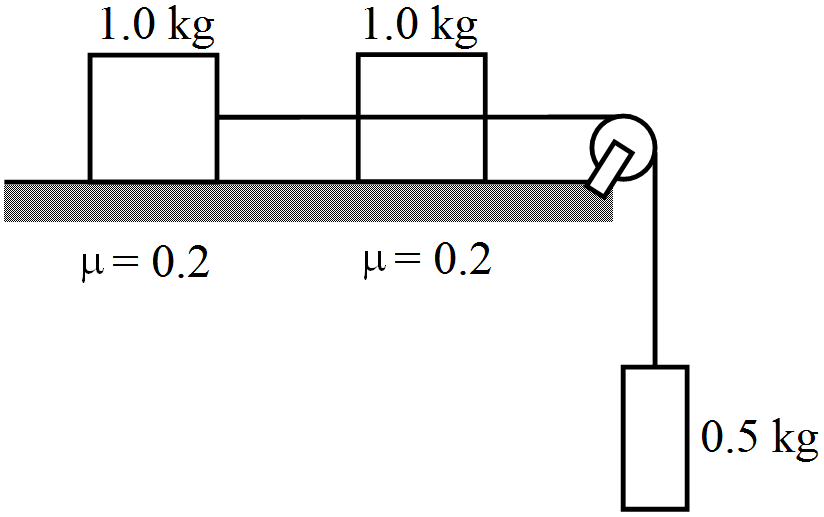
Consider the situation shown in figure. Calculate:
  1. The acceleration of the 1.0kg blocks.
  2. The tension in the string connecting the 1.0kg blocks.
  3. The tension in the string attached to 0.50kg.