Question
Suppose the ceiling in the previous problem is that of an elevator which is going up with an acceleration of $2.0m/s^2.$ Find the elongations.
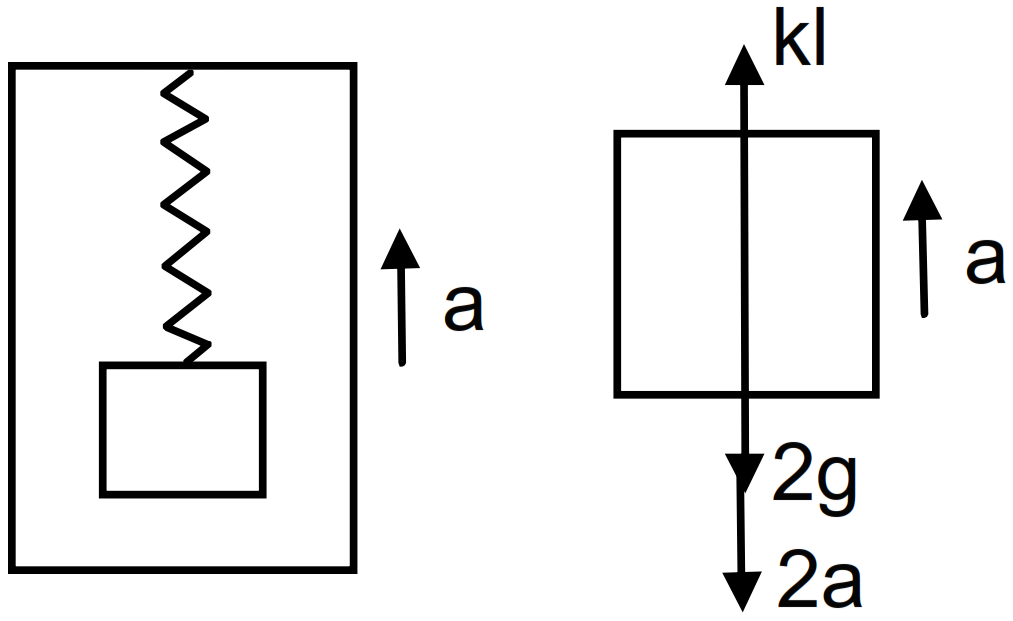
Answer

$a = 2m/s^2 kl - (2g + 2a) = 0$
$\Rightarrow kl = 2g + 2a = 2 \times 9.8 + 2 \times 2 = 19.6 + 4 = 23.6$
$\Rightarrow\text{I}=\frac{23.6}{100}=0.236\text{m}=0.24\text{m}$

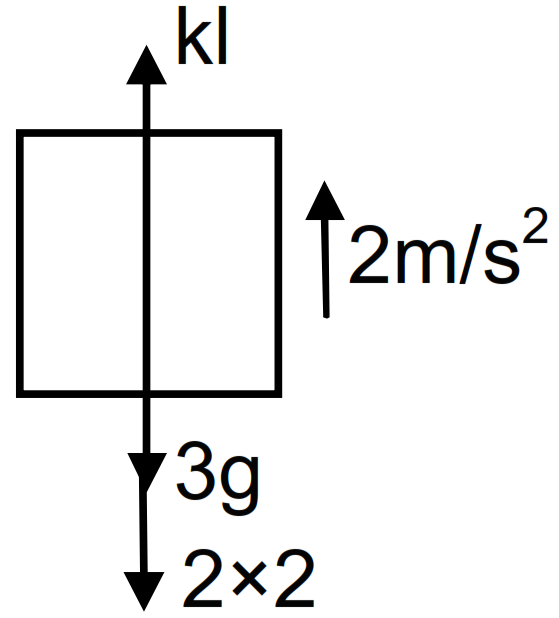
When 1kg body is added total mass $(2 + 1)kg = 3kg.$
elongation be $l_1\   kl_1 = 3g + 3a = 3 \times 9.8 + 6 = 33.4$
$\Rightarrow\text{I}_1=\frac{33.4}{100}=0.0334=0.36$
Further elongation $= l_1 - l = 0.36 - 0.24 = 0.12m.$ 

Need a full question paper?

Generate a complete, print-ready paper with questions like this in minutes — across 16+ boards, with answer keys.

Start Generating Free

Similar questions

A capacitor having a capacitance of $100\mu\text{F}$ is charged to a potential difference of 24V. The charging battery is disconnected and the capacitor is connected to another battery of emf 12V with the positive plate of the capacitor joined with the positive terminal of the battery:
  1. Find the charges on the capacitor before and after the reconnection.
  2. Find the charge flown through the 12V battery.
  3. Is work done by the battery or is it done on the battery? Find its magnitude.
  4. Find the decrease in electrostatic field energy.
  5. Find the heat developed during the flow of charge after reconnection.
  1. Derive an expression for equivalent capacitance of three capacitors when connected in series.
  2. Derive an expression for equivalent capacitance of three capacitors when connected in parallel.
A capacitor is made of two circular plates of radius R each, separated by a distance d < < R. The capacitor is connected to a constant voltage. A thin conducting disc of radius r < < R. and thickness t < < r is placed at a centre of the bottom plate. Find the minimum voltage required to lift the disc if the mass of the disc is m.
A charged particle oscillates about its mean equilibrium position with a frequency of $10^9 $ Hz. What is the frequency of the electromagnetic waves produced by the oscillator?
An electric dipole of dipole moment $\vec{\text{P}}$ is placed in a uniform electric field $\vec{\text{E}}.$ Write the expression for the torque $\vec\tau$ experienced by the dipole. Identify two pairs of perpendicular vectors in the expression. Show diagrammatically the orientation of the dipole in the field for which the torque is (i) Maximum (ii) Half the maximum value (iii) Zero.
A long cylindrical wire carries a positive charge of linear density $2.0 \times 10^{-8}Cm^{-1}$. An electron revolves around it in a circular path under the influence of the attractive electrostatic force. Find the kinetic energy of the electron. Note that it is independent of the radius.
  1. State the working principle of a potentiometer. With the help of the circuit diagram, explain how a potentiometer is used to compare the emf’s of two primary cells. Obtain the required expression used for comparing the emfs.
  2. Write two possible causes for one sided deflection in a potentiometer experiment.
A long wire carrying a current i is bent to form a plane angle $\alpha.$ Find the magnetic field B at a point on the bisector of this angle situated at a distance x from the vertex.
Four equal charges $2.0 \times 10^{-6}C$ each are fixed at the four corners of a square of side 5cm. Find the Coulomb force experienced by one of the charges due to the rest three.
A block slides down an inclined surface of inclination 30° with the horizontal. Starting from rest it covers 8m in the first two seconds. Find the coefficient of kinetic friction between the two.