Suppose the drift velocity $v_d$ in a material varied with the applied electric field $E$ as ${v_d}\, \propto \,\sqrt E $ .Then $V - I$ graph for a wire made of such a material is best given by
- A
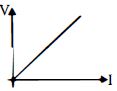
- B
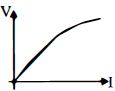
- C
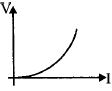
- D
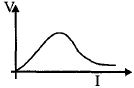
JEE MAIN 2015, Diffcult


Download our appand get started for free
Experience the future of education. Simply download our apps or reach out to us for more information. Let's shape the future of learning together!No signup needed.*
Similar Questions
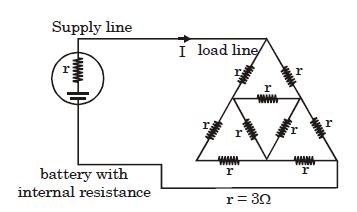
- 1By which of the following single load resistance the load bridge should be replaced so that the power to the load remains unchanged ................ $\Omega$View Solution
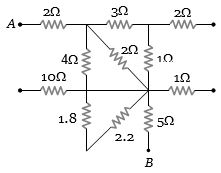
- 2What is the equivalent resistance between the points $A$ and $B$ of the network .................. $\Omega$View Solution
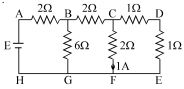
- 3The figure shows a network of resistors and $a$ battery. If $1\,A$ current flowsthrough the branch $CF$, then answer the following questions The current throughView Solution
- 4A copper wire of length $1\, m$ and radius $1\, mm$ is joined in series with an iron wire of length $2\, m$ and radius $3\, mm$ and a current is passed through the wires. The ratio of the current density in the copper and iron wires isView Solution
- 5Two resistors of $6\,\Omega $ and $9\,\Omega $ are connected in series to a $120\, volt$ source. The power consumed by the $6\,\Omega $ resistor is ........... $W$View Solution
- 6A uniform wire of resistance $R$ is uniformly compressed along its length, until its radius becomes $n$ times the original radius. Now resistance of the wire becomesView Solution
- 7The resistance of an electrical toaster has a temperature dependence given by $R\left( T \right) = {R_0}\left[ {1 + \alpha \left( {T - {T_0}} \right)} \right]$ in its range of operation. At ${T_0} = 300\,K,R = 100\,\Omega $ and at $T = 500\,K,\,R = 120\,\Omega $. The toaster is connected to a voltage source at $200\, V$ and its temperature is raised at a constant rate from $300$ to $500\, K$ in $30\, s$. The total work done in raising the temperature isView Solution
- 8The current flowing through a lamp marked as $50\, W$ and $250\, V$ is ............. $amp$View Solution
- 9Infinite number of cells having $emf$ and internal resistance $\left( {E,r} \right)$, $\left( {\frac{E}{n},\frac{r}{n}} \right)$, $\left( {\frac{E}{{{n^2}}},\frac{r}{{{n^2}}}} \right)$, $\left( {\frac{E}{{{n^3}}},\frac{r}{{{n^3}}}} \right)$..... are connected in series in same manner across an external resistance of $\frac{{nr}}{{n + 1}}$ . Current flowing through the external resistor isView Solution
- 10The total power dissipated in watt in the circuit shown here is ............. $W$View Solution