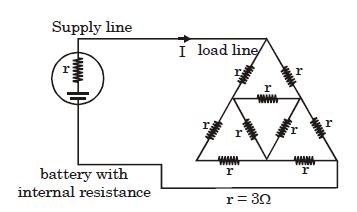
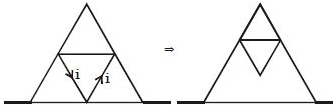
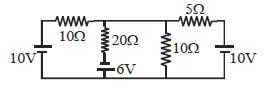
By which of the following single load resistance the load bridge should be replaced so that the power to the load remains unchanged ................ $\Omega$
Diffcult


Download our appand get started for free
Experience the future of education. Simply download our apps or reach out to us for more information. Let's shape the future of learning together!No signup needed.*
Similar Questions
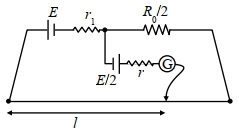
- 1In order to measure the internal resistance $r_1$ of a cell of emf $E$, a meter bridge of wire resistance $R_0=50 \Omega$, a resistance $R_0 / 2$, another cell of emf $E / 2$ (internal resistance $r$ ) and a galvanometer $G$ are used in a circuit, as shown in the figure. If the null point is found at $l=72 cm$, then the value of $r_1=$ . . . . $\Omega$View Solution
- 2A current of $10 \,A$ is maintained in a conductor of cross-section $1 \,cm ^2$. If the number density of free electrons be $9 \times 10^{28} \,m ^{-3}$, the drift velocity of free electrons is .......... $m / s$View Solution
- 3In a wire of cross section radius $r,$ free electrons travel with drift velocity $v$ when a current $I$ flows through the wire. What is the current in another wire of half the radius and of the same material when the drift velocity is $2v$ ?View Solution
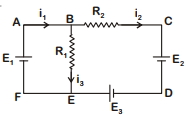
- 4For the circuit given below, the Kirchoff's loop rule for the loop $BCDEB$ is given by the equationView Solution
- 5The value of current through $20\,\Omega $ resistor is .................. $A$View Solution
- 6When a current of $2\, A$ flows in a battery from negative to positive terminal, the potential difference across it is $12\, V$. If a current of $3 \,A$ flows in the opposite direction potential difference across the terminals of the battery is $15\, V$, the $emf$ of the battery is ................ $\mathrm{V}$View Solution
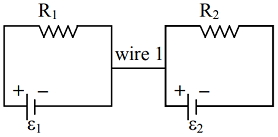
- 7In the circuit, wire $1$ is of negligible resistance. Then,View Solution
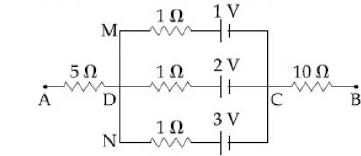
- 8In the circuit shown, the potential difference between $A$ and $B$ is ............. $V$View Solution
- 9Two solid conductors are made up of same material, have same length and same resistance. One of them has a circular cross section of area $A_{1}$ and the other one has a square cross section of area $A_{2}$. The ratio $\frac{A _{1}}{A _{2}}$ isView Solution
- 10View SolutionThe material of fuse wire should have