MCQ
Suppose the earth suddenly stops attracting objects placed near surface. A person standing on the surface of the earth will:
  • A
    Remain standing.
  • B
    Fly up.
  • C
    Sink into earth.
  • D
    Either (b) or (c).

Answer

  1. Remain standing.

Explanation:

If downward force on the earth stops, so upward self adjusting force also stop. In vertical direction, there is no force. Due to inertia person resists any change to its state of rest. Person will remain standing.

Need a full question paper?

Generate a complete, print-ready paper with questions like this in minutes — across 16+ boards, with answer keys.
Start Generating Free

Similar questions

A small, conducting circular loop is placed inside a long solenoid carrying a current. The plane of the loop contains the axis of the solenoid. If the current in the solenoid is varied, the current induced in the loop is:
  1. Clockwise.
  2. Anticlockwise.
  3. Zero.
  4. Clockwise or anticlockwise depending on whether the resistance in increased or decreased.
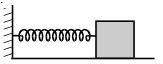
$A$ spring block system is placed on a rough horizontal floor. The block is pulled towards right to give spring an elongation less than $\frac{{2\mu mg}}{K}$ but more than $\frac{{\mu mg}}{K}$ and released.The correct statement is
One end of a uniform rod of mass m and length (l) is clamped. The rod lies on a smooth horizontal surface and rotates on it about the clamped end at a uniform angular velocity $\omega.$ The force exerted by the clamp on the rod has a horizontal component:

  1. $\text{m}\omega^2\text{l}$

  2. $\text{Zero.}$

  3. $\text{mg}$

  4. $\frac{1}{2}\text{m}\omega^2\text{l}$

An ideal fluid flows through a pipe of circular cross-section made of two sections with diameters 2.5cm and 3.75cm. The ratio of the velocities in the two pipes is:
A body of mass $m$ is thrown upwards at an angle $\theta$ with the horizontal with velocity $v$. While rising up the velocity of the mass after $ t$ seconds will be
The total energy of a particle, executing simple harmonic motion is
In case of a freely falling body, the ratio of kinetic energy at the end of the third second increase in kinetic energy in the next three seconds is:
A ball $'A'$ of mass $m$ falls to the surface of the earth from infinity. Another ball $'B'$ of mass $2m$ falls to the earth from the height equal to six times radius of the earth then ratio of velocities of $'A'$ and $'B'$ on reaching the earth is
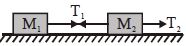
Two masses $M_1$ and $M_2$ are accelerated uniformly on a frictionless surface as shown in figure. The ratio of the tensions $T_1/T_2$ is 
A body of mass $m$ kg is lifted by a man to a height of one metre in $30\, sec$. Another man lifts the same mass to the same height in $60\, sec$. The work done by them are in the ratio