Question
Suppose the entire system of the previous question is kept inside an elevator which is coming down with an acceleration a < g. Repeat parts (a) and (b).
Answer

  1.  

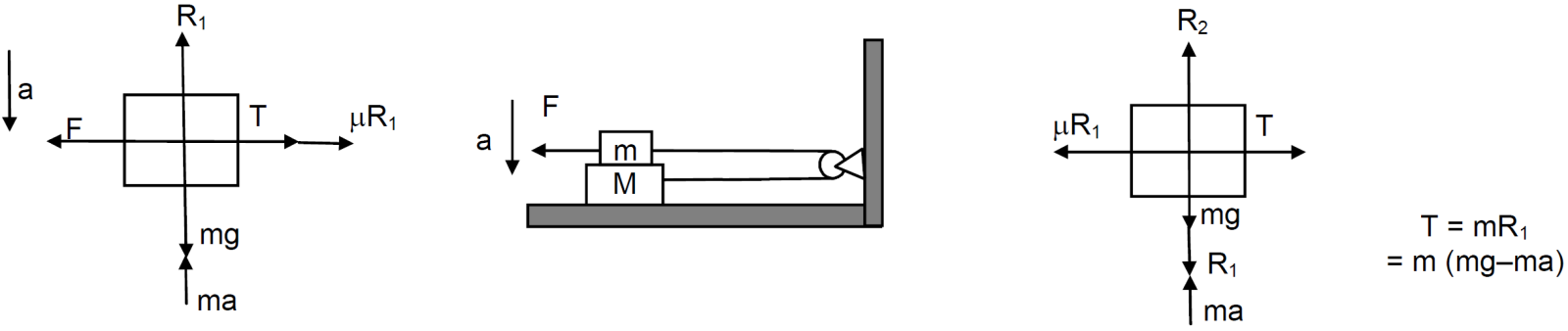
$\text{R}_1+\text{ma}-\text{mg}=0$
$\Rightarrow\text{R}_1=\text{m(g}-\text{a) = mg}-\text{ma} \ ...(\text{i})$
$\text{T}-\mu\text{R}_1=0\Rightarrow\text{T = m(mg}-\text{ma}) \ ...(\text{ii})$
Again, $\text{F}-\text{T}-\mu\text{R}_1=0$
$\Rightarrow\text{F}-\{\mu(\text{mg}-\text{ma})\}-\text{u}(\text{mg}-\text{ma})=0$
$\Rightarrow\text{F}-\mu\text{mg}+\mu\text{ma}-\mu\text{mg}+\mu\text{ma}=0$
$\Rightarrow\text{F}=2\mu\text{mg}-2\mu\text{ma}\Rightarrow\text{F}=2\mu\text{m(g}-\text{a})$
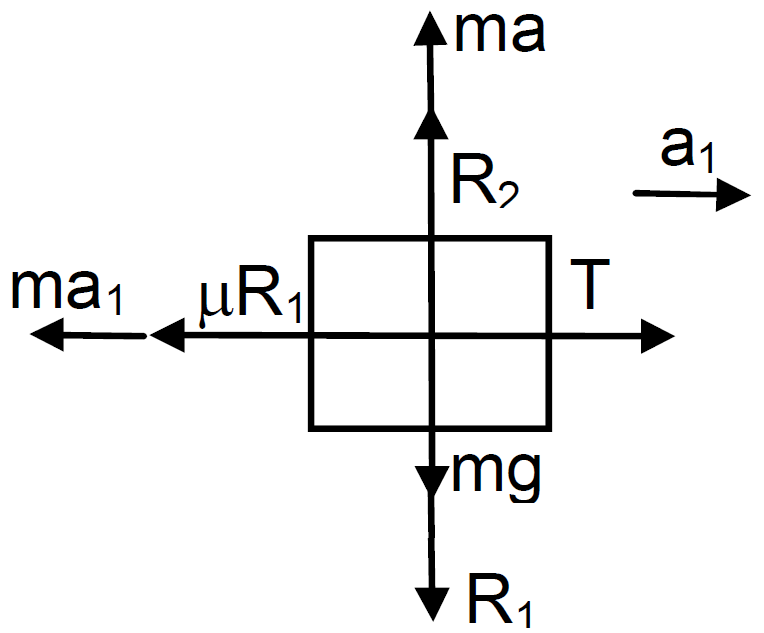
  1. Acceleration of the block be $a_1$

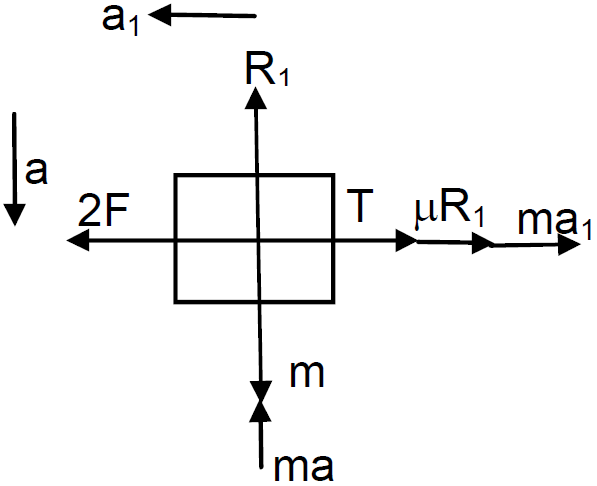
$\text{R}_1=\text{mg}-\text{ma} \ ...(\text{i})$
$2\text{F}-\text{T}-\mu\text{R}_1-\text{ma}_1=0$
$\Rightarrow2\text{F}-\text{t}-\mu\text{mg}+\mu\text{a}-\text{ma}_1=0 \ ...(\text{ii})$

$\text{T}-\mu\text{R}_1-\text{Ma}_1=0$
$\Rightarrow\text{T}=\mu\text{R}_1+\text{Ma}_1$
$\Rightarrow\text{T}=\mu(\text{mg}-\text{ma})+\text{Ma}_1$
$\Rightarrow\text{T}=\mu\text{mg}-\mu\text{ma + Ma}_1$
Subtracting values of F & T, we get
$2(2\mu\text{m(g}-\text{a}))-2(\mu\text{mg}-\mu\text{ma}+\text{Ma}_1)\\-\mu\text{mg}+\mu\text{ma}-\mu\text{a}_1=0$
$\Rightarrow4\mu\text{mg}-4\mu\text{ma}-2\mu\text{mg}+2\mu\text{ma = ma}_1+\text{Ma}_1$
$\Rightarrow\text{a}_1=\frac{2\mu\text{m(g}-\text{a})}{\text{M + m}}$
Both blocks move with this acceleration but in opposite directions.

Need a full question paper?

Generate a complete, print-ready paper with questions like this in minutes — across 16+ boards, with answer keys.
Start Generating Free

Similar questions

The temperature and humidity of air are 27°C and 50% on a particular day. Calculate the amount of vapour that should be added to 1 cubic metre of air to saturate it. The saturation vapour pressure at 27°C = 3600Pa.
Two cylindrical hollow drums of radii R and 2R, and of a common height h, are rotating with angular velocities $\omega$ (anti-clockwise) and $\omega$ (clockwise), respectively. Their axes, fixed are parallel and in a horizontal plane separated by $(3\text{R}+\delta).$ They are now brought in contact $(\delta\rightarrow0){:}$
  1. Show the frictional forces just after contact.
  2. Identify forces and torques external to the system just after contact.
  3. What would be the ratio of final angular velocities when friction ceases?
A simple pendulum with a brass bob has a time period T. The bob is now immersed in a non-viscous liquid and oscillated. If the density of the liquid is $\frac{1}{9}$ that of brass, find the time of the same pendulum.
A stone of mass $0.25kg$ tied to the end of a string is whirled round in a circle of radius $1.5m$ with a speed of $40 rev./min$ in a horizontal plane. What is the tension in the string? What is the maximum speed with which the stone can be whirled around if the string can withstand a maximum tension of $200N$?
State Newton's third law of motion. Discuss its consequences.
Suppose the ceiling in the previous problem is that of an elevator which is going up with an acceleration of $2.0m/s^2$. Find the elongations.
A hot air balloon is a sphere of radius 8 m . The air inside is at a temperature of $60^{\circ} \mathrm{C}$. How large a mass can the balloon lift when the outside temperature is $20^{\circ} \mathrm{C}$ ? (Assume air is an ideal gas, $\mathrm{R}=8.314 \mathrm{~J} \mathrm{~mole}^{-1} \mathrm{~K}^{-1}, 1 \mathrm{~atm} .=1.013 \times$ $10^5$ Pa the membrane tension is $5 \mathrm{~N} \mathrm{~m}^{-1}$)
Mercury has an angle of contact equal to $140^{\circ}$ with soda lime glass. A narrow tube of radius $1.00$ mm made of this glass is dipped in a trough containing mercury. By what amount does the mercury dip down in the tube relative to the liquid surface outside? Surface tension of mercury at the temperature of the experiment is $0.465 \mathrm{~N} \mathrm{~m}^{-1}$. Density of mercury $=13.6 \times 10^3 \mathrm{~kg} \mathrm{~m}^{-3}$.
What is called degree of freedom? How many types are there? Explain to them.
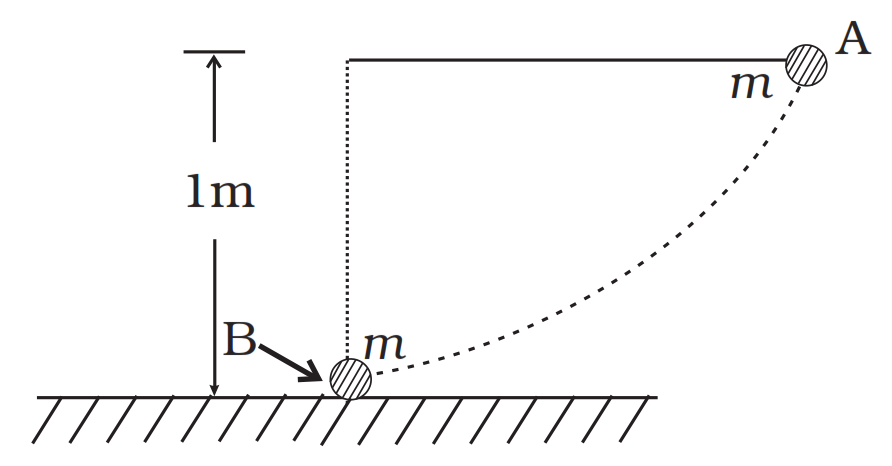
The bob A of a pendulum released from horizontal to the vertical hits another bob B of the same mass at rest on a table as shown in.
If the length of the pendulum is 1m, calculate.
  1. The height to which bob A will rise after collision.
  2. The speed with which bob B starts moving. Neglect the size of the bobs and assume the collision to be elastic.