Question
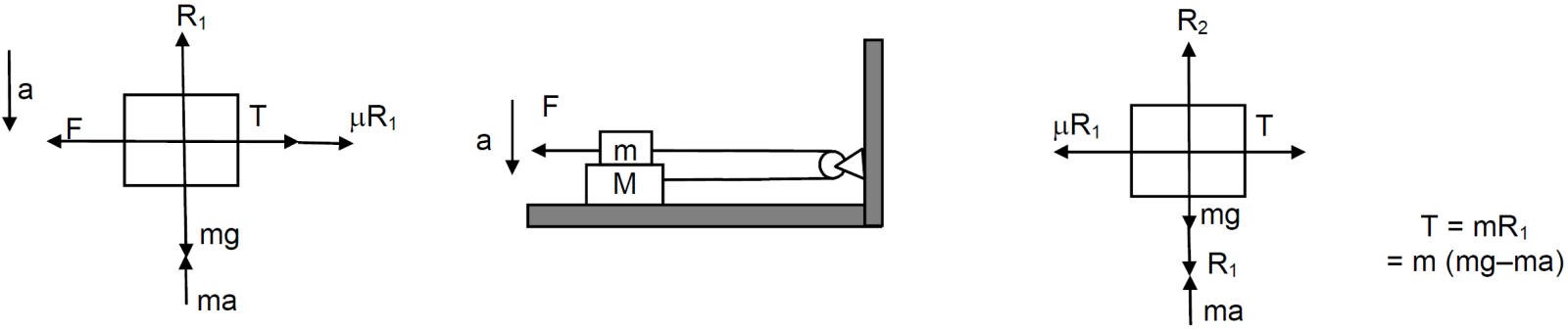
Suppose the entire system of the previous question is kept inside an elevator which is coming down with an acceleration a < g. Repeat parts (a) and (b).
Answer

  1.  

$\text{R}_1+\text{ma}-\text{mg}=0$

$\Rightarrow\text{R}_1=\text{m(g}-\text{a) = mg}-\text{ma} \ ...(\text{i})$

$\text{T}-\mu\text{R}_1=0\Rightarrow\text{T = m(mg}-\text{ma}) \ ...(\text{ii})$

Again, $\text{F}-\text{T}-\mu\text{R}_1=0$

$\Rightarrow\text{F}-\{\mu(\text{mg}-\text{ma})\}-\text{u}(\text{mg}-\text{ma})=0$

$\Rightarrow\text{F}-\mu\text{mg}+\mu\text{ma}-\mu\text{mg}+\mu\text{ma}=0$

$\Rightarrow\text{F}=2\mu\text{mg}-2\mu\text{ma}\Rightarrow\text{F}=2\mu\text{m(g}-\text{a})$
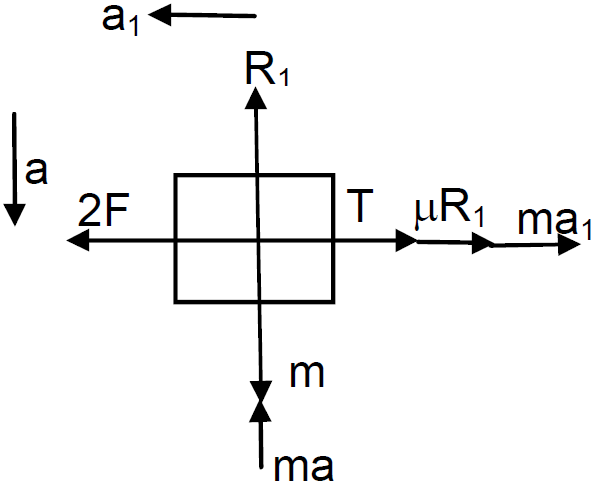
  1. Acceleration of the block be a1

$\text{R}_1=\text{mg}-\text{ma} \ ...(\text{i})$

$2\text{F}-\text{T}-\mu\text{R}_1-\text{ma}_1=0$

$\Rightarrow2\text{F}-\text{t}-\mu\text{mg}+\mu\text{a}-\text{ma}_1=0 \ ...(\text{ii})$
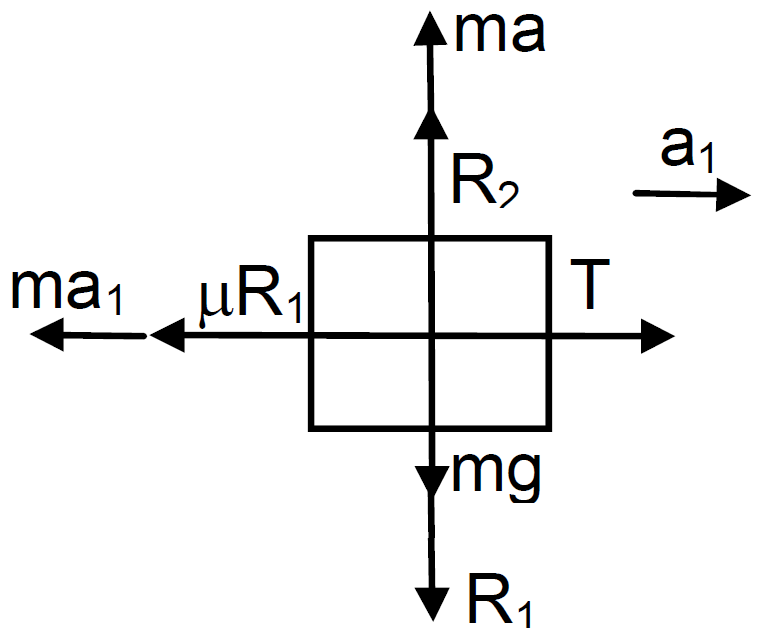
$\text{T}-\mu\text{R}_1-\text{Ma}_1=0$

$\Rightarrow\text{T}=\mu\text{R}_1+\text{Ma}_1$

$\Rightarrow\text{T}=\mu(\text{mg}-\text{ma})+\text{Ma}_1$

$\Rightarrow\text{T}=\mu\text{mg}-\mu\text{ma + Ma}_1$

Subtracting values of F & T, we get

$2(2\mu\text{m(g}-\text{a}))-2(\mu\text{mg}-\mu\text{ma}+\text{Ma}_1)\\-\mu\text{mg}+\mu\text{ma}-\mu\text{a}_1=0$

$\Rightarrow4\mu\text{mg}-4\mu\text{ma}-2\mu\text{mg}+2\mu\text{ma = ma}_1+\text{Ma}_1$

$\Rightarrow\text{a}_1=\frac{2\mu\text{m(g}-\text{a})}{\text{M + m}}$

Both blocks move with this acceleration but in opposite directions.

Need a full question paper?

Generate a complete, print-ready paper with questions like this in minutes — across 16+ boards, with answer keys.

Start Generating Free

Similar questions

What do you mean by interference of waves? Distinguish between constructive and destructive interference.
Standing waves are produced by the superposition of two waves
$\text{y}_1=0.05\sin(3\pi\text{t}-2\text{x})$ and $\text{y}_2=0.05\sin(3\pi\text{t}+2\text{x})$
where y and x are measured in metres and t in seconds. Find the amplitude of a particle at x = 0.5m.
A famous relation in physics relates ‘moving mass’ m to the ‘rest mass’ mo of a particle in terms of its speed v and the speed of light, c. (This relation first arose as a consequence of special relativity due to Albert Einstein). A boy recalls the relation almost correctly but forgets where to put the constant c. He writes:

$\text{m}=\frac{\text{m}_0}{(1-\text{v}^2)^{1/2}}.$

Guess where to put the missing c.
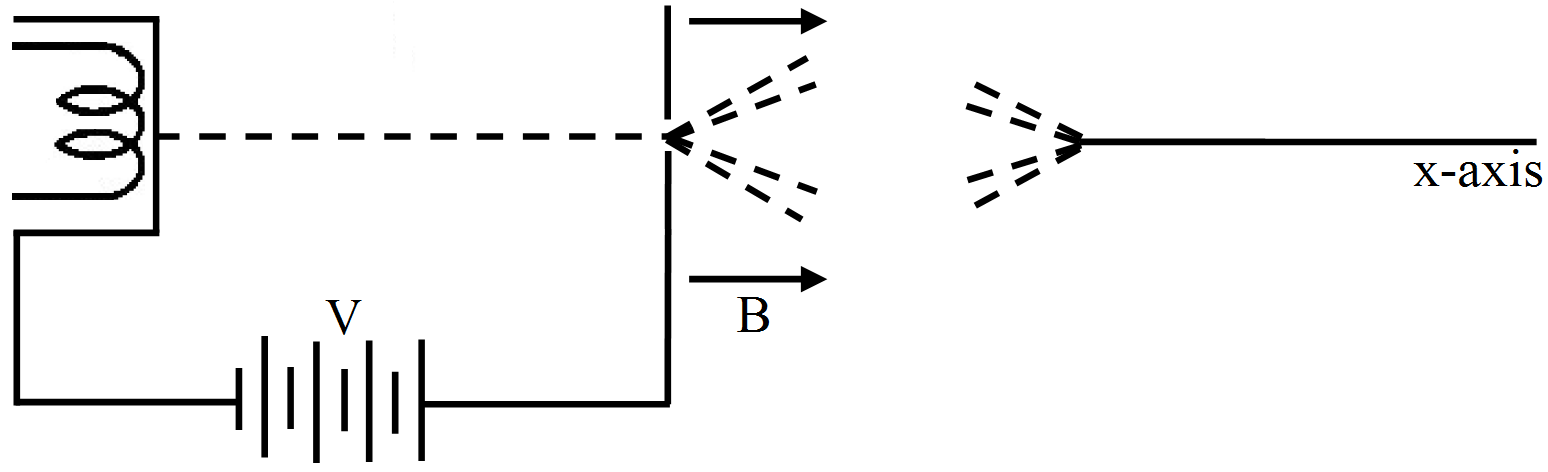
Electrons emitted with negligible speed from an electron gun are accelerated through a potential difference V along the x-axis. These electrons emerge from a narrow hole into a uniform magnetic field B directed along this axis. However, some of the electrons emerging from the hole make slightly divergent angles, as shown in the figure. Show that these paraxial electrons are refocussed on the x-axis at a distance $\sqrt{\frac{8\pi^2\text{mV}}{\text{eB}^2}}.$

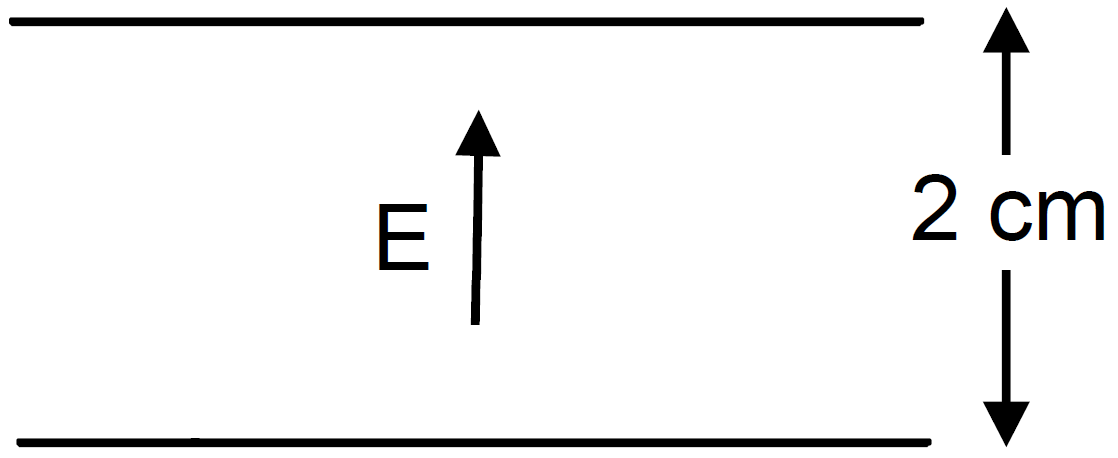
An electric field of magnitude 1000NC-1 is produced between two parallel plates having a separation of 2.0cm as shown in figure.

  1. What is the potential difference between the plates?
  2. With what minimum speed should an electron be projected from the lower plate in the direction of the field so that it may reach the upper plate?
  3. Suppose the electron is projected from the lower plate with the speed calculated in part (b). The direction of projection makes an angle of 60° with the field. Find the maximum height reached by the electron.

The air columns (of resonance tubes) 100cm and 101cm long give 17 beats in 20 seconds, when each is sounding its fundamental note. Calculate velocity of sound.
A body is dropped in a hole drilled across a diameter of the earth. Show that it executes S.H.M. Assume the earth to be homogeneous sphere of radius R.

A mass m is placed on a platform from a height 'h'. The platform is attached to a spring whose other end is fixed to the ground. Find the compression in the spring, if the spring constant is k.
To what height a mass can go, when sent up with a velocity half of the escape velocity?
Two absolute scales A and B have triple points of water defined to be 200A and 350B. What is the relation between TA and TB?
A simple pendulum is constructed by hanging a heavy ball by a 5.0m long string. It undergoes small oscillations.
  1. How many oscillations does it make per second?
  2. What will be the frequency if the system is taken on the moon where acceleration due to gravitation of the moon is 1.67m/s2.